Showing posts with label 1950s. Show all posts

Friday, 15 May 2015

Sepia Saturday 279: Looking for the Bonanza

Sepia Saturday by Alan Burnett and Marilyn Brindley

In the introduction to last week's edition of Sepia Saturday, Alan Burnett asked whether the meme is becoming old and tired, perhaps prompted by a recent reduction in the number of participants. Personally, I find the stimulus of a fresh sepia image chosen by someone else each week is just what I need to keep me blogging regularly, that is when I'm not too submerged in work or other projects to find the time. Following the theme is not a requirement, which gives me plenty of leeway to sail off on another tack when the mood takes me, or on the odd occasion that I fail to be inspired by the chosen image.

Many of my Photo-Sleuth articles are weeks or months in gestation, perhaps searching for that extra bit of information, cosidering the right angle to tackle a particular photograph, or waiting for the right image prompt, so always having images from a couple of weeks ahead to work on at the same time suits me well. My first SS contribution appeared four years ago (SS 64) and my 93 subsequent contributions have been made as and when the opportunity presents itself. I'm very grateful to Alan and Marilyn for the time and effort that they put in to making Sepia Saturday happen. I'd also like to acknowledge the body of fellow Sepians for the inspiring photos they post and thoughtful feedback regularly provided here. Without it, I fear that my blog would have fallen into disrepair long ago.

Image © and collection of Brett Payne
Unmounted paper print, 61 x 89mm
Image © and collection of Brett Payne

On the face of it, these two snapshots might appear a strange purchase for my collection of old photographs. Of unknown provenance, all contextual information apart from the captions handwritten on the backs has gone, leaving us with few clues to the identity of the subjects, even to where they were taken. It wasn't the challenge of sleuthing, though, that attracted me, but rather the content of the first image.

Even without the brief annotation on the back describing it as "The Mill," I recognised it as a three-stamp mill of the type commonly used in the nineteenth and early twentieth centuries to process gold ore, complete with heavy timber frame, driving wheel, cam shaft with tappets, stamper stems, mortar box with discharge screen, tables and amalgam plates. When I first started work as an exploration geologist in the Midlands of Zimbabwe during the mid-1980s, I came across a few of these antiquated but effective pieces of equipment still being used in remote bush locations, usually by equally aged smallworkers in a forlorn quest for their own bonanza.

Image © and collection of Brett Payne
Reverse of paper print

The caption identifies the subjects as 'Hamish,' with his back to the camera, 'January,' the mill foreman and presumably one of the two black men standing either side of the tables, and the two children 'A & J.'. The mere fact that January and the other gold mill worker are black doesn't necessarily mean that the photograph was taken in what was then called Southern Rhodesia (it became Zimbabwe after independence in 1980), but the countryside and vegetation depicted in the second of the two snapshots are very familiar to me, and I think it highly likely.

In 1945, after the end of the Second World War, the Southern Rhodesian government set up an ex-serviceman's rehabilitation scheme, whereby returning white soldiers were provided with training in small-scale mining at a former air force training facility at Guinea Fowl, near the town of Gwelo, now called Gweru. (As a sidebar, I might note that black soldiers also returning from the same war got absolutely nothing.) After completion of their training, they were given soft loans to re-open old gold mines closed during the war or start up new operations. With 221 men trained and 279 mines re-opened, the scheme was regarded as successful (Dreschler, 2001), and it seems quite likely that 'Hamish' could have been one of these smallworkers.

Image © and collection of Brett Payne
Unmounted paper print, 83 x 60mm
Image © and collection of Brett Payne

The second photo shows 'Joan, Heather & Andrew, on lawn, 1950, May' (resumably from right to left), so it was taken about four years later. Now there are three children, all wearing wide-brimmed hats to ward off the harsh African sun, and playing on a manicured lawn, rather than hanging around the dangerous mill site. The wide variety of toys suggests that Hamish had achieved at least some success at the mine.

Image © and collection of Brett Payne
Reverse of paper print

The snapshots are both roughly 2¼" x 3¼", equating to the 620 roll film format that was introduced by Kodak in 1931, and rapidly replaced the similarly sized 120-format film which used a slightly larger spool. By the mid-1940s various versions of the Six-20 Brownie box and Six-20 Kodak folding camera were probably the most popular options available to casual amateur photographers. Many of the folding models used an eye-level viewfinder by this time, and it looks to me that these shots were taken from the lower, waist-level view point characteristically employed with the box Brownies. In the first shot, the eyes of the older girl are on a level with Hamish's waist.

Image © and courtesy of Tauranga Heritage Collection
Kodak Six-20 Popular 'Brownie' box camera, 1937-1943
Image © and courtesy of Tauranga Heritage Collection

I suspect they were taken with something like the Kodak Six-20 Popular 'Brownie' which was manufactured from 1937 until 1943. It also seems safe to assume that the children's mother was both the photographer and the person who annotated the prints once they had been printed. Presumably Joan, Heather and Andrew were children of the said Hamish, and there is a remote chance that some member of the extended family of Scottish origin (after all, who else would have the name Hamish) will recognise them and get in touch.

Image © and collection of Brett Payne
Visiting smallworker gold claims, Munyati River, Zimbabwe, 1985
Image © and collection of Brett Payne

You might have thought the scene of such a rudimentary mining operation might have long gone by the 1980s. I don't have photos of the mill - which were indeed very much like the one depicted above - but I do have a snapshot that I took of my sister and a friend visiting Uncle Bob Huntly's smallworking near the Munyati/Umniati River south of Kadoma in 1985. The equipment at the head of the mining shaft consists of nothing more than a bucket suspended on a rope around a hand-operated windlass - not even a ratchet in case the hands slipped. I can't believe it, but I went down there, probably without even a hard hat.


The Stamping Ground, Rocky Creek Railway
Working Model by Glen Anthony

I'll close off with this entertaining video of an incredibly accurate working model mine, made by a very clever man in Christchurch, New Zealand. Once you've finished watching that I'm sure the rest of this week's Sepia Saturday participants will keep you entertained a while longer.

Thursday, 1 August 2013

Sepia Saturday 188: The Cornwall Coast in Colour


Sepia Saturday by Alan Burnett

A couple of months ago I purchased a large collection of glass plate negatives, and used several of these to illustrate a piece I wrote for Sepia Saturday about a visit to the Pleasure Palaces of Southport. In the second of a planned series of articles about this intriguing collection we return to the English coastline with six colour positive glass plate slides taken by an unknown amateur photographer.

The six slides each measure 89 x 63mm (3½" x 2½"), with the printable area roughly 3¼" x 2¼", corresponding to the standard quarter-plate format used by most amateur glass plate cameras in the early to mid-1900s. All six are coastal views but, like the rest of the collection, none have anything to indicate where they might have been taken, despite having a very English feel to them.

Image © and collection of Brett Payne

It was this view that provided the first clue. As a trained geologist I'm pretty familiar with landscapes and outcrop patterns produced by a variety of rock types, and this headland with its blocky nature produced by weathering of rectangular joint patterns seems to me very typical of granite.

Image © and courtesy of the Ordnance Survey
Geology of Cornwall and Devon
portion of Geological Survey "Ten-Mile" Map (1957)
Image © and courtesy of the Ordnance Survey

From what I remember of my A-Level geology studies the only place in England that you're likely to find granite right on the coast is in Cornwall, as the portion of the Geological Survey map for that area shows rather dramatically. The red blobs are granite intrusions, and the blob at the far left covers the land around Penzance, St Ives and Land's End.


Land's End, Cornwall
View Larger Map

That still leaves a fair distance of coastline to search, but if you're visiting Cornwall, what better place to take a photograph than at Land's End, that most touristic and memorable of spots, so that's where I looked first. You can search this coastline very effectively using either Google Maps or Google Earth. Noticing that the view in that first slide had some rocks off shore, with perhaps a lighthouse on one of them, I used Google Maps to come up with this view of rocky islets a few hundred metres to the west of Land's End.

Image © Tom Hurley and courtesy of 360 Cities
Land's End, Cornwall
Image © Tom Hurley and courtesy of 360 Cities

Google Earth gives you the opportunity to "fly through" the landscape in virtual 3-D, and to access "spherical panoramic" images hosted by 360 Cities. One of these fortuitously shows almost the exact view as in the slide, taken from Dr Syntax's Head with the Longships islets and lighthouse, as well as Kettle's Bottom rock, in the distance.

Image © and collection of Brett Payne

Walking a few metres out to the headland and turning right to face north-east gives us the scene shown in the second of the slides (above). The rugged coastline is identifiable by the characteristic sea arches, and a hotel building just visible on the horizon. These two panoramas can be viewed via browser on the 360 Cities web site here and here.

Image © and collection of Brett Payne
Harbour View A

The next three slides show a harbour, taken from different spots around the shoreline. This image is the most interesting, and in some ways frustrating, of the three. A large crowd gathers around something almost hidden from the view of the photographer. In the right foreground a neatly dressed woman pats the neck of a horse, complete with full collar and harness attached to the shafts of the cart, the buckboard of which is just visible through the crowd. Clearly the people are jostling for a closer view of whatever is on the cart. One man, wearing rolled up shirt sleeves and a flat cap, is standing at what is probably the tailgate of the cart, and has the attention of many in the crowd. At far left of the foreground, standing on some kind of platform, are three teenagers including two girls with dark blue school blazer, one with an unidentifiable crest.

A lorry with large drums piled on the back is parked between the crowd and the water. Almost hidden behind the cab of the truck, several boys play in waist-deep water. The harbour is scattered with boats at anchor, ranging from small pleasure craft to larger commercial fishing boats. A long stone wharf or breakwater extends almost across the entire width of the photo, with two lighthouses, a large one centrally placed and a smaller one at the distal end, marking one side of the harbour entrance. A couple of dozen cars, mostly black, are parked along the wharf, reminding one of that well worn quote often attributed to Henry Ford, "You can have any colour as long as it's black." The car at the far right looks like an early Morris Minor, first manufactured in 1948. Also arrayed intermittently down the wharf are a number of people standing and sitting, obviously enjoying the warm sunshine.

Image © and collection of Brett Payne
Harbour View B

This view of the harbour includes the shore-end of the wharf and part of a town, with a number of boats resting at anchor and several dinghies tethered by ropes and lying on the sand in the foreground exposed by an outgoing tide.

Image © and collection of Brett Payne
Harbour View C

A third view of the harbour is taken from the opposite direction, the photographer standing on the shore somewhere in the middle of the previous view. Boats are at anchor or under way in the small harbour, at least four of them with visible occupants, and several men, women and children can be seen on foot investigating the intertidal sand flats.

The slopes on the other side of the harbour are clad with a substantial number of buildings, indicating a sizeable town, and a smaller wharf protecting the other side of the harbour is visible in the left middle ground. At far left in the middle ground, beyond a rocky point, a beach crowded with pleasure seekers can just be made out.

Image © and courtesy of Google Earth
St Ives, Cornwall, December 2005 (see in Google Maps)

It took a little searching, but I eventually found the harbour using Google Earth. It is St Ives, situated on the northern Cornwall coast, a town well serviced with Streetview images, which meant I could locate three perfect shots for a "Now and Then" series.

Image © and courtesy of Google Earth
St Ives Harbour View A - May 2009
Image © and courtesy of Google Earth

The first view was clearly taken near the top of this boat ramp, and I suspect the cart contains a catch of fish, crab or lobster recently hauled onshore from one of the fishing boats now at anchor in the harbour.

Image © and courtesy of Google Earth
St Ives Harbour View B - May 2009
Image © and courtesy of Google Earth

Image © and courtesy of Google Earth
St Ives Harbour View C - May 2009
Image © and courtesy of Google Earth

The second and third views indicate that the photographer was walking around the harbour as the tide went out.

Image © and collection of Brett Payne

The last of the six slides depicts a beach at low tide, filled with dozens of people enjoying the sunny afternoon. Some recline in their deck chairs, reading newspapers, chatting to friends or watching the children playing. The photographer has caught a young boy having just bowled a ball at his sister, and she's in the act of batting it away. Two young ladies bravely sunbathe in the lea of a rocky outcrop. Another group of children are digging in the sand. One young man or woman scans the sky anxiously, wondering how much longer the sun will last or perhaps keeping a lookout for pesky seagulls.

Image © and courtesy of Google Earth
View of Newquay Harbour entrance from Towan Beach
Image © buthe79 and courtesy of Panoramio

This has been identified as Town Beach at Newquay, which recent images show to have remained popular with holidaymakers. The rocks here are Devonian sandstones, by the way.

The clothing fashions in these photographs, particularly those worn by the women, appear to me to be typical of the post-Second World War era, i.e. the late 1940s and early to mid-1950s, illustrated by the images on Geoff Caulton's PhotoDetective web page for this period.

Image © and collection of Brett Payne
Detail of St Ives Harbour View A
Image © and collection of Brett Payne

It was when zooming in on these images that I noticed a very unusual feature, one that I've never previously noticed in any of the colour images that I own. Although not visible to the naked eye, the colours are actually made up of three differently coloured sets of diagonal lines. According to Robert Hirsch's history of colour photography (Hirsch, 2011), colour plates made up of a "checkerboard of red, green, and blue elements" were produced by the Finlay Colour process, also known as the Thames Colour Screen, which was originally patented in 1906 but abandoned after the Great War. It was subsequently re-introduced in the late 1920s and early 1930s.

The Paget Dry Plate process, "patented in Britain in 1912 by G.S. Whitfield and first marketed by the Paget Prize Plate Company in 1913," was a very similar technique (Wikipedia).

The system used two glass plates, one of which was the colour screen plate while the other was a standard black-and-white negative plate. The colour screen plate comprised a series of red, green and blue filters, laid down in a regular pattern of lines to form a réseau, or matrix ... Transparency positives could be made from the system's panchromatic negatives by contact printing; these positives were then bound in register with a colour viewing screen of the same type as used for exposure, to reproduce the image in colour.
James Morley has a small collection of early colour positive slides produced by the Paget process here. My examples, however, appear to have been taken considerably later, probably in the very late 1940s or early 1950s.

For more coastal excursions, in various hues, visit the other participants in this week's Sepia Saturday effort.

References

Hirsch, Robert (2011) A Concise History of Color Photography, in Exploring Color Photography, 5th Edition, Focal Press.

Elusive colour: Paget colour system, on Captured in Colour, Australian War Memorial.

Thursday, 23 May 2013

Sepia Saturday 178: Polyfoto, The Natural Photography


Sepia Saturday by Alan Burnett and Kat Mortensen

I do appreciate that, for Saturday Sepians at least, sepia is a state of mind rather than a colour, shade or bygone photographic hue, but this week I will share a photograph in the traditionally sepian style from my aunt's family collection.

Image © and courtesy of Barbara Ellison
Lieutenant Charles Leslie Lionel Payne, 1941
Unmounted silver gelatin print (76 x 98mm)
Image © and courtesy of Barbara Ellison

Her father - my grandfather - had served as a machine gunner in the Canadian Expeditionary Force during the Great War but, when the Second World War broke out, at 47 he was a little old to head off abroad, and was commissioned as an officer in the Pioneer Corps. Judging by the number of passport-style shots of my grandfather taken during the war years, he and the rest of the family were rather proud of his achievements, and justifiably so. In early 1942 he was promoted from Lieutenant to the rank of Captain, and by mid-1943 he was Major Payne, Officer Commanding 315 Company at Newport, Monmouthshire.

Image © and courtesy of Barbara Ellison
Reverse of silver gelatin print (76 x 98mm)
Image © and courtesy of Barbara Ellison

The back of an almost identical print has the remains of stamp edging stuck to the four edges, suggesting that it may at one time have been affixed to a mount or frame of some sort. Both this and the previous print have a small number 60 pencilled on the back, in the lower right-hand corner.

Image © and courtesy of Barbara Ellison
Lieutenant Charles Leslie Lionel Payne, 1941
Unmounted silver gelatin prints (each strip 110 x 37mm)
Image © and courtesy of Barbara Ellison

The prints are sepia-toned enlargements of a negative which also resulted in the two strips of 1¼"-square portraits above, and are almost certainly a product of the Polyfoto process. Unfortunately the reverse only has the date 1941 (corrected from 1940) written in blue ink by my grandmother. Derby had its own Polyfoto studio during and after the war, situated first at The Spot, and later in the Midland Drapery Co. Building on the corner of St Peter's and East Streets.

Image © and collection of Brett PayneImage © and collection of Brett PayneImage © and collection of Brett PayneImage © and collection of Brett Payne
Two portraits of an unidentified woman, undated, estd. c1935-1945
Unmounted silver gelatin Polyfoto prints (37 x 37mm)
Image © and collection of Brett Payne

One of these two similar-sized head-and-shoulders portraits from my own collection fortunately does have the remnants of the manufacturer's name on the back, as well as the number 22 written in purple pencil, although the subject sadly remains anonymous.

Image © and courtesy of the National Media Museum
The Polyfoto camera, made in England by Kodak Limited, 1933
Image © and courtesy of the National Media Museum

The camera used to produce these photographs was a rather unusual one, employing an automated process which reduced costs dramatically, although it did not, such as with Photomatic photobooths, dispense with the need for an operator. Originally of Danish design, and subsequently manufactured under license in England by Williamson Maunfacturing and Kodak Ltd from 1933, they used a repeating back, a series of 48 half-inch-square exposures being made on a 7" x 5" glass plate negative as a handle on the side was cranked.

Image © and courtesy of the Polyfoto web site
Taking portraits in a Polyfoto studio, c.1949
Image © and courtesy of the Polyfoto web site

They were deployed in booths located in all the major towns in England, Scotland and Wales. Caulton (2010) lists 109 of them existing around 1950, most operated as concessions in large department stores, although there were a number of stand-alone studios in busy central locations.

Image © and courtesy of British Pathé
Sabrina at a Polyfoto studio in a department store, 1956
Image © and courtesy of British Pathé

British Pathé has a wonderfully evocative film clip of Sabrina in her sweater (for those among you familiar with the Goon show) having her portrait taken at a Polyfoto booth in Bourne and Hollingsworth's department store (click on image above to view the clip). They advertised themselves as "the only system of photography giving natural and truly characteristic portraits, since the sitter can move and converse freely whilst the 48 photographs are being taken."

The sitter was asked to look this way and that. Sometimes the session was stopped, to remove a hat or coat. The photographer would chat to the sitter to put them at ease and often induced a genuine smile. Children were often given a ball or balloon to play with.

(Geoff Caulton, 2010)

A former employee of Polyfoto describes here how the camera was operated and the glass plates then dispatched to the Head Office and factory at Stanmore in North London (later located at Boreham Wood, Hertfordshire) (Anon, 2006).

Image © and collection of Brett Payne
Polyfoto proof sheet envelope
Image © and collection of Brett Payne, courtesy of Anthony Norton

After developing the glass plate negative, 48-photo proof sheets were printed using fixed-focus enlargers and sent back to the studios. The envelope shown above, marked with the address of Derby's Polyfoto studio at number 3 The Spot, is presumed to be one in which the proof sheet was delivered to the studio, ready for collection by the customer.

Image © and courtesy of Alison Richards
Yvonne Chevalier, De Gruchy's Department Store, St Helier, Jersey, c.1948
Proof sheet (silver gelatin print, 225 x 300mm) and numbered plastic sleeve by Polyfoto Ltd.
Image © and courtesy of Alison Richards

This proof sheet shows 48 different photographs arranged in a 6x8 grid, together with a numbered plastic sleeve or overlay, from which the customer could choose to have one or more shots enlarged at an additional cost.

Image © and courtesy of Barbara EllisonImage © and courtesy of Barbara Ellison
Variation in degree of sepia-toning of Polyfoto print enlargements
Images © and courtesy of Barbara Ellison

The enlargements could be supplied in a number of different formats, ranging from 4" x 5" to 10" x 12", and with a variety of finishes, including sepia toning and colouring.

Image © and courtesy of George Plemper
Enid Joan Goacher, Sussex, c.1948
Proof sheet (silver gelatin print, 225 x 300mm) by Polyfoto Ltd.
Image © and courtesy of George Plemper

Of course the individual prints on the proof sheet could themselves be used and, as Geoff Caulton notes (2010), many carefully selected shots were cut out and "carried in purses, wallets and paybooks in every theatre of war."

Image © and courtesy of Paul Godfrey
Paul Godfrey, Arnold's Ltd., Great Yarmouth, 1949
Mounted proof print, taken by Polyfoto Ltd in a department store booth
Image © and courtesy of Paul Godfrey

Many proof prints were individually mounted behind simple pre-printed passe-partout card frames, such as this cute example from fellow photohistory enthusiast Paul Godfrey.

Image © and courtesy of Geoff Caulton Image © and courtesy of Geoff Caulton

Geoff Caulton also has a number of fine specimens displayed on his PhotoDetective web site (click the Gallery button), most of which appear to have been taken during the war years, and I suspect this is when the Polyfoto attained its greatest popularity.

Image © and courtesy of Nigel Aspdin
Mary Lavender Wallis in WAAF uniform, before June 1942
Booklet of proofs by Polyfoto Ltd.
Image © and courtesy of Nigel Aspdin

One could also chose to have the proof sheet cut up into blocks of six and mounted in a plastic-covered album, such as this booklet ordered by Nigel Aspdin's mother, and probably taken at a Polyfoto branch in London shortly before she received a commission in the WAAF in June 1942. She visited the studio for another session in her new officer's uniform sometime after that date, for which Nigel also has an almost complete proof sheet.


It appears that Polyfoto was not restricted to the United Kingdom. The above unidentified and undated print is from Denmark, and I have also seen a characteristically diminutive print originating from Leipzig, Germany. I'd be interested in hearing from readers who have seen examples from even further afield, as I am unsure whether the cameras ever reached North America or the Antipodes.

Image © and courtesy of -fs-
Former Polyfoto studio in Hainstrasse, Leipzig, Germany
Digital image taken with Sigma DP2s camera, 19 February 2012
Image © and courtesy of -fs-

It is not clear how long the Polyfoto network lasted although certainly by the late 1960s, when the head office moved to Watford, its popularity was on the wane. Several sources claim that the reason for its demise was the coin-operated photobooth although I have my doubts, since the operator-free booths were already well established prior to the Second World War, when the Polyfoto network was expanding rapidly.

Image © and courtesy of George Eastman House
Duc de Coimbra, c.1860
Albumen print (201 x 237mm), uncut carte de visite sheet, by Disderi
Image © and courtesy of George Eastman House (GEH NEG:13908)

The idea of exposing multiple frames on a single photographic plate was not a new one. In fact, it had been around for nearly seven decades prior to the Polyfoto camera's debut in 1933, and indeed formed the basis of popular commercial photographic portraiture in the 1860s and 1870s, as introduced by Disderi and others with the carte de visite format in the mid- to late 1850s. Using a multi-lens camera several (usually eight) exposures were made on a single collodion wet-plate which was contact-printed on albumen paper. The images were then cut up and mounted on card separately as cartes de visite.

Image © and courtesy of David Tristram Ludwig
Simon Wing Ajax Multiplying Wet Plate Camera, c.1899-1900
Image © and courtesy of David Tristram Ludwig's Antique Cameras Photo Gallery

This technique of taking several frames on a single plate also found very popular use in the production of gem tintypes, which I will cover in a forthcoming Photo-Sleuth article. The multiplying wet-plate camera designed by Simon Wing and shown above, had a mechanism surprisingly similar to that of the Polyfoto camera of 1933. So, as some say, there is nothing new under the sun.

Before you head over to see what the rest of the Sepia Saturday folk have in store for you this week, have a look at this poignant two-and-a-half-minute Polyfoto compilation by Daniel Meadows about his parents.

References

Polyphoto Portrait Photography Studios web site. [retrieved 19 May 2013]

Anon (2006) Reviving the Polyfoto, on Camster Factor, 2 March 2006. [retrieved 19 May 2013]

Anon (nd) Polyfoto Vintage Style Photobooths, on Ian Johnson Wedding Photographer. [retrieved 19 May 2013]

Caulton, Geoff (2010) The Polyfoto and Polyfoto Studios, on PhotoDetective. [retrieved 19 May 2013]

Coe, Brian (1978) Cameras: From Daguerreotypes to Instant Pictures, United States: Crown Publishers.

Friday, 3 May 2013

Sepia Saturday 175: Andy Warhol looks a scream, Hang him on my wall


Sepia Saturday by Alan Burnett & Kat Mortensen

Several regular visitors from Sepia Saturday have in the past commented on the length of some of my articles and asked how long it takes me to compile them. The short answer is How long's a piece of string? because some (e.g SS173) are off the cuff, while others are years in the making, gestating slowly either in my mind or as an accumulating collection of notes on the computer's hard disk. This week's contribution is one of the latter, a culmination of some four years of research, the publication of which has been triggered by a fortuitous find in the Tauranga Heritage Collection's store of cameras and photographic paraphernalia, and Alan's image prompt featuring coin-operated machines.

Image courtesy of The Metropolitan Museum of Art
Photobooth self portraits by Andy Warhol, c. 1963
Gelatin silver prints, each 36 x 196 mm
Image courtesy of The Metropolitan Museum of Art

I've long had a fascination with the idea of photobooths, although by the time Andy Warhol turned them into tools of pop art and culture in the 1960s, they were well past their heyday. I don't remember ever seeing one, let alone having my portrait captured in one, during my youth in the 1960s and 1970s, but admittedly I was living in a former colonial backwater.

What made this style of portrait unique, at least until the advent of digital cameras and the ubiquitous camera phone, and no doubt the main attraction for the average joe (Hofman, 2011) as well as Warhol and like-minded celebrities, was that its composition was placed firmly in the hands of the subject.
For Warhol, the photo booth represented a quintessentially modern intersection of mass entertainment and private self-contemplation ... In these little curtained theaters, the sitter could adopt a succession of different roles ... Here, Warhol has adopted the surly, ultracool persona of movie stars such as Marlon Brando and James Dean, icons of the youth culture that he idolized.

(Anon, 2000)


Photobooth portraits of Surrealist figures
Photomontage by André Breton, 1928

He was not the first to use the photobooth in such a manner, the French surrealist André Breton having reputedly persuaded various contemporaries, including Salvador Dali, Max Ernest and Rene Magritte, into entering recently installed Photomaton booths on the Champs-Élysées in Paris, the products of which he then compiled into the slightly disturbing photomontage above (Bloch, 2012).

Image © and collection of Brett Payne
Portrait of two unidentified men, one in soldier's uniform, c.1915-1916
Taken at Sidney Boultwood's Stickybacks studio, 66 St Peter's St, Derby
Image © and collection of Brett Payne

While I don't intend to recount the origins and early history of the photobooth here, I will recommend Mark Bloch's Behind the Curtain and David Simkin's Automatic Portrait Photographs, which do exactly that, in an authoritative, concise manner. For a more detailed account, try Näkki Goranin's recently published and well received book, American Photobooth. Although there were various attempts at mechanisation and automation of the photographic portraiture process from the late 1880s onwards, including Spiridione Grossi and Abraham Dudkin's Stickybacks in the United Kingdom (Simkin, 2013a & b), none appear to have met with significant commercial success until the mid-1920s.

Image © Modern Mechanics and courtesy of modernmechanix.com
Anatol Josepho with his Photomaton booth
Image © Modern Mechanics and courtesy of modernmechanix.com

Then in 1925 Anatol Josepho, a distant relative of Abraham Dudkin, patented the first reliable coin-operated automatic photobooth, the Photomaton. Advertised as producing a strip of eight cheap, good quality photographs in 8 minutes, the first Photomaton booths in New York were spectacularly successful, reputedly attracting "280,000 customers in the first 6 months." Two years later Josepho sold the Photomaton machines and patent rights to Henry Morgenthau for a staggering million dollars and future royalties (Kneen, 1928 & Bloch, 2012).

Image courtesy of Google PatentsImage courtesy of Google Patents
William Rabkin's 1937 Photomatic Patent Application No. 2,192,755
Images courtesy of Google Patents

Throughout the 1930s there were numerous copy-cat efforts and refinements, but the most significant development took place in 1934, after William Rabkin bought out both Photomaton and the International Mutoscope Reel Company. He improved the design of the photographic apparatus, transformed the exteriors with art deco styling and changed the name to the Photomatic. A new wave of photobooth popularity ensued, perhaps due to the chic styling available at a low cost during the peak of the Great Depression.

Image © and courtesy of The Powerhouse Museum
Original Photomatic photo booth, Machine No. DP 3
Image © and courtesy of The Powerhouse Museum

Photomatic booths were manufactured in enormous numbers, in almost any colour you could think of, and shipped to all corners of the world. The remarkably intact apparatus in the image above from Sydney's Powerhouse Museum, apparently one of the few examples that have survived, was probably used in Queensland around 1935 to 1938.

Image © and courtesy of Tauranga Heritage Collection
Instruction plate from a Photomatic photo booth, c.1935-1940
Image © and courtesy of Tauranga Heritage Collection

This rather grimy Photomatic booth instruction plate from the Tauranga Heritage Collection (above, Machine No. DP 220) is all that's left of a seemingly identical apparatus, suggesting that the machines may also have been exported to and used within New Zealand. Wellington's Evening Post carried an advertisement in January 1940 (below) calling for the services of a "smart young girl" to operate a Photomatic machine at the New Zealand Centennial Exhibition.

Image © and courtesy of National Library of New Zealand and Papers Past
Advertisement, Evening Post (Wellington, New Zealand), 23 January 1940


Portrait of unidentified woman, 14 October 1938
Silver gelatin print in crimped metal frame with printed card backing
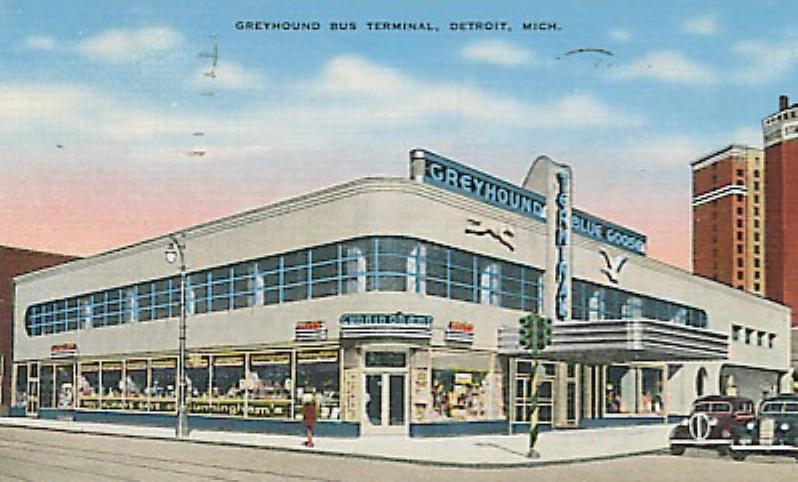
Taken by Photomatic booth at Detroit Bus Station

The feature differentiating Photomatic portraits from those produced by competitors was that the customer received a print "already framed." Constructed of a thin strip of sheet metal, the frame was crimped around the silver gelatin print and a printed card backing. Early Photomatic frames were all silver in colour and the backing designs simple, allowing for a date and place taken to be written by the customer. The card itself followed the art deco theme, and was usually a shiny silver colour.


Postcard of Greyhound Bus Terminal, Detroit, Michigan
Image © and courtesy of Donald Coffin's Greyhound Bus Memories

The Photomatic booth where the 1938 portrait above of a woman in her smart hat and furs was taken would have matched the sleek lines of the Greyhound Detroit Bus Terminal exterior perfectly.

Image © Marc Frattasio and courtesy of the New Haven Railroad Historical and Technical Association, Inc.Image © Marc Frattasio and courtesy of the New Haven Railroad Historical and Technical Association, Inc.
Portrait of unidentified woman, undated
Silver gelatin print in crimped metal frame with printed card backing
Taken by Photomatic booth on the NYNHH Railroad
Image © Marc Frattasio and courtesy of the New Haven RR H&T Assn

Photobooth concessions were operating in public places country-wide, and the backing card stock soon carried the names of the locations or concessions. The portrait of the woman above was probably taken by Photomatic booth located on a station platform or in a waiting room similar to that shown at Boston's South Station, below.

Image © and courtesy of The New Haven Railroad Historical and Technical Association, Inc.
Photomatic booth in waiting room, South Station, Boston
Image © Marc Frattasio and courtesy of The New Haven Railroad Historical and Technical Association, Inc.


Portrait of unidentified man, 6 November 1938
Silver gelatin print in crimped metal frame with printed card backing
Taken by Photomatic booth at Plankinton Arcade, Milwaukee, Wisconsin

This taciturn young man and his somewhat oversized cap paused long enough in the Photomatic booth in the busy Plankinton Arcade to record his passing through in the autumn of 1938. Wherever there were throngs of people, the International Mutoscope Reel Co. installed their Photomatic booths.

Image © Brian and courtesy of The Photobooth Blog
Portrait of unidentified soldier, 13 January 1942
Silver gelatin print in crimped metal frame with printed card backing
Taken by Photomatic booth in Washington, D.C.
Image © Brian and courtesy of Photobooth.net

A little over three years later, and the booths were filled with very different looking subjects. After the Japanese attack on Pearl Harbour on 7 December 1941, the United States was at war and tens of thousands of uniformed servicemen all wanted a photo before they shipped out. Five weeks after the Declaration of War, this soldier was probably both excited and nervous when he posed with a cupid-style caricature cut-out in Washington D.C. in January 1942.

Image © and collection of Brett PayneImage © and collection of Brett Payne
Portrait of unidentified US Marine, 25 February 1944
Silver gelatin print with magenta card frame & printed card backing
Taken by Photomatic booth in Newark, New Jersey
Image © and collection of Brett Payne

In 1944 and 1945, possibly due to shortages of metal, Photomatic portraits were produced with thick coloured satin-finish card "Photoframes." This example from early 1944 shows a marine home on furlough in Newark, New Jersey.

Image © and collection of Brett Payne
Portrait of unidentified woman, September 1945
Silver gelatin print with blue card frame & printed card backing
Taken by Photomatic booth in New York City

These wartime issues had no special place on the back for the place and date to be filled, but some helpful subjects wrote them anyway. This happy bespectacled woman in a striped blouse was presumably caught up in the euphoria that swept New York after the Japanese surrender on 14 August:
In the summer of 1945, New York was a city riding a wave of triumph ... It was a time of unbridled self-confidence. The city had contributed 850,000 servicemen to the war effort. The war had transformed New York into the capital of the world.

(Roberts, 1995)


Image © and collection of Brett Payne
Portrait of unidentified woman, 8 June 1947
Silver gelatin print with red metal frame & printed card backing
Taken by Photomatic booth in New York

After the war ended, Photomatic reintroduced metal frames, and for a couple of years they were enamelled in a variety of colours, including white, red, pale blue, lime green and orange. However, the frame itself had a slightly different profile, as shown in a modified patent application filed by Rabkin in 1948 (below), and included a fold-out stand.

Images courtesy of Google Patents
William Rabkin's 1948 Photomatic Patent Application No. 2,647,834
Image courtesy of Google Patents

Image © and collection of Brett PayneImage © and collection of Brett Payne
Portrait of unidentified US soldier, undated
Silver gelatin print with silver metal frame & printed card backing
Taken by Photomatic booth in unidentified location
Image © and collection of Brett Payne

Eventually the enamelling was dispensed with, and the standard issue frames returned to either plain silver or, more rarely, gold. I suspect this young man's uniform is not military (Correction: this is a US Army cap badge, thanks Mike), but he was proud of it and it's sad that he didn't take the time to record a message on the back. It is probably from the late 1950s.

Image © and collection of Brett PayneImage © and collection of Brett Payne
Portrait of two unidentified women, 13 July 1953
Silver gelatin print with silver metal frame & printed card backing
Taken by Photomatic booth in unknown location
Image © and collection of Brett Payne

This image of two young women was taken in July 1953 and bears the caption, "Dig this". Comparing their clothing and hairstyles with an old Life magazine from that date, it seems likely that they'd been out shopping or to the hair stylist. They do seem rather pleased with themselves.

Image © musicmuse_ca and courtesy of Flickr
Portrait of Beth's mother, 17 July 1945
Silver gelatin print with silver metal frame & printed card backing
Taken by Photomatic booth at Grand Central Station, New York City
Image © and courtesy of musicmuse_ca & Flickr

It is a sad reality that many of the subjects of such found photos and the places where they were taken will never be identified, let alone the context or situation be deduced. However, browsing the internet for examples of Photomatics, one soon appreciates that many of them are still in situ, so to speak, and form an important part of family history. This image on musicmuse_ca's Flickr photostream shows her mother on her wedding day.
This is the shot my mother took on the day she got married to her first husband Fred. It was taken on a photomatic photo machine in Grand Central train station in NYC.
He got a job working for the Canadian Press in NYC. He had been dating my mother since 1939, and they had virtually lived together for several years in Toronto. He asked her to marry him and they took the train from Toronto to NYC.
The marriage to Fred did not last more than 5 years, but my mother's love affair with NYC lasted from 1945 until her death in Manhattan in January of 2003.
These words and further background to the story (Truth, Lies and Betrayal 9/1939) make it a material symbol, despite its inauspicious beginnings in the hustle and bustle of New York's Grand Central Station.

Image © and collection of Brett Payne
Portrait of unidentified woman, undated
Silver gelatin print with red plastic frame & printed card backing
Taken by Photomatic booth in unknown location

By the late 1950s, the design of the frame had changed again, the crimped metal being replaced by much more the much more versatile, rust-proof and cheaper ubiquitous plastic. The characteristic art deco styling of the Photomatic brand was gone forever.


Unidentified couple, Long Beach Pier, Los Angeles, California, undated
Snapshot by unidentified photographer

The Photomatic was also facing stiff competition from rivals. Bloch (2012) suggests that it was outclassed by the superior technological, marketing and distribution techniques of companies such as Auto-Photo Co. One should not ignore the fact that more and more people owned their own cameras. This snapshot, probably from the mid- to late 1950s, shows a sailor and his sweetheart, the latter with a camera in a leather case around her shoulder. They are posing in front of a Penny Arcade at Long Beach Pier, an unoccupied photobooth clearly visible in the background.

Image © and courtesy of These Americans Archive
Photomatic photobooth, candy and cigarette machines, Kansas, 1959
Image © and courtesy of These Americans Archive

I get the impression that Photomatic booths, despite attempts at rebranding and restyling, were slowly being relegated to the amusement arcades and drugstores where their predecessors had originated a quarter of a century earlier. This 1959 booth, perched between the candy and cigarette machines, boasts a brand new look and a comely invitation to "Take your photo ... now!" but I detect a whisper of hesitation. Perhaps she, like Jeannette below, is waiting for the right man to come along.


"Jeanette" and Elvis Presley, undated
Photobooth portrait at unidentified location

References

Photobooth.net, by Brian and Tim

International Mutoscope Reel Company, from Wikipedia.

The History & Progression of the Photo Booth, from Green Cheeze's Blog.

Andy Warhol, lyrics by David Bowie, 1971

Photographic booths, 1930-1940, from The Powerhouse Museum.

Anon (1934) Business & Finance: Pin Game, 24 December 1934, TIME Magazine.

Anon (1935) Science: Photomatic, Monday, 4 February 1935, TIME Magazine.

Anon (2000) "Andy Warhol: Photo Booth Self-Portrait (1996.63a,b)," in Heilbrunn Timeline of Art History, New York: The Metropolitan Museum of Art, 2000. (October 2006)

Anon (2004) The "PhotoMatic" Photo Machines, New Haven Railroad Historical and Technical Association, Inc.

Anon (2013) Say 'cheese in the photobooth, from Diario de Una Pin Up Frustrada, 24 January 2013.

Bloch, Mark (2012) Behind the Curtain: A History of the Photobooth.

Goranin, Näkki (2008) The history of the photobooth, 7 March 2008, The Telegraph, Extract from American Photobooth by Näkki Goranin, publ. by W.W. Norton & Company.

Griffiths, Katherine (2011-2013) - Photobooth Journal: A life in a photobooth.

Hofman, Juli (2011) Photomatic Pics of my Grandpa: D*** It Feels Good To Be a Gangsta, posted 5 Dec 2011 on The Williamson Vampires blog.

Kneen, Orville H. (1928) Penniless Inventor Gets Million for Photo Machine, in Modern Mechanics and Inventions, November 1928.

Linderman, Jim (2011) Mat Mugs! The Wonderful Photomatic Photograph Machine and Mutoscope. William Rabkin Fast Talking Genius of the Photomatic Machine and the Claw, posted in April 2011 on the Dull Tool Dim Bulb blog.

Roberts, Sam (1994) NEW YORK 1945; The War Was Ending. Times Square Exploded. Change Was Coming. in The New York Times, 30 July 1995.

Simkin, David (2013a) Automatic Portrait Photographs: The Sticky Backs Studio, Spiridione Grossi, Abraham Dudkin, Anatol Josepho and the Photomaton, on Sussex PhotoHistory.

Simkin, David (2013b) Sidney Boultwood and his Stickybacks Studios, on Sussex PhotoHistory.
Join my blog network
on Facebook