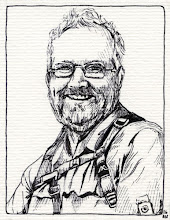


Auguste Edouart, self portrait, 1843
Silhouette, Lithograph on paper
Image © National Portrait Gallery, Smithsonian Institution
Options available for preserving a likeness of yourself for posterity in the pre-photographic era of Georgian England were limited, unless you were wealthy enough to commission a portrait, life size or miniature. A cheaper alternative was to have a silhouette portrait either cut from black paper or painted. In fact the name itself implied a low price. French finance minister Etienne de Silhouette imposed severe economic austerity measures during the Seven Years War, and his surname came to signify anything that was done on the cheap. Auguste Edouart (1789-1861) was probably the most widely celebrated silhouettist of his time, establishing his reputation first in London and then touring England, Scotland, the United States and France.

Advertisement by William Seville, Lancaster, 1824
from Jackson (1911)
I have written previously of Mancunian William Seville (1797-1866), who made the transition from an active career cutting silhouette portraits, spanning three decades, to an arguably less successful spell taking collodion portraits (ambrotypes) at Derby in the mid- to late 1850s. Edward Foster of Derby was also a prolific artist of this genre. After travelling widely throughout England and painting silhouettes from 1809 until at least 1838, he turned to the compilation and publication of educational books and charts in the 1840s. Although Foster apparently never made the move to photographer, there is evidence that he appreciated the value of the carte de visite as a means of self promotion.

Handbill by Mr. G. White of Rose Hill, c.1850-1855
Image © Derby Local Studies Library and courtesy of Michael Spencer
Another Derbyshire-born profilist - a term commonly in use before Edouart popularised the eponymous "silhouette" - was George White. Although silhouettes cut by one or more artists named White, together with various trade labels, have been been documented by Jackson (1982) and McKechnie (1978), his true identity has not previously been established. I have known of George White's photographic exploits (Payne 2008a) for a couple of years, but had not appreciated his connection with silhouette portraiture, until I spotted the following in his advertising handbill:
G. WHITE will also take his BRONZED AND SHADED LIKENESSES, from the plain bust to the highly finished whole length figure. LIKENESSES COPIED. Keeps constantly a variety of suitable Frames for the Daguerreotype Portraits and Paper Cuttings.Although it doesn't refer to them as profiles or silhouettes, that is what these "bronzed and shaded likenesses" were. I have previously demonstrated (Payne 2008b) that this Mr. G. White, who spent a brief period cutting profiles and taking daguerreotype portraits in Chesterfield during the early to mid-1850s, is the same person as the George White (1810-1880) who operated a photographic studio at 1 Queen's Terrace, Adelaide Street, Blackpool from 1849 to 1869 (Jones, 2004).

Trade label: "Cut with scissors at White's," undated
Image © and courtesy of Peggy McClard
McKechnie lists several trade labels on photographs and profiles, of which this one from 1855 is typical:
Photographic Portraits, Paper Cuttings, &c. Taken by Mr. White at his Gallery (daily), Queen's Terrace, opposite the Royal Hotel, Blackpool. Likenesses faithfully copied. Open from 7 am until 7 in the evening.It is clear that the examples described by McKechnie and Jackson (1982), all apparently dating from the early 1850s, are likely to have been by the same George White.
George was born in 1810 in the Derbyshire village of Winster, near Matlock, the second of eight children of James White (1775-1854) and Elizabeth Hodgkinson. He was baptised on 28 December 1810 at the parish church of St John the Baptist. His family moved to Chesterfield between 1814 and 1817, where James worked as a gardener. Little further is known about George White's teenage years, his education or early adulthood, until his marriage at Duffield in 1834 to Ann Melbourne (1808-1895), daughter of a Belper nail manufacturer.

The Manchester Times and Gazette, 26 September 1835
A year later he opened a shop at number 20, Piccadilly, Manchester in September 1835, offering to "cut likenesses of ladies, gentlemen, and children; dogs, horse, &c." for prices ranging from 2/6 to 10 shillings.

The Preston Chronicle, 23 April 1836
He remained there for seven months, and then moved to Preston where he occupied a shop at number 128 Fishergate. His prices were similar, ranging from one to five shillings, depending on whether the likenesses were full length, half length or busts, plain, shaded or elegantly bronzed. He no longer offered sittings for horses or dogs - perhaps it was too tricky to keep them still, even for three minutes. By mid-June he had built up a collection of "likenesses of many well-known individuals of [the] town", which were for sale and on display in his shop window. He announced that he would shortly be taking up engagements in Southport and Blackpool, where he would cater to visitors during the bathing season.

Silhouette of young girl by White, undated
Image © and courtesy of Peggy McClard
A series of newspaper advertisements suggest by their wording that White made regular visits to Preston and Lancaster from 1836 to 1839. He probably also worked in other Lancashire towns, although evidence for these has been elusive. There is also a curious dearth of information about White's activities during the 1840s. By June 1841, he and his wife were in Bispham, north of Blackpool. Living them was George's younger brother James, aged 15 and described in the census as an artist's apprentice. Perhaps they were preparing themselves for the forthcoming summer season, although the great tourism boom was still to arrive, with the railroad, after 1846.
The next sighting of George White is an 1849 entry in Gillian Jones' compilation, Lancashire Professional Photographers, which shows him with premises at number 1, Queen's Terrace, Blackpool in that year. However, it is not clear if he was already working as a photographer by that time, since Mannex & Co's History, Topography, and Directory of Westmorland for 1851 shows him merely as an artist and lodging house keeper. He was obviously still travelling to find business, because the 1851 Census shows him in the village of Church, near Accrington, while his wife and nine month-old son remained at the house in Blackpool.

Chesterfield Town Hall, Rose Hill, Chesterfield
Image © Alford and courtesy of Panoramio
The handbill which advertised his services in Chesterfield was probably ordered from Chesterfield printer John Roberts in the early 1850s. Rose Hill - now occupied by the grand Chesterfield Town Hall building, shown above - was where his parents lived, at least until his father's death in 1854.

Portrait of unidentified elderly man, c. mid-1860s
Image © and collection of Brett Payne
By April 1861 he had returned to his family in Blackpool, where he described himself as an artist. The carte de visite portrait shown above was probably taken in the early to mid-1860s in his studio at 1 Queen's Terrace, Adelaide Street. The last directory entry noted by Jones was in 1869, and on census night April 1871 he described himself as a retired artist. Since late 1869 their address had been 23 Adelaide Street, although it is not clear whether they had moved or the street had simply been renumbered.

"G WHITE PHOTO BLACKPOOL"
Blind stamp from front of carte de visite
George White died at Blackpool on 23 March 1880, aged 69, leaving his widow Ann and son Frederick George White, a banker's clerk.
Acknowledgements
Many thanks to Peggy McClard for providing information about White's career as a silhouettist, and for kindly giving me permission to reproduce the wonderful image of her White silhouette. If you're interested in silhouettes and other folk art, I strongly recommend visiting Peggy's web site, Peggy McClard Antiques. I'm grateful also to Michael Pritchard and Ian Leith for their lookups, to Ann Halford for information about the Melbourne family of Belper, and to Dawn Scotting for her work on Winster families. I'd also like to thank Mike Spencer, who spotted the handbill amongst the archives at the Derbyshire County Record Office, and sent me a photocopy, thus sparking off the whole quest in the first place.
References
1841-1911 UK Census Collection, England & Wales National Probate Calendar and England & Wales BMD Index from Ancestry.
Anon (1835) Likenesses cut with scissors, in three minutes (Advertisement, dated 25 Sep 1835), The Manchester Times and Gazette, 26 September 1835.
Anon (1836a) Striking likenesses cut with scissors, in three minutes (Advertisement), The Preston Chronicle, 23 April 1836.
Anon (1836b) Likenesses, The Preston Chronicle, 18 June 1836.
Anon (1838a) Likenesses cut with scissors (Advertisement), The Preston Chronicle, 13 October 1838.
Anon (1838b) Likenesses cut with scissors (Advertisement), The Lancaster Gazette and General Advertiser, 1 December 1838.
Anon (1839) Likenesses cut with scissors (Advertisement), The Preston Chronicle, 12 October 1839.
Anon (1855) Slater's Directory of Lancashire, from Ancestry.
Halford, Ann (n.d.) Melbourne Tree, Ann & John's Family Histories.
Heathcote, Bernard & Pauline (2002) A Faithful Likeness - The First Photographic Portrait Studios in the British Isles, 1841 to 1855, publ. by the authors (courtesy of Ian Leith)
Jackson, Emily Nevill (1911) The History of Silhouettes, London: The Connoisseur, 121p, 72pl, at Archive.org
Jackson, Emily Nevill (1982) Silhouettes: A History and Dictionary of Artists, New York: Dover Publications, 154p, 103pl.
Jones, Gillian (2004) Lancashire Professional Photographers 1840-1940, PhotoResearch (courtesy of Michael Pritchard)
Knipe, Penley (1999) Shades and Shadow-Pictures: The Materials and Techniques of American Portrait Silhouettes, The Book and Paper Group Annual, Vol. 18 (1999), Paper delivered at the Book and Paper specialty group session, AIC 27th Annual Meeting, June 8-13, 1999, St. Louis, Missouri.
Mannex & Co. (1851) History, Topography & Directory of Westmorland, from the University of Leicester's Historical Directories.
McClard, Peggy (2007) Cut & paste silhouette of a young girl carrying a basket, by White, Peggy McClard Antiques.
McKechnie, Sue (1978) British Silhouette Artists and their Work, 1760-1860, London: Sotheby Parke Bernet, 799p. Extracts by kind courtesy of Peggy McClard (Peggy McClard Antiques)
Payne, Brett (2008a) Advertising by Photographers (1) Daguerreotypist, G. White of Rose Hill Chesterfield, Photo-Sleuth, 17 February 2008.
Payne, Brett (2008b) George White of Chesterfield & Blackpool, Photo-Sleuth, 8 May 2008.
Payne, Brett (2009) William Seville (1797-1866), silhouette and photographic artist, Photo-Sleuth, 17 Sep 2009.
Scotting, Dawn (2010) The Ancestral Trees of the Families of Winster Derbyshire, Rootsweb/Ancestry.com


