Showing posts with label Illinois. Show all posts

Wednesday, 9 April 2014

Sepia Saturday 223: The Finest Equipped Photographic Gallery in the Vicinity


Sepia Saturday by Alan Burnett and Marilyn Brindley

This week's Sepia Saturday image prompt is all about buildings and town scenes. I'll be taking a closer look at some tintypes from my own family's collection, and an emerging story about a photographic studio in Chicago, Illinois. The building itself will only appear later in the article, so please bear with me.

Image © and collection of Brett PayneImage © and courtesy of Barbara Ellison
Charles Leslie Lionel Payne (1892-1975), taken c. October-November 1892
Sixth plate tintypes (63 x 88mm, 65 x 90mm), unidentified photographer
Probably by H.R. Koopman, 11104 Michigan Ave, Roseland, Chicago
Images © and collection of Brett Payne & Barbara Ellison

Among the family photographs that my aunt and I have inherited are a series of four sixth-plate tintypes. The term "sixth-plate" refers to the size of the photograph, produced by cutting a full plate (8½" x 6½" or 216 x 165mm) into six, each measuring roughly (2¾" x 3¼" or 70 x 83mm). As with many such tintypes, the edges are roughly cut and the corners have been trimmed to make them easier to slip into photo album slots.

Image © and collection of Brett Payne Image © and courtesy of Barbara Ellison
Detail of two six-plate tintype portraits of Leslie Payne

As is also commonly found with this format, they have no photographer's details or other distinuishing marks, but I can be fairly certain that the two almost identical portraits of my grandfather Charles Leslie Lionel Payne were taken in Chicago. He was born there in April 1892 and returned to England with his parents in mid- to late November that year, so would have been six or seven moths old at the time he parents took him to the studio. The two images appear at first glance to be of the same view. A detailed examination of the child in the pram reveals identical poses which I think we have to assume would be impossible to duplicate for two separate exposures.

Image © and collection of Brett Payne Image © and courtesy of Barbara Ellison
Detail of two six-plate tintype portraits of Leslie Payne

Sharp-eyed readers will however have noticed subtle differences, which are more obvious in these two views of the pram's undercarriage. There is a considerable shift in the position of the rear axle in relation to the rim of the front wheel in the two images. How can this be if the two photographs were taken in the same split second, as evidenced by the child's pose? Well, the answer lies in a question of parallax, defined in the COD as the "apparent displacement of an object, caused by actual change of point of observation." This Wikipedia article has an animation which shows the effect very well.

Image © and courtesy of Rob Niederman
9-tube "Gem" wet-plate camera, by unknown U.S. maker
Image © and courtesy of Rob Niederman

In other words, the two portraits were indeed taken at the same instant, but from two slightly different positions. This was achievable with a multi-lens camera, such as the one shown above. Camera collector and very knowledgeable historian Rob Niederman points out that the noticeable vertical parallax, along with no perceptible horizontal parallax, suggests the second image was probably directly above the first on the original plate. The camera must have had at least a four lens set (1/9-tubes, using a 4¼" x 5¼" plate) or conceivably 9, 12 or 16 lens sets. He adds, "In summary, studio outfits were very adaptable in what you could do with them."

Image © and courtesy of Barbara Ellison
Charles Hallam Payne (1870-1960), taken c. 1892
Sixth plate tintype (62 x 86mm), unidentified photographer
Probably by H.R. Koopman, 11104 Michigan Ave, Roseland, Chicago
Image © and courtesy of Barbara Ellison

The third tintype is a three-quarter length standing portrait of Leslie's Uncle Hallam - Charles Hallam Payne (1870-1960) - who was with Leslie and his parents in Chicago in 1891 and 1892.

Image © and courtesy of Barbara Ellison
Unidentified subject, taken c. 1892
Sixth plate tintype (66 x 88mm), unidentified photographer
Probably by H.R. Koopman, 11104 Michigan Ave, Roseland, Chicago
Image © and courtesy of Barbara Ellison

In the fourth portrait, an unidentified young man, smartly dressed and with a moustache, is seated in a studio with a painted backdrop.

Image © and collection of Brett Payne Image © and courtesy of Barbara Ellison
Detail of backdrops in two six-plate tintype portraits

Examination of the painted backdrop (above left) shows similarities with that used in the two portraits of Leslie Payne. I have some reservations, but the similarity of the branches and knots in the tree trunks has more or less convinced me that they are the same backdrop, although perhaps touched up a little between the two sittings.

It seems likely therefore, given the similarity of features and their provenance, that all four tintype portraits were taken in the same studio. But who was the man with a moustache?


Pullman Car Works, Roseland, Chicago, c.1890
Photograph by H.R. Koopman

Leslie's parents Charles Vincent and Amy Payne had travelled to Chicago, Illinois from their home in Derbyshire, England in May-June 1891, very soon after their wedding. Accompanying them was Vincent's younger brother Frank Payne, and together they would join another brother Charles Hallam Payne, who had gone to Chicago to look for work a year earlier. Uncle Hallam had been working as a carpenter at the Pullman Car Works.

The moustachioed man is obviously not Charles Hallam and, by comparison with many other photographs in my collection, is not my grandfather Charles Vincent. I thought at first that it might be Frank (unfortunately we have no other photographs in the family collection with which to compare it), but Frank would have been only 18 years old at the time, so I think that is very unlikely. Perhaps he was a friend.


Pullman Car Works, Roseland, Chicago, c.1890
Photograph by H.R. Koopman

In a letter written to him on 12 January 1891 his father Henry Payne thanked Hallam for a ...
"... book of Pulman [sic]. I am glad to hear that Pulman does not go in for many hotels. Perhaps you will make a note of that."
This book, currently in the collection of my aunt, includes a number of photographs of Pulman's works and the town he built to house his workers, including the two shown above, all taken by photographer H.R. Koopman.

Image © and collection of Brett Payne
Employee's Pass for The World's Columbian Exposition, 1 June 1892

Image © and collection of Brett Payne
United Carpenter's Council Quarterly Working Card, Oct-Dec 1892

Some time after the arrival of his brothers all three found employment at the Chicago World's Fair, officially known as The World's Columbian Exposition. However, it appears that they were still living in Roseland - Lesley Payne's birth certificate shows that he was born at 10810 Curtis Ave, Roseland, Chicago on 9 April 1892.

Image © Pullman State Historic Site & courtesy of Illinois Digital ArchivesImage © Pullman State Historic Site & courtesy of Illinois Digital Archives
Koopman Advertising Flyer, 1 May 1888, Printed paper (150 x 220mm)
Portrait of H.R. Koopman, c. 1894, Oval silver gelatin print (70 x 133mm) on grey-coloured card mount (108 x 212mm)
Images © Pullman State Historic Site, courtesy of Illinois Digital Archives

Henry Ralph Koopman (1865-1944) operated photographic studio in Roseland, a suburb of Chicago, from 1884 until the early 1900s, offering a wide variety of formats at what he boasted was the "finest equipped photograph gallery in the vicinity."

Image © Pullman State Historic Site & courtesy of Illinois Digital Archives
Koopman's Photograph Gallery, Cor. 111th St and Michigan Av., 1886
Silver gelatin print (239 x 182mm) mounted on card
Image © Pullman State Historic Site, courtesy of Illinois Digital Archives

This image of Koopman's Photograph Gallery at 11106 South Michigan Avenue, on the corner with 111th Street, was taken in 1886. The large windows and skylight on the side of the building indicate the position of the studio towards the rear. By the time the Paynes arrived in Roseland in 1892, where they lived only three blocks away from the gallery, Koopman had built himself a much grander three-story building with a studio on the third floor, although I've not managed to find a corresponding external view.

Image © Pullman State Historic Site & courtesy of Illinois Digital Archives Image © and courtesy of The Cabinet Card Gallery
Portraits of unidentified woman and children, c. late 1880s
Cabinet portraits taken by H.R. Koopman, Roseland, Illinois
Images © Pullman State Historic Site & courtesy of Illinois Digital Archives, © and courtesy of The Cabinet Card Gallery

The cabinet portraits above were taken in the late 1880s to early 1890s in Koopman's studio, and demonstrate that he used a very similar style of painted backdrop to those seen in the tintypes, although I have been unable to match the specific backdrop used in the latter with any marked Koopman portraits.

Image © Pullman State Historic Site & courtesy of Illinois Digital Archives
HR Koopman photographing his daughter, Marie, in his studio, c. 1895
Silver gelatin print (353 x 279mm)
Image © Pullman State Historic Site, courtesy of Illinois Digital Archives

This wonderfully evocative print from Koopman's archives preserved at the Pullman State Historic Site shows the photographer himself at work in the studio, capturing a portrait of his daughter Marie around 1895. He is composing the image on a ground glass screen at the back of a large format glass-plate studio camera, his head under a black cloth to exclude light. The lighting available from the large window and skylight can be moderated and diffused by the drapes hanging from the ceiling. A painted canvas backdrop is in place behind the seated girl, and a second rolled backdrop can be seen hanging above. There are a number of different items of standard studio furniture, including padded stool, side tables, cane chair, ornate screen, carpets and curtains, as well as a small stove to keep the studio warm and the clients comfortable.


Charles Vincent Payne, August 1891
Cabinet card by Harrison & Coover, Central Music Hall,
cnr. State & Randolph Streets, Chicago, Illinois
Image © and collection of Brett Payne

There were many photographic studios in Chicago, and I even have a cabinet portrait of my great-grandfather Charles Vincent Payne taken at Harrison & Coover's downtown studio in August 1891. However, I don't believe there were many photographers operating in Roseland in the early 1890s, and I think it is very likely that all four tintypes were made there. However, until I find another portrait showing that identical painted backdrop, I can't be sure. To this end, I've saved a search for Koopman portraits on eBay in the hope that some will turn up in due course.

The identity of the moustachioed man remains a mystery.

References and Further Reading

Horn, Don (2003) The Pullman Photographers, Railroad Heritage, No. 7, p. 5.

Nickell, Joe (2010) Camera Clues: A Handbook for Photographic Investigation, University Press of Kentucky.

Payne, Brett (2003) Fifty Years of Payne Journeys to North America - 1890-1892 : Chicago, Pullman & the Worlds Fair.

Payne, Brett (2009) Letter to America - A moment in the life of a young girl in late Victorian Derby, on Photo-Sleuth, 14 February 2009.

Payne, Brett (2009) Whistling Bird, the Arizona Cowboy and the Disappearing Lady, on Photo-Sleuth, 1 November 2009.

Payne, Brett (2011) Fearless femmes: great-grandmother Amy, on Photo-Sleuth, 6 March 2011.


Sunday, 6 March 2011

Fearless femmes: great-grandmother Amy

Image © and collection of Brett Payne
1894-1895 at Derby [1]

She is as impenitent and self-possessed a young lady as one would desire to see among the best behaved of her sex. Her small head and tiny resolute mouth and chin; her haughty crispness of speech and trimness of carriage; the ruthless elegance of her equipment, which includes a very smart hat with a dead bird in it, mark a personality which is as formidable as it is exquisitely pretty. She is not a siren, like Ann: admiration comes to her without any compulsion or even interest on her part; besides, there is some fun in Ann, but in this woman none, perhaps no mercy either: if anything restrains her, it is intelligence and pride, not compassion. Her voice might be the voice of a school-mistress addressing a class of girls who had disgraced themselves, as she proceeds with complete composure and some disgust to say what she has come to say.

Man and Superman, George Bernard Shaw, 1903 [2]

These words could only have written by a man, I suppose, and the language and sentiment are clearly a product of the late Victorian times, but when I read them I thought immediately of this photograph of my great-grandmother Amy Payne née Robinson (1867-1932). The cabinet portrait shown above, pictures her with husband and son (my grandfather Leslie), probably in the garden of their home at 83 St James' Road, Normanton in late 1894 or early 1895.

The historical record, particularly prior to the 20th Century, often left far fewer clues to the details of our female ancestors' lives than for their menfolk, and this is certainly the case with Amy. I've written previously of my great-grandfather Charles Vincent Payne (1868-1941) on Photo-Sleuth, including a piece about his musical abilities, but I've hardly mentioned his wife Amy and should remedy that.

In the United States, March is National Women's History Month, and to celebrate this, Lisa Alzo (The Accidental Genealogist) has reprised her month's worth of blogging prompts, Fearless Females. It's a good opportunity not only to write about female ancestors, fearless or not, but to think about what records, memories and, in particular, photographs remain to provide the clues which can tell us something about their lives.


1926 at Derby [3]

In my family photos there are at least a dozen images which include Charles Vincent, but only four in which his wife Amy appear, and I suspect this three-to-one male to female imbalance would not be unusual in other collections from that era. The small print shown above (109 x 69 mm or 4¼" x 2¾") is the only one showing her as an older woman, pictured seated at front left on the occasion of my grandparents' wedding in 1926. She died only six years later, at the age of sixty-five, when my Dad and his sister were four years and eight months old, respectively. As a result, neither of them had or have any memory of her at all. However, my Dad did tell me that his father was very fond of his mother Amy and, after her second son Harold Victor died in May 1921, he abandoned his job as a clerk at Eaton's Department store in Winnipeg, returning home from Canada to be a comfort to her [4].


9 Lower Forester Street, Derby [5]

Amy Robinson was born at 42 William Street, in the parish of St Alkmund, Derby, on 28 February 1867, where her father Daniel was a police constable [6]. She was baptised at the parish church a few weeks later on 7 April [7]. By 1871 they had moved to 9 Lower Forester Street, in St Werburgh's parish [8], and between 1876 and 1879 they moved again to 74 Fleet Street, Litchurch [9].

Image © and collection of Brett Payne
c.1885-1888 at Derby [10]

I don't know where Amy went to school, but she must have been bright. By the time of the census in April 1891, she was 24 years old and working as a commercial clerk [11]. I believe she must have been the first female member of her family to work in a profession heretofore normally reserved for men.

Image © and collection of Brett Payne
c.1887-1889 at Skegness [12]

She certainly looked a self assured young woman when she was in her late teens and early twenties, whether visiting a Derby photographic studio [10] or promenading with a stylish parasol and high velvet round hat with a huge bow in Skegness [12].

Image © and collection of Brett Payne
On the ocean steamship landing, Liverpool [13]

On the 18th May she married Charles Vincent Payne at the parish church of St Thomas [14], and a week later they departed from Liverpool aboard the S.S. Nova Scotian for Baltimore [15]. With her predilection for headgear, she would not have been out of place amongst these fashionable ladies on the Landing Stage at Liverpool. Accompanying the newly married couple were Charles' younger brother Frank who, although only 17, had been working as a junior clerk at the Derby Union Poor Law Offices. Their intention was to join another brother Charles Hallam in Chicago. He had been working for the Pullman Car Company for some months and presumably Charles Vincent hoped to take advantage of his experience as a joiner [16] and carriage finisher [17]. Things did not quite go according to plan, and it may be that Mr. Pullman was not quite the employer Hallam had thought he was ... the story that Uncle Hallam told about their escapades is recounted in a previous Photo-Sleuth article, Whistling Bird, the Arizona Cowboy & the Disappearing Lady [18].

Image © and courtesy of Illinois Digital Archives
East 111th Street & Curtis Avenue, Roseland, Chicago [19]

Amy is hardly mentioned and I have no idea whether she managed to find a job, although it seems unlikely. Not long after their arrival she, as might be expected, fell pregnant, and on 9th April 1892 gave birth to my grandfather Charles Leslie Lionel at 10810 Curtis Avenue, Roseland, Chicago [20]. Curtis Avenue subsequently became South Edbrooke Avenue, and Google Maps' Street View shows a neighbourhood that has, sadly, seen better days (check out this boy doing a handstand for the Street View camera) [21]. In the 1890s and early 1900s, however, with the jobs and affluence created by the nearby Pullman works, it was a good deal more salubrious, as the view by Roseland photographer H.R. Koopman above demonstrates [19]. All three of the men eventually found jobs as carpenters at the site of the Chicago World's Fair, or to give it it's proper name, The World's Columbian Exposition, where they worked in the construction of the dome of the Horticultural Building [22,23].

Image © and courtesy of Barbara Ellison
Charles Leslie Lionel Payne, c. October 1892, Chicago [24]

It seems likely that Amy took the infant Leslie to Koopman's studio, situated only a few blocks away at 11104 Michigan Avenue (corner of 11th) [25], for this tintype portrait, shortly before they left Chicago in mid-November. Why did they go home after being there only eighteen months? It could have been a paucity of work. Perhaps the bulding work was over, and more jobs were hard to come by? It is possible that there was already some intimation amongst employers of the Panic of 1893 [26], with resulting layoffs. On the other hand, it may be that Amy'd had enough of the big, unfriendly, windy city, and couldn't face another harsh Chicago winter with a small child to look after, and little spare money for the small comforts.

Image © and courtesy of Barbara Ellison
Payne family grocery/off-licence, 83 St James' Road, Normanton [27]

Whatever the reason for their return, they arrived home in England on 30th November 1892 [28]. For the first couple of years they lived at the house where the Payne boys had grown up (Charles Vincent's parents and younger siblings moving into a much large property further up the road), and where they took over the running of the family grocery and off-licence [9,29]. By 1896 Hallam had taken over the grocery, they had moved into a house across the road, and Amy's husband described himself as an estate agent [9,30]. Amy gave birth to her second son Harold Victor at this house (17 Hastings Street) on 4th January 1898.

Image © and courtesy of Google Maps Street View
139 St James' Road, Normanton [31]

Around 1903, with their two boys growing, they moved again to the big house (number 139, also known as "The Hollies") at the end of the road, recently vacated by the Paynes senior, who had semi-retired to Sunny Hill [32]. After Henry Payne died in 1907, however, the Sunny Hill residence was left to Charles Vincent's sister Lucy Mary and her husband, then recently married, while their mother Henrietta moved back into The Hollies [33].

Image © and courtesy of Google Maps Street View
154 Almond Street, Normanton [34]

Amy, her husband and the two boys moved into what must then have been a newly built house nearby at 154 Almond Street, where they were shown living in April 1911 [35] and where they would remain for twenty years. In early September 1912, Amy's elder son Leslie left home for a new life in Canada, intending to work as a storekeeper in Wolseley, Saskatchewan [36,37].

Image © and collection of Brett Payne
Note of marriage date, Amy's handwriting, c.1914-15 [38]

Two years later, after war had broken out, in November 1914 Leslie enlisted in the Canadian Expeditionary Force, and around that time Amy made some notes regarding marriage and birthdates at her brother-in-law Hallam's request. This scrap of paper may be the only example left of Amy's handwriting [38].

Image © and collection of Barbara Ellison
Constance May Hogg, Christmas 1913 [39]

Leslie was at the Front in France by late 1915, and spent most of the war with the Canadian Machine Gun Corps, returning to marry a neighbourhood girl Connie Hogg in November 1917 [40]. By mid-1918 Harold had joined up too with the British Tank Corps [41], but in early September came the news that Leslie had been seriously wounded, with a machine gun bullet lodged in his left shoulder [42]. After an operation to remove the bullet was successful [43], he spent the rest of September and the early part of November recuperating, before being discharged on the 14th October [44]. Leslie arrived at his parents' home during the peak of the Spanish Flu epidemic only to find Connie ill, and a few days later she died [45,46].

Image © and collection of Brett Payne
Postcard written by Harold Victor Payne to Amy [47]

Leslie returned to Canada where he was discharged in February 1919. Harold, even though the war was over, was serving in the British Army of the Rhine (B.A.O.R.) and wrote the following on a postcard sent home to his mother in late November 1919:

Dear Mam,
I am at present in Cologne awaiting demob guess I shan't be long now. I am quite well & hope both you and dad are the same. Must catch this post. Best love & Xs from Harold.
Image © and collection of Barbara Ellison
Harold Victor Payne, wounded soldiers, c.1919 [48]

This photograph, also sent by Harold to his mother, must have caused some worry. It bears the following caption on the reverse: "Woulded soldiers. Ive met 'em, Yes sir." while another in the same sequence states, "I look pretty thin Eh!"

Harold died in May 1921 and, as stated previously, my grandfather returned to Derby shortly after, marrying and producing two grandchildren for Amy before she died on 22nd March 1932.

The course of most of my female ancestors' lives, apart from bare bones of "vital statistics" dates (birth-baptism-census-marriage-children-death), appear from the documentary records to consist largely of what their menfolk were doing. To a great extent, this may be a fairly accurate representation of what their lives were like. In other words, their day-to-day activities were full of the usual household- and child/family-related activities, but the overall course was largely dictated by the careers, movements and interests of their husbands. Sadly, though, this tells me very little of their personalities and, without first hand accounts, writing about them properly remains a very difficult task.

Image © and collection of Barbara Ellison

Perhaps there's a hoard of personal ephemera of Amy's somewhere which has yet to be revealed, but I think it's very unlikely. The members of my family who've taken on the reponsibility of collecting, preserving and handing down family documents, photographs and ephemera have often been male and, perhaps as a result, the subject matter has been reflected by their views on what was important to keep. For the moment she will remain, at least to me, the "self-possessed young lady ... [wearing] a very smart hat with a dead bird in it."

References

[1] Photographic portrait of Payne family group (Amy Payne née Robinson, Leslie Payne and Charles Vincent Payne), Cabinet card (109 x 165 mm)) by A. & G. Taylor of 63 London Road, Derby, probably taken c. late 1894-early 1895 at 83 St James' Road, Normanton, Derby, Collection of Brett Payne.

[2] Excerpt from "Man and Superman," by Bernard Shaw, Penguin Books, 1946, p.85-86.

[3] Photographic portrait of wedding party (Charles Leslie Lionel Payne, Ethel Brown, and parents), by unknown photographer, Silver gelatin print (109 x 69 mm) on Velox paper, dated (on the reverse) Sept. 20. 1926 and taken in the garden at 121 Crewe Street, Normanton, Derby, Collection of Brett Payne.

[4] Payne, Brett (2003) Fifty Years of Payne Journeys to North America, 1919-1921 : Final Years in Winnipeg.

[5] View of 9 Lower Forester Street, Derby, Courtesy of Google Maps Street View

[6] Certified copy of an Entry of Birth for Amy Robinson, 28 Feb 1867, Extracted 22 May 1914, [Photocopy] Collection of Brett Payne.

[7] Baptism of Amy Robinson, St Alkmund, Derby, 7 April 1867, International Genealogical Index (IGI), Batch No. K055374, LDS Family Search.

[8] 1871 Census of 9 Lower Forester Street, Derby St Werburgh, Derbyshire, England, 2 April 1871, The National Archives Ref. RG10-3572-26-10-57, UK Census Collection, Ancestry.co.uk

[9] Derby Electoral Registers, 1868-1900, Derbyshire County Record Office, Matlock, Derbyshire, Microfilmed by LDS Church, FHL Film Nos. 2081839-41, 2081818-22, 2081961.

[10] Photographic portrait of Amy Payne née Robinson, Carte de visite (presumed, size not recorded) by A. & G. Taylor of 57 London Road, Derby, probably taken c.1885-1888 in the Derby studio, Collection of Brett Payne.

[11] 1891 Census of 74 Fleet Street, Litchurch, Derby, Derbyshire, England, 5 April 1891, The National Archives Ref. RG12-2733-127-18-112, UK Census Collection, Ancestry.com.

[12] Photographic portrait of Amy Payne née Robinson, Carte de visite (presumed, size not recorded) by Charles Smyth, Lumley Studio, Skegness, probably taken c.1887-1890 in the Skegness studio, Collection of Brett Payne.

[13] On the ocean steamship landing, Liverpool, England, Stereocard photograph by Underwood & Underwood, No. 193, Collection of Brett Payne.

[14] Copy of marriage certificate for Charles Vincent Payne & Amy Robinson, 18 May 1891, St Thomas, Derby, [Photocopy] Collection of Brett Payne.

[15] Passenger list for the S.S. Nova Scotian, Departing from Liverpool for Baltimore, 26 May 1891, Passenger Lists Leaving UK 1890-1960, FindMyPast.co.uk

[16] 1891 Census of 1 Pear Tree Street, Litchurch, Derby, Derbyshire, England, 5 April 1891, The National Archives Ref. RG12-2735-67-25-157, UK Census Collection, Ancestry.com.

[17] Passenger list for the S.S. Nova Scotian, Arriving at Baltimore from Liverpool, 10 June 1891, Baltimore Passenger Lists 1820-1948, Ancestry.com

[18] Payne, Brett (2009) Whistling Bird, the Arizona Cowboy & the Disappearing Lady, Photo-Sleuth blog.

[19] East 111th Street & Curtis Avenue, Roseland, Chicago, Postcard by H.R. Koopman, 1906, Collection of Illinois Digital Archives.

[20] Report of Birth for Charles Leslie Lionel Payne, Vital Statistics Department, County Clerk's Office, Cook County, 17 November 1931, Copy taken from microfilm of original record, Family History Library, Salt Lake City (Courtesy of Frank Wattleworth), Collection of Brett Payne.

[21] View of 10810 South Edbrooke Avenue, Roseland, Chicago, Courtesy of Google Maps Street View

[22] Payne, Brett (2003) Fifty Years of Payne Journeys to North America, 1890-1892 : Chicago, Pullman & the Worlds Fair.

[23] World's Columbian Exposition, Wikipedia.

[24] Portrait of Charles Leslie Lionel Payne, c. October 1892, Chicago, Sixthr-plate tintype (64.5 x 90 mm), by unidentified photographer (possibly Henry Ralph Koopman of 11104 Michigan Avenue, Roseland, Chicago)

[25] Chicago Photographers, 1847 through 1900, Chicago Historical Society, 1958.

[26] Panic of 1893, Wikipedia.

[27] Photograph of Payne family grocery/off-licence, 83 St James' Road, Normanton, Paper print (138 x 87.5 mm), taken c.1910 by unknown photographer, Collection of Barbara Ellison.

[28] Passenger list for the S.S. Circassian, Arriving at Liverpool from Montreal, 30 November 1892, UK Incoming Passenger Passenger Lists 1878-1960, Ancestry.co.uk

[29] Kelly's 1895 Directory of Derbyshire, [microfiche] Derbyshire Family History Society.

[30] Kelly's 1899 Directory of Derbyshire, Historical Directories, University of Leicester.

[31] View of 139 St James' Road, Normanton, Derby, Courtesy of Google Maps Street View

[32] Cook's 1903/4 Derby and District Directory, Derby Local Studies Library, Courtesy of Paul Slater.

[33] 1911 Census of The Hollies, 139 St James' Road, Normanton, Derby, Derbyshire, England, 2 April 1891, The National Archives Ref. RG14-20-9-35-20935_0001_03, England & Wales Census Records 1841-1911, FindMyPast.co.uk

[34] View of 154 Almond Street, Normanton, Derby, Courtesy of Google Maps Street View

[35] 1911 Census of 154 Almond Street, Normanton, Derby, Derbyshire, England, 2 April 1891, The National Archives Ref. RG14-20-9-32-20932_0373_03, England & Wales Census Records 1841-1911, FindMyPast.co.uk

[36] Passenger list for the S.S. Virginian, Departing from Liverpool for Quebec, 12 September 1912, Passenger Lists Leaving UK 1890-1960, FindMyPast.co.uk

[37] Passenger list for the S.S. Virginian, Arriving at Quebec from Liverpool, 23 September 1912, Canadian Passenger Lists 1865-1935, Ancestry.ca

[38] Handwritten notes made by Charles Hallam Payne and Amy Payne, c.1914-15, Collection of Brett Payne.

[39] Photograph of Constance May Hogg, Christmas 1913, Postcard format (89 x 140 mm), unidentified photographer, Collection of Barbara Ellison.

[40] Copy of marriage certificate for Charles Leslie Lionel Payne and Constance May Hogg, St Paul, Boughton, Cheshire, 30 November 1917, Collection of Brett Payne.

[41] Medal Roll Index Card for Harold V. Payne 315778, British Army WWI Medal Rolls Index Cards, 1914-1920, Ancestry.co.uk

[42] Casualty Form - Active Service for Sgt Leslie Payne, 1989 (Army Form B.103), CEF Service Records, Library & Archives of Canada.

[43] Medical Case Sheet for Sgt Leslie Payne, 1989 (Army Form I.1237), CEF Service Records, Library & Archives of Canada.

[44] Casualty Report Card for Sgt Leslie Payne, 1989, CEF Service Records, Library & Archives of Canada.

[45] 1918 Flu Pandemic, Wikipedia

[46] Copy of death certificate for Constance May Hogg, 154 Almond Street, New Normanton, Derby, 20 October 1918, Collection of Brett Payne.

[47] Commercial Real Photo Postcard (of two young girls, publisher unknown, 85.5 x 135 mm) sent by Harold Payne (Cologne) to Amy Payne (Derby), dated 22-11-19 & postmarked 23 Nov 19, Collection of Brett Payne.

[48] Photograph of wounded soldiers, including Harold Victor Payne, c.1919, by unidentified photographer (81.5 x 55.5 mm, roughly trimmed), Collection of Barbara Ellison.

Sunday, 1 November 2009

Whistling Bird, the Arizona Cowboy and the Disappearing Lady

83rd Carnival of Genealogy - Play Me

The 83rd Carnival of Genealogy, hosted by Janet Isles at her blog Janet the Researcher, is entitled Play Me, and encourages Geneabloggers to write about a musical instrument that they or other family members have played. Apart from my youngest daughter and aunt who both, like the elegantly coiffured and dressed lady in the footnoteMaven's inviting COG poster above, have learned to play the piano during their school years, very few of my family members have progressed much beyond the recorder in their early grades. However, my great-grandfather Charles Vincent Payne (1868-1941) did have something of a reputation for his singing voice.

Of course I never met my great-grandfather. He died twenty years before I was born and, since my father and his sister were pretty young at the time, they never recalled much about him either. He has therefore been far less prominent a figure in the family history than his younger brother, Charles Hallam Payne (1870-1960), who lived almost two decades longer, was always known as "the grand uncle" and generally regarded as the head of the family.

Image © and collection of Brett Payne - Colourised by Andre Hallam
Charles Vincent Payne, c.1915-1920
Post card portrait, possibly by Pollard Graham of Derby
Image © and collection of Brett Payne
Colourised by Andre Hallam

I am interested, therefore, in how much we can deduce about the type of person Charles Vincent was from the photographs and meagre ephemeral clues that we have. The postcard portrait above, expertly colourised for me by Andre Hallam, was probably taken in Derby. Although not marked with a studio name it is of a style and format used by the Pollard Graham in the period 1915-1920, when he was aged about fifty, and the backdrop is very similar to those used in Graham's Derby studio. He seems rather pleased with himself, looking confidently at the camera, with his right hand partly in his jacket pocket, and holding his pipe in his left hand. He is dressed, as always, very smartly in a dark suit with waistcoast, collar and bow tie, and a light-coloured trilby with a dark hat band.

The earliest reference that I have found for his prowess as a singer is the report of a concert held by the Normanton Musical Society on 28 January 1889, probably at St Giles church, Normanton. [1] He was the first of a dozen soloists and duet performances in a lengthy evening's entertainment:
"Mr. Vincent Payne received a well-merited encore for his song 'They all love Jack,' to which he responded with 'The Old Brigade.'"
He was at this time working as a carriage finisher - in other words as a skilled joiner - at the Midland Railway works in Litchurch, Derby. He and Amy Robinson, daughter of a local policeman, were married at St. Thomas Church at Litchurch in May the following year, and almost immediately they headed off for Chicago, accompanied by another brother Frank Payne, to join Hallam who was working for the Pullman Car Company. After leaving the port of Liverpool in late May, they arrived in the port of Baltimore aboard the S.S. Nova Scotian on Wednesday 10 June 1891.

Image © and collection of Brett Payne
Charles Vincent Payne, August 1891
Cabinet card by Harrison & Coover, Central Music Hall,
cnr. State & Randolph Streets, Chicago, Illinois
Image © and collection of Brett Payne

Why did they go to America? Was it the allure of the forthcoming World's Columbia Exposition, which attracted millions? Although it is likely that Charles Vincent and Frank had both planned to join Hallam working at Pullman - their destination is listed as "Pullman, Ill." on the passenger list - it seems this did not happen. The only clues that I have for Charles Vincent's activities during those first few months are some notes made by my father of a conversation with his great-uncle Hallam in 1959 [6]:
"After one year Vincent, newly married, came out and for some time was jobless. Eventually got job, was to go with a troupe touring States as a singer. They fell on CV as makeshift - but the other fellow turned up so that was off. CV gets along with a man one of these variety artist blokes who had been an Arizona cowboy - he did tricks and Frenchman who did vanishing lady. Went round village in Illinois, CV handing out bills in am [morning]. After show was over fetch bills back. Frenchman used to go to next place and spout about the show. They went to a place called Warconder, 10 miles from Chicago."
It must have been at around this time that Charles Vincent visited the photographic studio of Harrison & Coover in the Central Music Hall, on the corner of State and Randolph Streets in Chicago to have a portrait taken. We have three copies of the portrait shown above - one of them has the date "August 1891" written in an apparently contemporary hand on the reverse.

Image © and courtesy of the New York Public Library Digital Collection
Central Music Hall, Chicago, c.1890s
Stereoview (Left half) by unidentified photographer
Robert N. Dennis collection of stereoscopic views
Image © and courtesy of the New York Public Library Digital Collection
Image ID: G90F171_006F

A quick search on the net reveals that Harrison & Coover's subjects were often from the music and entertainment industry, which is perhaps not surprising since the studio was located in the building which housed the popular Central Music Hall. The image above, taken from a stereoview of the period, shows a likely studio location with a frieze of large plate glass windows on the sixth floor. It seems likely to me that Charles Vincent had his portrait taken here as a means of furthering his job prospects.

Image
Cad. Wilson & Madge Davenport, c.1891-1892
Cabinet card by Harrison & Coover, Central Music Hall, Chicago
Image © The New York Public Library for the Performing Arts, Lincoln Kirstein Collection & Courtesy of the NYPL Digital Gallery
Ref. MOMA_0077V

The Chicago industry was perhaps a little different from the musical society gatherings that he was used to. Harrison & Coover's other clients included Cad. Wilson and Madge Davenport, who provoked the following review in The Buffalo Courier of 22 September 1891:
"In the Congo dance Cad Wilson and Madge Davenport create a sensation. When women dance, however, their movements should be graceful rather than exhibit [missing text] audience, it is reasonable to suppose, who enjoy seeing a woman twist herself into the postures of a contortionist." [8]
... and in June-July 1892 appeared in the musical "A Trip to Chinatown" at Hoyt's Madison Square Theatre in New York, but "failed to please" and their dance was soon withdrawn from the repertoire. [9] Cad Wilson later gained notoriety as one of the most successful of the "good time girls" of the Klondike gold rush [10][11], while Madge Davenport appears to have ended her days in much less fortunate circumstances. [12] Another customer of Harrison & Coover was the provocative Kittie Wells, dubbed Chicago's "Queen of the Levée." [13][14]

Performances at the Central Music Hall, however, were not always of the musical variety, public lectures often attracting the "brains, fashion and wealth of Chicago society." [15] Charles Vincent was, no doubt, quite out of his depth in such a sophisticated entertainment industry, and my guess is that this is why he stumbled into a vaudeville outfit touring the towns surrounding Chicago.
"Hallam wanted to know whether CV wanted to go into fresh lodgings or a flat. So Hallam went by train to Warconder - but they'd left for Machenry 10 miles further on, so lodged in ice cream saloon for the night. Proprieter drove Hallam to Machenry at 5 am the following day. CV decided to take flat and told Hallam that at last place's performance they'd pinched Hall curtains. Followed by sheriff's posse. A black man called Whistling Bird joined troupe and CV left."
Wauconda and McHenry were very small towns 50 to 60 miles north-west of Chicago. The prospects seem to me to have been decidely risky, even without having the sheriff's posse on one's tail and Amy would, no doubt, have been relieved at Charles Vincent's role being supplanted by a man whose speciality was imitating bird whistles. Vaudeville whistling, and more particularly imitating bird sounds, became popular in the 1880s and 1890s, but has always remained the preserve of fairground-type performances. [16]


Unidentified man, possibly Frank Payne, 1892
Sixth-plate tintype portrait by unidentified photographer, Chicago, Illinois
Image © and courtesy of Barbara Ellison

"To get back he got up on gravel truck with only a roll of music. Arrived early am. Got flat next day. Frank [his younger brother] was there then having come over with CV and wife. Frank and Hallam slept on mattress in front room. Heard burglars trying to get in a couple of nights. Sat up one night - but went to sleep, and then there was revolver shot. CV had shot at shadow on window frame, hitting frame. The burglars tried again and we told police - but they were never caught. At this time Hallam was joiner at Pullman Car Co."
This flat where all four of them stayed was possibly the 10810 Curtis Ave, Roseland, Chicago address where Amy later gave birth to my grandfather Charles Leslie Lionel Payne on 9 April 1892. By then Charles Vincent and Hallam had found jobs at the Chicago World's Fair, or to give it it's proper name, The World's Columbian Exposition, where they were employed as carpenters working on the dome of the Horticultural Building. Within seven months, however, they had decided to call it quits and returned home to England via Montreal, arriving at Liverpool on board the S.S. Circassian on 30 November.

From June 1894 until February 1896 Charles Vincent ran the family grocery shop and off-licence at 83 St James' Road, New Normanton and possibly assisted his father in the latter's building operations. After handing the shop over to Hallam he became an estate agent, and remained in this business until his retirement, probably in the 1920s.

Image © and collection of Brett Payne
Charles Vincent Payne, c.1894
Cabinet card by Pollard Graham, Derby
Image © and collection of Brett Payne

This cabinet card portrait of Charles Vincent was taken by Pollard Graham in Derby, probably around 1894, after he had returned to England. He appears to be dressed in some sort of fancy dress with frilly shirt, jacket embellished with braid and velvet trim and cowboy's hat. I have always thought that this must be related to his singing career in some way, either a pose in clothes which he had brought back with him from the States, or part of an act which he performed in Derby. He certainly did continue with the amateur singing, as the following excerpt from The Derby Mercury (16 May 1900) demonstrates.
"A smoking concert was held in aid of the Normanton Reservists' Fund (now affiliated with the Derbyshire Transvaal War Fund) on Wednesday evening at the Sherwood Hotel ... The programme was as follows: Part 1 ... song, 'Skipper,' Mr. C. Vincent Payne ... Part 2 ... song, "Anchored," Mr. C. Vincent Payne ... song, "Drinking," Mr. C. Vincent Payne ... a most enjoyable evening was spent." [19]
Image © and collection of Brett Payne
Large group, Old Bell Hotel courtyard, Sadlergate, Derby, c.1920s
Post card portrait by unidentified photographer
Image © and collection of Brett Payne

As he got older, I think the "drinking" aspect of these recreational activities may have taken over from the music. This postcard portrait of a large group of men, a young porter and a solitary, somewhat disgruntled, young woman (perhaps a barmaid unwillingly coerced into posing) in the courtyard behind the Old Bell Hotel in Derby is titled, "Ding Dongs." Charles Vincent is standing in the back row, second from right. The meaning of this title has sadly - or perhaps fortuitously - been lost over the years but, from the number of subjects imbibing beer and tobacco, they had obviously recently decamped from the bar.

Charles Vincent Payne died at his home at "The Hill", Chellaston, Derby on 25 July 1941 at the age of 73. The death certificate reveals that his lifestyle took its toll in the end.
Cause of Death:
a. Myocardial Degeneration
b. Cerebral Haemorrhage
c. Arteriosclerosis
d. Carcinoma of Tongue
Certified by MD Groves MRCS
[21]
References

1. Post card portrait of Charles Vincent Payne, taken c. 1915-1920, by unidentified studio photographer [possibly Pollard Graham, Derby], Collection of Brett Payne. (Digital image colourised by Andre Hallam)

2. The Derby Mercury, 6 February 1889, 19th Century British Library Newspapers from Gale CENGAGE Learning

3. Cabinet card portrait of Charles Vincent Payne, taken August 1891 by Harrison (Thomas) & Coover (D.R.), Central Music Hall, State & Randolph Streets, Chicago, Collection of Brett Payne.

4. Cabinet card portrait of Charles Vincent Payne, dated August 1891, taken by Harrison (Thomas), Central Music Hall, State & Randolph Streets, Chicago, Collection of Barbara Ellison.

5. Stereoview of Central Music Hall, Chicago, c.1890s, taken by unidentified photographer, Robert N. Dennis collection of stereoscopic views, New York Public Library Digital Collection, Image ID: G90F171_006F.

6. Notes of Conversation, 1959, between Charles Hallam Payne (1870-1960) and Charles Bernard Payne (1928-2006), Collection of Brett Payne.

7. Cabinet card portrait of Cad. Wilson & Madge Davenport, c. 1891-92, taken by Harrison & Coover, Central Music Hall, State & Randolph Streets, Chicago. The New York Public Library for the Performing Arts, Lincoln Kirstein Collection. Courtesy of the NYPL Digital Gallery. Ref. MOMA_0077V.

8. Amusements, Extract from The Buffalo Courier, 22 September 1891, Buffalo, New York. Source: New York State Library Microfilm, from Newspaper Abstracts.

9. Odell, George C.D. (1949) Annals of the New York Stage, Vol. 15: 1891-1894. New York, NY: Columbia University Press, p. 41.

10. Morgan, Lael (1999) Good Time Girls of the Alaska-Yukon Gold Rush: A Secret History of the Far North, Alaska Book Adventures, p. 72. [Partially available online at Google Books]

11. Berton, Pierre (1958) Klondike. London: W.H. Allen. 456p.

12. Morbid Fact du Jour - Archive, 1 June 2008, from Low Life: Lures and Snares of Old New York, by Luc Sante (2003), Farrar Straus & Giroux.

13. Cabinet card portrait of Kittie Wells, c. 1891-92, taken by Harrison & Coover, Central Music Hall, State & Randolph Streets, Chicago. Courtesy of PictureHistory Prints, Ref. MES10765.

14. Stevens, Grant Eugene (1906) Wicked City, Chicago, p.108. [Available online at the Internet Archive]

15. Dedmon, Emmett (1953) Fabulous Chicago. New York: Random House, Inc. p.202.

16. Schlitz, J.M. (n.d.) Whistletainment, in Kunstpfeifen: an Overview.

17. Sixth-plate tintype portrait of unidentified man [possibly Frank Payne], 1892, taken by unidentified photographer, Chicago, Illinois. Collection of Barbara Ellison.

18. Cabinet card portrait of Charles Vincent Payne, taken c.1894 by Pollard Graham of Derby & Burton-on-Trent. Collection of Brett Payne.

19. The Derby Mercury, 16 May 1900, 19th Century British Library Newspapers from Gale CENGAGE Learning

20. Post card portrait of large group, c. 1920s, Old Bell Hotel courtyard, Sadlergate, Derby, by unidentified photographer. Collection of Brett Payne.

21. Certified Copy of an Entry of Death for Charles Vincent Payne, died 25 July 1941, Registered at Derby, 28 July 1941. [Photocopy] Collection of C.B. Payne.

Saturday, 14 February 2009

Letter to America - A moment in the life of a young girl in late Victorian Derby

I've long had a fascination for old photographic portraits, and it was probably during an investigation into the life of my paternal grandfather a few years ago that this matured into what should more accurately be described as an obsession. I hardly knew my grandparents. They lived on another continent - half-way around the world - and what memories I have of them are understandably hazy. I met my grandfather only a few times in my childhood, the last occasion being a year before he died, when I was in my early teens and he was eighty-two. Although my Dad had many anecdotes about his father, he admitted to knowing very little about his early life. My aunt and cousin, who lived with Grandpa and Grandma for many years, have explained that he almost never talked about his war service years. As a result, my initial research relied heavily on linking up a framework of dated events and a sizable collection of photographs taken throughout his lifetime.

I'm sure other photo-sleuths will attest to the peculiar mixture of a sense of accomplishment and gratification, that one receives from the process of trying to extract as much information as one can from a photograph, inevitably accompanied by a modicum of frustration in the knowledge that one almost certainly hasn't discovered everything there is to find. A typical example for me was the war-time photograph of my grandfather which I featured in a previous Photo-Sleuth article, "His lordship taking his rum ration."

As I delve further into the background story relating to such photographs, which capture but a brief moment in the general narrative of the subject's life story, I suppose that what I'm hoping to do is build up in my mind a character portrait of the subject. Conventionally posed Victorian and Edwardian studio photographs certainly provide fewer circumstantial and peripheral clues to a subject's character than the less formal snaps which became commonplace after the turn of the century. Nevertheless, in spite of the stiff, arranged postures and the photographer's presumed instructions not to let a smile pass across their subject's lips, I believe that such a portrait can offer a valuable window into their lives, particularly when presented as part of a narrative, and with the support of other material. On a more practical note, a portrait may also be used as a convenient focusing point on which to base one's initial research of an individual in a family tree.

Recently I've been trying to sort scanned images of a collection of old family portraits belonging to my aunt. Amongst these are a number which ostensibly include the three sisters of my great-grandfather Charles Vincent Payne (1868-1941). Some of the identifications were inscribed on the reverse in recent decades by my aunt and, by her own admission, may not be entirely reliable, since the last of the daughters died over forty years ago. Henry & Henrietta Christina Payne of New Normanton, Derby, who featured in a previous article, had seven children altogether, including three girls.

Their eldest daughter Lucy Mary was born on 29 November 1876 at 38 St James' Road, Normanton, the house that Henry had built for them the previous year, and from which he was licensed to sell beer in September 1877. Maggie, as she was known in the family, grew up in Normanton, her mother running the grocery shop and off-license while Henry was building houses in St James' Road and nearby Crewe Street. Although I haven't had an opportunity to check the actual records, I assume that she attended St James' Road Board School in the 1880s, following her three older brothers and being followed in turn by another brother, two sisters and eventually by my grandfather - her nephew - in the late 1890s.

Image © and courtesy of Barbara Ellison
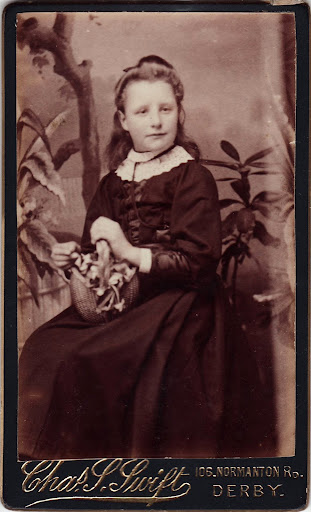
Lucy Mary Payne (1876-1953), aged about 14
Taken c. 1890-1891
Carte de visite by Chas. S. Swift of 106, Normanton Rd. Derby
Photograph collection of Barbara Ellison

This carte de visite portrait by Charles S. Swift of 105 Normanton Road, Derby (Studio Location) was probably taken in 1890 or 1891, and shows Lucy Mary Payne when she was about fourteen years old. It's the earliest image that I have of her, although there are a further nine portraits and portrait groups (Collection: The Daughters of Henry Payne) taken at irregular intervals throughout the rest of her life.

Although I can't be certain of the exact date, Charles Swift had certainly opened his Normanton Road studio by the time of the compilation of the 1891 edition of Kelly's trade directory - perhaps in late 1890 - having previously worked for his brother William E. Swift in the latter's studio at 30 St. Peter's Street, Derby. William sold his studio to R.K. Peacock and moved to Skegness some time after 1887. The rather crudely painted canvas backdrop used is the same one that can be seen in another of Swift's photographs (Image), and likewise the photographer has inadvertently included some of the rucked up right-hand edge in the photo. His later photographs showed a little more skill, a reason to suspect that the portrait of Lucy Mary was taken early on during his professional career.

Image © The National Archives and courtesy of Ancestry
1891 Census: 38 St James Rd, New Normanton DBY
NA Ref. RG12/2739/99/18/106
Image © The National Archives and courtesy of Ancestry

In the 1891 Census, shown in the enumerator's sheet above, Lucy Mary is fourteen, and it seems likely that she visited Swift's studio at around this time. Her father described himself as Vaccination Officer (a position to which he had been appointed by the Derby Board of Guardians in 1885), Rent Collector (presumably for the houses which he had been building, but perhaps on behalf of other property owners too) and "Off Beer Licence Holder." His eldest son Charles Vincent (my grandfather), by then aged 23 and working as a joiner/carriage finisher at the Midland Railway works, had moved out and was boarding with a family nearby in Pear Tree Street. The second son Charles Hallam had also left home by then, but had moved significantly further afield. He too had entered the building trade, but had travelled to the United States in late 1890 and was successful in finding employment as a carpenter at the Pullman Car Company railway carriage works in Chicago (Illinois).

Image © and collection of Brett Payne
Envelope addressed to C.H. Payne, Box 165, Roseland, Chicago, America
Stamped & Postmarked Normanton & Derby 12 Jan '91
and Roseland & Chicago ?26 Jan 1891 on front and reverse
Collection of Brett Payne

In my collection of family papers is an envelope addressed to Hallam in Chicago, stamped and franked at Normanton and Derby Post Offices with the date 12 January 1891. Inside the envelope are letters to Hallam from his father and from his three sisters Maggie, Lily and Helen.

Image © and collection of Brett Payne
Letter from Henry Payne to his son Charles Hallam in Chicago,
dated 12 January 1891 at Derby
Collection of Brett Payne

In his letter, Henry thanks Hallam for his recent letter accompanied by a "book of Pulman," a large format bound collection of mounted prints depicting Pullman's developments in southern suburbs of Chicago, which has fortunately survived in the family archives. He describes the effects of the severe winter on employment in Derby and relates a couple of anecdotes which provides some insight into the family's day-to-day life in Derby.
We are having awfully cold weather here now for the last six weeks. Many are out of employ. I saw your old friend Smith otherwise Carbo, to day. He, with others had been discharged from [Midland Railway] Signal dept. at Christmas, and is now walking about. Out door work is completely at a standstill on account of the severe weather ... The youngsters are giving you a history of their Switchback slide running across the green from top corner of Crewe St. to half way down St. James's Rd. The lads have had splendid up & down sliding or as they call it Switchback ... Your mother desires me to tell you to be sure and be a good lad & save your money. She occasionally fills a plate at meal times forgetting there is one short at table, but Fred says it don't matter he can manage it ...
The letters from Hallam's sisters are charming, although pretty much what you would expect from a fourteen, eight and seven year-old, respectively, with those of the two younger characterised by rounded, shaky handwriting and a few spelling mistakes.

Image © and collection of Brett Payne Image © and collection of Brett Payne
Letter from Lucy Mary Payne to her brother Charles Hallam in Chicago,
dated 23 December 1890 at Derby
Collection of Brett Payne

Maggie writes:
Dear Hallam
I wish you manny [sic] happy returns of your Birthday, all of us do if they had not time to say so in their letters. We are going to have a little entertainment. We have all sent a few cards to you. I send you my Photo. Ma says when you have half an hour to spare pop across & put hinge on Table door. It wont take long. We often look at the time & think what time it is with you. The snow is coming down fast. Ma & Pa went to our entertainment last Friday & left Frank to serve beer, just fancy. I played a duet. With love from Maggie.
How exciting to find in there the reference, "I send you my Photo." Could she be referring to the photograph of her featured above, now in my aunt's collection? I think it very likely. Hallam was, according to my father, an inveterate hoarder and almost certainly would have brought back to England such letters and photographs when he returned home in November 1892. My grandfather inherited all of Uncle Hallam's family photos when he died in 1960, and they were subsequently passed on to my aunt a decade and a half later. Even if this is not the exact portrait, I think we can safely say that this is more or less how she would have looked at the time she wrote the letter.

Image © and courtesy of Barbara Ellison
Charles Hallam Payne (1870-1960), aged about 20
Possibly taken c. 1890-1892 in Chicago
Tintype by an unknown photographer
Photograph collection of Barbara Ellison

I don't have any portraits of Charles Hallam Payne that I can categorically state were taken during his brief stay in Chicago, from late 1890 until November 1892, but I believe this tintype to be a very likely candidate. Unfortunately it is slightly out of focus, roughly trimmed, has experienced some darkening and loss of contrast, and the lacquer used to coat the image now has a honeycomb of fine cracks, but it still gives a good impression of Hallam as a young man. As referred to in Maggie's latter, Hallam turned twenty on Boxing Day 1890, and he looks to be about that age in this photograph. In the last decade of the nineteenth century tintypes of this size were far more commonly used in the United States than in England. In fact, of only two other tintypes of similar vintage in our family collection, one is of my grandfather Charles Leslie Lionel Payne in a baby carriage, which I am fairly certain was taken in late 1892, also in Chicago.

While this investigation is by no means complete - I expect to continue finding more snippets relating to Lucy Mary's childhood in the years to come - I am starting to build a mental picture, not only of her but of the family and their life at that time.

I can envisage Henrietta getting the four youngest children ready for school each day, and them heading off on the journey which would only have taken them a couple of minutes, as the school was situated diagonally opposite their house, and the gates were just a few yards up Hastings Street. I can imagine the enormous amount of fun that she and her brothers would have had playing in the snow after school had finished for the day, making tracks to slide on when it all turned to ice, not to mention the pile of dripping and muddy clothes that Henrietta would have had to deal with when they got home.

I can easily see her sitting down reluctantly with her two younger sisters, each clutching identical single pieces of notepaper, two days before Christmas, after having been nagged by their mother. Then I imagine them wondering aloud what they could write that might be of the remotest interest to their older brother, who had set off a few months earlier on an exciting adventure across the seas. They were perhaps sitting at the same kitchen table in the St James' Road house where, a few minutes earlier, Henrietta had distractedly served an extra plate of food for an her absent son, which was then wolfed down eagerly by an ever hungry eleven year-old boy. Since my own pre-teenage daughter is learning to play the piano and also performs at concerts two or three times a year, the entertainment referred to by Maggie is another facet of their lives that I have no difficulty in bringing to mind.

To me, the photograph is what brings it all to life, and the family photo collection therefore is the most important part of the material heritage I have received and which I will pass on to the next family historian in due course.
Join my blog network
on Facebook