Showing posts with label frames. Show all posts

Monday, 18 February 2013

Portraits in Sepia ... and Charcoal

Joan Hill has a blog Roots'n'Leaves through which she shares memories, family history, and of course old photographs, many of which form part of her regular contributions to Sepia Saturday. Joan recently sent me some images of an old photographic portrait, framed and mounted behind glass. She was wondering whether the subject could be her great-grandfather, and was therefore looking for an approximate date that it could have been taken.

Image © and courtesy of Joan Hill

The frame is a fairly typical moulded and painted papier-mache on wood frame, common in the latter part of the 19th Century. The moulding appears to have worn or broken off on the two lower corners, revealing the plain wooden base underneath, again not unusual for a frame of that age and quality.

Image © and courtesy of Joan Hill

Joan was able to remove the picture from the frame, but at 16" x 20" (400 x 500mm) it was too large to fit on her scanner so she photographed it. She also noticed an unusual feature of the photograph:
I was surprised when I took the picture out of the frame; it appeared to have a charcoal overlay on all of the dark surfaces. (When my finger tips brushed the edge of the picture, there was a dark residue and the picture actually felt like charcoal.) Was this charcoal overlay a style? If so, about when was this popular? There is a halo effect around [the head], but that is created primarily by how the "charcoal" was applied.
The portrait is of a style quite commonly produced in the late 19th and early 20th Century. I believe it was originally a photographic portrait, almost certainly with a camera which used glass plate negatives (probably 4" x 6"), but then enlarged roughly by a factor of four to produce the print which you now have in your possession.

One of the side effects of such enlargements from smaller negatives is that any blemishes or imperfections in the original, including a lack of contrast between light and dark shades, would be enlarged and/or enhanced in appearance. As a result, such enlargements were often retouched or embellished in a variety of ways. In some cases the customer might even have requested, for example, a special colouring of the portrait, whatever the quality of the black & white or sepia version.

These effects were achieved using pencil, charcoal, pastels, water colours or oil paints, and I've discussed a number of examples of retouched or otherwise modified portraits previously on Photo-Sleuth:


Sometimes the retouching was so extensive that little was left of the original photograph. Usually the medium used for the retouching would later be "fixed," but in this case that does not seem to have happened, perhaps because it was to be mounted immediately under glass. Besides, they wouldn't have had access to the wide variety of fixatives that are available today.

As far as a date is concerned, it is difficult to be very precise, but I estimate from the style of portrait and the man's clothing that it was taken in the mid- to late 1880s or early 1890s. Part of the reason for my uncertainty is that this particular style of enlargement/retouching with charcoal was a good deal more common in North America (particularly the United States) than in England.

Saturday, 26 May 2012

Sepia Saturday 127: Everyday life in Victorian photos


I haven't got off to a very good start with my return to Sepia Saturday, having missed last week's edition, but hopefully I'll manage to submit this week's in time. Alan's choice of image prompt depicts a vibrant, busy market scene at Ballybricken Green in Waterford. The photograph was taken by A.H. Poole in 1910, and is full of people, animals and character.

Image © and collection of Brett Payne

My own contributions this week are a carte de visite and two other mounted photos of similar size, but trimmed. All three are from an album that I purchased a few years ago on eBay. The carte de visite shows a man in working clothes, sturdy leather shoes and peaked cap in the act of filling a metal bucket with water from what appears to be a hand pump encased in wood, set against a brick wall. The pump looks to be fairly new - at least the casing's been freshly painted. The man's clothing is obviously not his Sunday best, and the brick wall looks somewhat decrepit.

With no photographer's details or an inscription to identify the subject, it's a little difficult to date, but I estimate it was probably taken in the late 1890s or early 1900s, a decade or so prior to Waterford market scene. I've chosen it for today's post because, even if posed, it represents something not often seen in family photos from this period, an accurate, natural and matter of fact depiction of everyday life.

Image © and collection of Brett Payne

The other two photographs have been trimmed to roughly CDV size, presumably to fit in the album slots. One shows a young man, again in trousers, shirtsleeves, waistcoat, leather shoes and flat cap, standing outside a stable, with a horse poking its head out. The walls of the very high-ceilinged stable look in substantially better trim than the wall seen in the first photo. There is a water trough made from a wooden barrel at lower left, with a tap for refilling it, and a cast iron grating - presumably a drain cover - can be seen at lower right.

Again there are no identifying marks to indicate the location or the name of either the photographer, the young man - or the horse, for that matter.

Image © and collection of Brett Payne

The third photograph is a silver gelatin print mounted on grey card with a slight fabric "grain" on the reverse, and was possibly taken some years later, although it is difficult to be more specific. It depicts a man, perhaps middle-aged, with a rather splendid white moustache, apparently interrupted while gathering in the hay. He is dressed, once again, in working clothes, but this time wearing a wide-brimmed fedora-style felt hat and carring a two-tined pitchfork.

Image © and collection of Brett Payne

The man stands in a field bordered by stone walls, and in the background a rural scene and collection of houses can be seen.

Image © and collection of Brett Payne

At the time I purchased the album, the only clue to its contents was an inscription in the front. There was not a single inscription on the photos themselves, or any annotations on the album pages. However, a good proportion of the portraits in the album were by Derbyshire studio photographers - indeed, that is what attracted me to the album in the first place.

Image © and collection of Brett Payne
Allestree
August 25th 1894
In Rememberance of past Kindness,
With Best Wishes from
Henry Mitchell
I had little success in tracing Henry Mitchell - it was just too common a name to be sure I had the right one. However, in February 2007 I posted images of several of the portraits by Derbyshire studios in the respective profiles on my Derbyshire photographers web site, including a CDV and cabinet card by W.N. Statham of Matlock Bridge. Some time later, I was very excited to hear from Marilyn McMillan and Betty Jane Rotteau, from Ontario and British Columbia respectively, who had identified some of the individuals in these portraits.

Image © & courtesy of Marilyn McMillan
Henry and Ann Jane Statham
Image © & courtesy of Marilyn McMillan

Actually, an enlarged, coloured and framed version of one of the portraits, depicting her great-grandparents Henry and Ann Jane Statham, hangs on the wall of Marilyn's home, so there could be no doubt whatsoever about the identification.

Image © & collection of Brett PayneImage © & collection of Brett Payne
Henry and Ann Jane Statham

I wrote an article about this exciting discovery here on Photo-Sleuth in February 2008. Apart from the information sent to me by Marilyn, I had done some of my own research into the family, because it turned out that not only were they closely related to the photographer W.N. Statham, but there was also a distant connection with my own family - one of the Statham photographers married my grandfather's sister-in-law, Jessie Louisa Hogg. However, I still had been unable to discover any links to a "Henry Mitchell."

Image © 2012 Brett Payne
Statham family of Matlock
Click image for a larger version

Then, in January last year (2011) Betty Jane Rotteau emailed me with details of a break through:
Just to give you a bit of our Statham ancestry to help make sense of this. Isaac Statham married Sarah Carline and they had 6 children who lived to adulthood. Isaac married in 1873, Henry was our gr-grandfather who you know about, Louisa and Caroline never married but lived together their whole lives, William was with Louisa & Caroline until 1911. I am still looking for a marriage and/or death for him. Then there was Clarissa. She married Henry Mitchell in 1882 and they had 3 children. I think this is the Henry who wrote the above message. From what I can figure Allestree was near Derby at that time, whether this is where Henry & Clarissa were living I don't know for sure. During the 1891 and 1901 census Henry, Clarissa and family were living in Derby area, Quarn Street and Elm Street. Their children's birth were all registered in Derby.

View Larger Map

Both Quarn Street and Elms Street are just off Kedleston Road, in a north-western suburb of Derby. In fact, both addresses are now shown as part of the same cul-de-sac, the road system having been modified somewhat over the last century or so. It is not too far from present day Allestree, which nowadays is really just another suburb of Greater Derby, although separated from it by the A38 motorway.

Image © and courtesy of Ordnance Survey
Masson Farm, near Matlock, Derbyshire
from Ordnance Survey One-Inch Map, Buxton and Matlock, 1947

My immediate thought was that Henry Mitchell could have been giving the album to his parents-in-law, but of course Sarah Statham was dead by that time. Isaac Statham died at Masson Farm, Matlock on 13 November 1894, less than three months after the inscription was made, and by 1901 the three remaining single children were all living at Masson Farm. Betty had an idea:
This just raises more questions. I wonder who Henry was referring to when he wrote his message. Could it have been a message to his sister-in-laws, Louisa and Caroline who took care of their father until he passed away in November, 1894.
I think it's quite possible that Henry gave the album to either Isaac Statham senior or Caroline and Louise, but most likely to his sisters-in-law. When Caroline died in 1931, the executors of her will were Frederick Lewis Mitchell and Edward Mitchell, the two sons of Henry and Clarissa. It seems very likely that either they or their sister Clarissa Zenobia, by then married to Thomas Hayes, inherited the album, perhaps along with other family effects.

That is, of course, just a wild theory. However, it would explain how photographs from Loughborough and Leicester found their way into the album, since I note that in the census records Henry Mitchell states that he was born in Loughborough. Most of the photographs are from Matlock, Matlock Bath, Chesterfield and Derby. It is important to note that there are many portraits which were taken well before the album was purchased and inscribed in 1894, so they must have been inserted afterwards. It is tempting to theorise that many of the older Derbyshire portraits could be of other members of the Statham family.

Image © and courtesy of Google Earth Streetview
View from Salter's Lane, Masson Farm, near Matlock
Image © and courtesy of Google Earth Streetview

I am also intrigued by the possibility that the portraits of the man by the water pump, the horse hand, and the haymaker could all have been taken at or near Masson Farm. It's possible that all three may be the same man, Henry Mitchell's brother-in-law William Statham (1864-1944).

Image © and courtesy of Chris Statham
William Nathan Statham (1863-1940)
Image © and courtesy of Chris Statham

In May last year Chris Statham, grandson and great-grandson respectively of photographers Percival "Percy" Joseph Statham (1894-1977) and William Nathan Statham (1863-1940), was in touch with me. Subsequent emails have revealed that he has in his possession the family photo album of Abanathan "Nathan" Daffin Statham (1823-1874). Among other interesting items of information about W.N. Statham's career, Chris also sent this imposing portrait of the photographer in his Freemason's regalia. I am most intrigued, and the next step will be to ascertain whether any of the people who appear in the "Mitchell/Allestree" album also appear in the "Abanathan" album. In particular, my primary task will be to identify the man/men in the three farm portraits.

The other contributions for Sepia Saturday this week may not have chosen a similar theme to mine, but you can sure they will be well worth a visit.

Tuesday, 5 July 2011

In Death They Were Divided

Diana Burns sent me scans of three photos from her own collection asking if I had an "Oddities and Curiosities" folder containing some further examples of a similar ilk.

Image © and courtesy of Diana Burns

Diana writes: "The mounting is of the type I associate with daguerreotypes but it appears to be a carte de visite cut in two, with the remains of the sitter's female companion's dress still clearly visible. The motive for editing rather than destruction is not clear, although it may have been the cost of photos that caused the sitter to retain his own image."

I note the manner in which the photograph has been cut, leaving all extremities of the bearded man intact, rather than stright down the middle, retaining as much as possible of both people in the two halves. This suggests to me that the purpose was not make two portraits out of one, but to remove the left hand subject - who, judging from the clothing, must be a woman - from the portrait while keeping the right-hand subject whole.

This type of leatherette-covered wooden case, complete with brass "finisher," cover glass and pinchbeck surround, was indeed used for daguerreotype and ambrotype portraits, and often hinged with a velvet lined cover. However, this particular one is probably of a slightly later date - at least the late 1850s or 1860s, but possibly later - and the hanging ring just visible at the top shows that it never had a cover. Travelling photographers often used these cheap cases to house ambrotypes and tintypes, even as late as the 1890s - see this example from the 1890s which has come adrift from its case but still retains the pinchbeck surround. The small size of carte de visite portraits didn't render them ideal for framing, but I have occasionally come across them displayed in that manner. In this case, I believe someone has rather crudely inserted the remains of the cdv into a frame which originally contained some other portrait.

Image © and courtesy of Diana Burns

In the same genre, I have a photo of my husband's aunt, cut off for all eternity from (presumably) her spouse by a series of razor blade strokes (my late father-in-law is the prime suspect).

Image © and courtesy of Diana Burns

In the third example, which is a contact print made from a glass negative, someone (perhaps a child or an early animal rights activist) has crudely scratched out the face of the fur-loving woman from the negative. Nowadays, photos of detested acquaintances are likely to be simply deleted before ever seeing the light of day, but I was intrigued by the censorship methods employed by earlier generations.

I have seen many such photographs, although not from my own family collection, thank goodness. The more recent ones are often accompanied by interesting oral traditions; sadly the relevance of the excision in the older ones is usually lost.

Image © and courtesy of Nigel Aspdin

Nigel Aspdin has an early carte de visite portrait of a large family group (click image for a larger version) by Derby photographer J. Burton & Sons, which has a similar mutilation of the face of a central seated gentleman. Since the group itself is as yet unidentified, the reason for the clearly purposeful excision of said gentleman can only be guessed at.


This particular paper print by a street photographer in Lowestoft appears to have survived unscathed, although it, too, was unwanted. As recounted in a previous Photo-Sleuth post, the former owner devised a different, but equally effective, and possibly more satisfying, innovative solution for getting rid of photographs of detested relatives. He sells them on eBay, creating, I suppose, the potential for a new genre for which someone will eventually - if they haven't already - create a Flickr group: Unadoptable Orphan Photos.

Many thanks to Diana for both the images and the idea for this article.

Wednesday, 27 April 2011

A Hoby print revisited


Composite portrait of the Hoby family, New Plymouth, c.1866
Image courtesy of Philip Duke

In part 5 of my biographical sketch of George Hoby, photographer of New Plymouth and Nelson, I included this image of a composite photograph of the Hoby family, taken around 1866. It was sent to me by Hoby descendant Philip Duke, who told me that it was scanned from an original at the Puke Ariki Museum in New Plymouth.


Taranaki Museum photo index card with "Hoby composite portrait"
Image courtesy of Puke Ariki

I subsequently received a series of images from Kate Boocock, Pictorial Technician at Puke Ariki. The first image, taken from "file card drawers in the research centre," appears to be a Taranaki Museum (succeeded by Puke Ariki in 2003) photo index card with a very similar version of the "Hoby composite image" either printed on or affixed to it. Handwritten in the relevant spaces on the card are a File Number P.2.1436, Negative Number LN 672, the names of the subjects in each of the cameo frames, the number E.C.385 and a note "storage album 2, pg 37." The final note may refer to the location of an "original," but of course this location reference may no longer be valid.


Mounted photographic print of "Hoby composite portrait"
Image courtesy of Puke Ariki

Of much greater interest was a scan of "a black and white copy photograph, mounted on card that was on display in the old Taranaki Museum." I have made the following observations:
- the buff-coloured card mount measures approx. 234 x 296 mm
- the b&w photographic print, slightly smaller than the mount, measures approx. 231 x 293 mm, has three small pin holes at top right, top left and bottom centre, and slight flaking damage to the photographic emulsion at edges and corners
- part of a white rectangular passe-partout frame with rounded corners is visible, internal dimensions approx. 199 x 265 mm
- series of 10 elliptical-shaped cut-out vignetted head-and-shoulders portraits (each approx. 57 x 73 mm) arranged in 2-3-2-3 pattern, and overlapping from bottom to top, on a darker background


Edge of "Hoby composite portrait" frame, compared with typical 1850s/1860s ambrotype frame

The passé partout frame appears to be very similar in design to those sometimes used for ambrotype (collodion positive) photographs in the 1850s and 1860s (example here), probably somewhat more expensive than the standard wooden cases lined with velvet, with the glass positive image mounted behind a brass matt and pinchbeck surround (example here).

The largest format glass plate negative in general use during the 1860s was the full plate, measuring a standard 6½" x 8½" (or 165 x 216 mm). Since the internal dimensions of the frame visible in the photographic print are substantially larger than this, the print is most likely to have been an enlargement. This fact, in combination with the appearance of the photographic emulsion, suggests to me that the print was made some time later than the original composite was produced. It is possible that it was produced when the Taranaki Museum either acquired the original, or had it on loan, perhaps from a family member. The appearance of light and dark patches within the darker background may be due to reflections from a glass behind which the original was mounted.


Detail of "Hoby composite portrait" print
Image courtesy of Puke Ariki

The overlapping nature of the vignetted cameo portraits, as well as the appearance of shadows at the edges of the cameos (see detail above) suggests that the individual head-and-shoulders portraits were originally printed separately using the vignetting techniques that Hoby displayed in other portraits (see Hoby Part 4). They were then cut out and arranged on a plain, darker backgroundbefore being mounted behind glass and in the ambrotype-style frame.


Reverse of "Hoby composite portrait" print card mount
Image courtesy of Puke Ariki

The reverse of the card mount shows a series of label remnants, inscriptions and annotations, obviously created at different times and by a variety of hands, as follows (and not necessarily in the order they were created).
(1) The remnants of a rectangular label are visible close to the top of the mount, its approximate original extent visible from the
(2) What may be the earliest extant inscription is handwritten in pencil:
Mr + Mrs Geo Hoby + family
Mr + Mrs H + the elder members
of family arrived in N.P. from
London, of which they were citizens,
by the "Fatima" in 1851.
The names of family starting from
second row from top + from left to right
Oliver, Amy (Mrs Keeling), George
Clara (Mrs Merridge) Lilla,
Arthur, Percy, Hubert
(3) Handwritten in pencil at the top, probably in several different hands, different again from that of (2) above, is the text "EARLY SETTLERS: groups and reference numbers, "P2/1436" and "LN 672."
(4) Handwritten in black ink, possibly felt tip, at top right, is the number "25."
(5) The list of subjects has been re-written, by a different hand, in black ink.
(6) The reference number E.C. 385, handwritten in black ink, has been added.
(7) A purple stamp, "TARANAKI MUSEUM," is at the bottom of the mount.
(8) A number, possibly "26," is handwritten in black ink close to the bottom edge of the mount, appearing to have been crossed out in slightly different black or brown ink.
(9) A thin, irregularly trimmed rectangle of white paper, measuring roughly 289 x 129 mm and with typewritten text (image above), has been glued by its left hand edge to the back of the card mount. The text - relating to George Hoby junior rather than his father, who died in 1882 - reads as follows:
MR G. HOBY AND FAMILY Page 49 Obituaries
He died on the 4th October, 1927.
The death of Mr. G. Hoby, one of the oldest settlers in the Bell Block, occured in the N.P. Hospital yesterday. Mr. Hoby was in his 85th year. He was one of the earliest settlers in Bell Block and there he had his schooling. As youn g man he found himself in the thick of the Maori War. he immediately joined Captain Deveaux's Mounted Corps and served with it from 1861-1866. Mr. Hoby went right through the Maori War, taking an active part in the famous battle of Waireka.
Trooper Hoby gained the reputation of being one of the most daring fighters in the district. He flirted with danger.
After the way, he continued his military duties, being Captain of the Volunteer Corps at Bell Block for some years after Captain Cornwall had retired. Later in life he carried on a contracting firm and then a land commission business. he was a good type of settler, a fine, hard-working man in his prime, and straight in his dealings. he married Miss H. Chapman whose parent emigrated from England, and who predeceased him by about two years. Mr Hoby leaves eight children, Mrs G.E. Grover (Fitzroy), Mts Motteram (Opotiki) Mrs Wood (Whareroa), Mrs Somerville (Okoia), Mrs Addenbrooke (Ngaere), and Messrs G. Hoby (Nelson), P. Hoby (Tataraimaka), and R. Hoby (Bell Block). Another son Stanley, was killed in the Great War.
Not being familiar with the Taranaki Museum and Puke Ariki cataloguing and refencing systems and practices, I can't comment on the several numbers present, except to say that several different number sequences may have been employed over the years. The handwritten number "26" (8) appears to have been partly truncated, which may indicate that the mount has been trimmed at some stage. The pin holes are probably a relict of its being used for display purposes in the old Taranaki Museum.

Conclusions

An anlaysis of a scan of the mounted photographic print of the "Hoby composite portrait" provided by Puke Ariki has revealed that it is a later copy of a pre-existing composite portrait. The mounted copy print appears to have been produced (possibly by Puke Ariki's predecessor, the Taranaki Museum) by photographing either the framed print or a print of that. The "original" may have been constructed by George Hoby senior himself, by photographing and printing portraits of the family members, cutting out the cameos, and mounting them on a darker background, probably under glass, and then within an ambrotype-style frame. What has happened to that "original" is another matter altogether, perhaps best left to Hoby descendants to pursue if they wish. It may well not have survived, which makes the documentation of this print, possibly the best surviving copy, all the more important.

Treatment of the Photograph as an Artefact

Researching this article has been a timely reminder - to myself as much as I hope it will be to the readers of Photo-Sleuth - that thorough examination and analysis of a photograph as a physical object, or artefact, is often just as important as are discussions about the photographer/originator or the subjects. Such a description will provide a firm base on which all future work can be done, and an analysis will often provide very useful clues regarding provenance, photographers, dates and subjects featured in the photograph. To conduct these examinations, it's obviously best to have the artefact in your hand, suitably gloved, or many details and subtleties may be lost. However, when this is not possible much can be deduced from digital scans, provided they are done properly.

I don't intend to provide an exhaustive list of scanning Dos and Don'ts (perhaps in a later article), but these are the most important things to keep in mind. To produce useful, I strongly recommend that the user familiarise his/herself with the scanner control software, and that the scanning operations be carried out from within the software, rather than using the buttons on the scanner. It just isn't possible to manipulate the scanner parameters when using the scanner buttons.

  • Scan in full 24-bit (or 48-bit) colour, even if the photograph itself is black and white.
  • Always include the full extent of the print, mount and any enclosing folders.
  • Scan the reverse as well, even if there are no obvious marks or inscriptions.
  • Scan at the highest resolution (optical, not interpolated) the scanner can manage; a minimum resolution 300dpi is just acceptable, 600dpi better, but 1200dpi is best. Note that the smaller the original, the larger resolution you need to use to capture detail.
  • Save all files in TIF format, and optionally in JPG format at the same time, although you can easily convert them subsequently.
  • Number and file the scans meaningfully.
Acknowledgements
Many thanks to Kate Boocock of Puke Ariki and Philip Duke for their assistance in this project.
Saturday, 29 November 2008

Two framed ambrotypes from Yorkshire

One of the ways in which a photographic studio could "add value" to its products was to offer an enlargement and framing service, and all but the smallest or most itinerant of operations tended to do this. The most basic type of framing in the early days, for daguerreotypes and ambrotypes, was an embossed leather- or papier mache-covered and silk- or velvet-lined rectangular wooden or thermoplastic case, which served the dual purpose of protecting the delicate images, examples of which are relatively common. If the portrait was wanted for display purposes, however, an alternative option was to have it mounted behind glass with a mat and frame, in much the same way as painted portraits were done.

Image © and courtesy of Brenda Croome

Brenda Croome recently sent me two images of framed ambrotypes of family members, with the following explanation:
I went north in October, and visited an old lady of 89 who is the great-grand-daughter of Christopher Richardson, my great-grandfather Thomas's brother. She very kindly gave me two photographs of two of Thomas and Christophers' sisters. The eldest girl is Mary Ann Esther Richardson born 1844, and her sister is Eliza Richardson 1847/1852. They were born in Neasham, Yorkshire, near to Darlington, their father was a shoemaker. I know very little about early photography - except that I seem to recall that daguerrotypes were very expensive, so for the rich!

I have taken the back off one of them and found:- Looking at the photos from the front, there is a glass covering, behind that the white and gilded mount. Behind that a coloured glass plate (with blue poorly fixed powdery substance, which came away on a cotton bud). Behind that a loose piece of almost black velvet, and laid on this loose piece of velvet at the bottom edge, about 1\3" thick, a roll of velvet - this holds the bottom of the glass negative just off the loose piece of velvet. Behind that a piece of card. The whole inner part pinned to the frame with ½" nails with extremely small heads.

The only other method of photography in about 1848 I have heard vaguely of is the process known as albumin negatives. Would there have been a photographic studio in Darlington at such an early date? Or would there have been travelling photographers? These are the earliest photographs I have and I would be thrilled to learn more about them.
Image © and courtesy of Brenda Croome

After I had cautioned Brenda about the danger of dismantling ambrotypes and daguerreotypes, she assured me "that I only took the cotton bud to the extreme edge of the glass plate, to see if the 'blue' was fixed. The whole process of taking the picture apart frightened me hugely!

Image © and courtesy of Brenda CroomeImage © and courtesy of Brenda Croome

They are, in fact, ambrotypes, which succeeded daguerreotypes and were considerably cheaper. The wet plate collodion positive process was invented in 1851 by Frederick Scott Archer, and became very popular for portraiture in a short space of time, so that by the mid-1850s, it had all but supplanted the daguerreotype. As it required little skill and a much lower cost to set up and produce ambrotypes, this continued to be the method of choice for almost a decade, until the even cheaper tintypes, paper prints and cardboard-backed carte de visites took over in the early 1860s.

The photograph was printed as a negative on the inside of the glass, and the black velvet backing then had the effect of turning this into a "positive" image. The coloured plate was used to impart colours to the image, as trying to colour the image itself would have destroyed the collodion. The whole set-up was then usually encased in a box similar to those previously used for daguerreotypes, although framed examples with white and gilt matts such as these are fairly common. A further development of the collodion positive process resulted in the ferro-type, commonly referred to as a tin-type. In this method the collodion was coated onto a thin sheet of black-enamelled, or "japanned," iron, and often covered with clear varnish, thus rendering them more durable than the ambrotypes that they replaced. Being more robust meant that they did not need cases, and could be sold "as is," in cardboard and/or paper frames, or presented in specially designed gem tin-type albums.

Image © and courtesy of Brenda CroomeImage © and courtesy of Brenda Croome

Being ambrotypes, Brenda's two portraits were indeed affordable to many everyday folk of the period, although would still, I suspect, have been quite a significant expense to the family of a shoemaker. The younger child appears to be about two years old, the older one perhaps four. I estimate that they were taken in the early to mid-1850s, say between 1853 and 1856, and the mounts and frames appear to be contemporary with the photographic images. The portraits both have the same toy in the left hand foreground, a wheeled horse with a missing head. This suggests to me that they were taken on the same occasion, and that one should therefore be looking for two children, aged about two years apart, who were born c.1849-1852 and c.1851-1854, respectively.

These dates don't really quite fit with the birth dates of Brenda's Mary Ann Esther and Eliza Richardson. I found them on the 1851 Census, living with their parents, Robert & Ann Richardson in the village of Neasham, County Durham, and numerous siblings, although by the time of the 1861 Census, Mary Ann was working as a servant and Eliza was nowhere to be found. I presume that she had died in 1852. I think it very unlikely, therefore, that the two children are Mary Ann and Eliza as identified by Brenda's relative, and would suggest looking for other members of the family who they might have been.

There were almost certainly photographic studios in Darlington by the mid- to late 1850s, although they may have been operated on a temporary basis by photographers visiting from larger towns. Alternatively, family members may have travelled to a larger town and had their portrait taken there.

More from Brenda:
There is ... a problem. With one, not very likely, exception, there are absolutely no other children who could fit that time frame. If the photograph was taken mid-1851, there is one other child born who could fit. This was William born 22 May 1849, the younger brother of the two girls, so Eliza would have been 5, and William 2 years and some months. Can the younger of the children be seen as a boy? It doesn't seem likely, why is 'he' wearing a frock. There would have been 'hand-me-downs' from the three elder sons.
Young boys and were commonly dressed in very similar, if not identical, clothes in this era, in particular dresses, and boys were often only "breeched," i.e. fitted with trousers, when they were 6 to 10 years old. One can sometimes tell from the position of the parting in the hair (central for girls, or side for boys) whether a child was a boy or girl, but this is by no means a fool-proof method.

Image © and courtesy of Brenda Croome

I'd prefer to leave further interpretation to Brenda, as so much of the investigative process depends on a detailed knowledge of the particular family. Out of interest, a close up image of the top left hand corner of one of the frames shows that it is made from wood with plaster embellishment. Roger Vaughan has an ambrotype of a couple and a small child with a very similar mat and frame, here.

For those readers who are interested in learning more about daguerreotypes, ambrotypes and the processes used to create them, I would like to strongly recommend The Birth of Photography: The Story of the formative years 1800-1900, by Brian Coe (publ. Spring Books, London, 1989, ISBN 0 600 56296 4). My copy was very kindly "rescued" and sent to me by Sylvia Rhodes. I have also put together a few links to online galleries of ambrotypes:

Friday, 14 November 2008

Ye Olde Ferncroft Inn, Middleton, Massachusetts

My friend Irene Savory sent me this image of a framed photograph that she recently acquired, asking for an approximate date.

Image © and courtesy of Irene Savory
We found the picture at a yard sale in Portsmouth, New Hampshire. They said the items were part of their great aunt's estate. The woman on the right is our grandmother. We are 98% sure unless she had a twin. The Ye Olde Ferncroft Inn was in Danvers, Massachusetts we think. Our grandmother lived in Lynn, Massachusetts. Danvers from Lynn is about 10 miles and probably 25 miles or so due south ... From all other photos of our grandmother, it certainly looks like the same person ... Can you tell us anything about when it was taken?
Image © and courtesy of Irene Savory

Responding to some questions about nature and dimensions of the frame and print, Irene sent a more detailed scan, and provided the following:
The frame is metal, even the back and the stand. It is 92 mm wide and 83 mm high to the top of the curve. If you measure along the straight side, it is 76 mm. The photo is 70 mm square. I think it is paper, rather than card. It has started to curl.
She also sent a couple of photographs of her grandmother, and some information about her life.

Image © and courtesy of Irene Savory

[My grandmother] Irene A. Lennon was born on 15 August 1891 in Lynn, Massachusetts to James F. Lennon and Mary Elizbeth Cunningham. She had three older sisters, all born in Lynn. [with whom she is shown in the photograph above, presumably taken in the late 1890s] They were Mildred M., born 8 February 1886; Lizzie, born 5 December 1887; and Mary Bridget, born 23 March 1890. Their mother died of acute fever on 7 August 1892, just a week before Irene's first birthday. James remarried and the girls were sent to convent school.
Image © and courtesy of Irene Savory

This photograph was taken in 1918, when Irene was aged 27.
Irene worked as an operative in the shoe industry, as did many members of her family and at least half of the city of Lynn. On 12 April 1913 she married Lionel Percy Pope in Lynn, where they resided until my mother was about two. They had three children, but only my mother survived. Paul died at age four of diptheria, Mary was stillborn, and my mother, who was born in 1925. They moved to Bradford/Haverhill when she was very young. Irene had rheumatoid arthritis which was so bad that she opted to have nerves cut to relieve the pain. From that point on she was totally bedridden.

My parents married during WWII, and my mother continued to live with her parents. After the war they moved to Kittery, Maine, where my father was working, taking Irene and Lionel with them. Irene died there in 1946.
I managed to track Irene through Federal Census records, using the indexed images available on the Ancestry subscription service. In 1900, she was with her sisters Mary and Elizabeth, wards of the City Orphan Asylum in Lafayette Street, Salem City, Massachusetts. I was unable to locate her in 1910, but in 1920, Lionel and Irene were in a lodging house at 26 Ireson Street, Lynn, and in 1930, they were living at 131 Colby Street, Haverhill - Irene, her husband Lionel, four year old daughter were there, together with Irene's unmarried sister Mary.

Back to the framed photograph. The frame itself is very definitely in the art deco style, which developed partly as a response to the forced austerity imposed by the Great War, and is unlikely to have been manufactured and sold prior to the 1920s.


The Ferncroft (or Fern Croft) Inn appears to have been in existence from the early 1900s until well after the Second World War, on a location where the Radisson Ferncroft hotel is now. I found images of several pre-Great War postcards itemised on eBay, ranging in date of use from 1906 to 1910.

It also turns out that the inn was a favourite watering hole for Boston politicians prior to the First World War, mentioned in relation to an event that happened in 1913 in this article from the Marshfield Mariner. An extract from The Lowell Sun dated 9 January 1915 (in the Newspaper Archive)describes one Henry K. Mansfield as the proprietor of the Ferncroft Inn. The book "Hidden History of the Boston Irish" by Peter F. Stevens (GoogleBooks) refers to the not so salubrious reputation of the Ferncroft during that era as "a saloon and gambling den on the Newburyport Turnpike. Cards, booze, sex - all could be had at the Ferncroft." On 9 May 1922, the New York Times reported the sale of the "famous New Croft Inn, on the Boston Post Road, New Rochelle," to a James Colville.

Of course, the photograph does not have to be contemporary with the frame, and could easily have been inserted by a previous owner at any time. My impression, however, is that it could easily have been taken in the 1920s or 1930s. The vertical stripes on the skirt of the young woman would also fit with this period between the wars. The style of the wooden building in the background, does not really fit with the photographs that I have seen of the Ferncroft Inn, and I suspect it is not the same one.

Image © and courtesy of Irene Savory

With regard to the likeness between the young woman in the Ferncroft Inn portrait and Irene Lennon Pope, I am always a little wary of such comparisons. I agree that their faces are very similar indeed, but if the Ferncroft Inn portrait was taken in the 1920s at the earliest, as I have suggested, Irene would then have been in her thirties. Although the image is not very clear, the young woman in the striped skirt, however, looks to me to be in her late teens.

Image © and courtesy of Irene Savory

Although I hesitate to provide a definitive answer on the date of the Ferncroft Inn photograph, my feeling is that it is from the 1920s, and that it is unlikely to include Irene's grandmother.

Monday, 20 August 2007

Ambrotypes - portraits for the middle class

Although photography had been "invented" by Louis Daguerre and William Henry Fox Talbot in the late 1830s, the daguerreotype remained expensive, and only affordable to the relatively wealthy, including the professional and political classes. With the introduction by Frederick Scott Archer of the glass negative process in 1851, and the ambrotype three years later, the cost was reduced considerably - they were available for between sixpence and a shilling - and photographic portraiture became easily accessible to the middle class. In contrast to daguerreotypes, which remain fairly rare, there are still many ambrotypes in existence in family collections, and you may well have one among your old family heirlooms. Although ambrotypes continued in occasional use until about 1880, they were most popular in the decade from 1855 until 1865, after which they were overtaken and superseded by the carte de visite.

The ambrotype was created by coating a glass plate with collodion and photosensitive silver nitrate. The plate was exposed in a camera, then quickly taken out and treated in a dark room with a developing solution to bring out the image. This produced a photographic negative which was then backed with something dark, such as dark felt or black varnish, which had the effect of inverting the image. It was then mounted and framed or cased, as had been the daguerreotype.


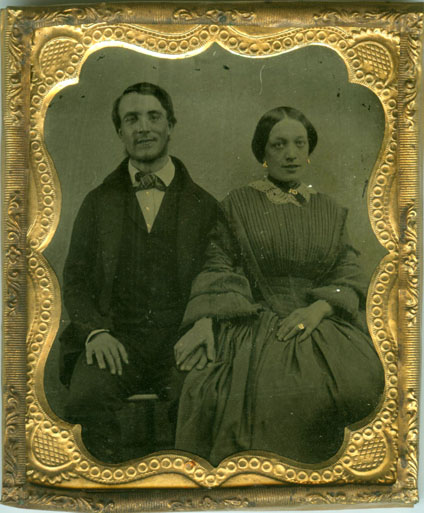
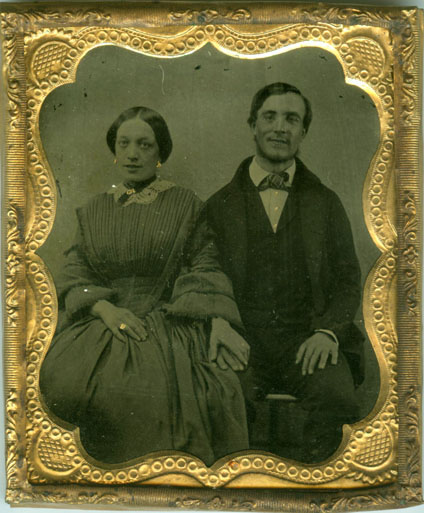
The ambrotype shown above is one from my own small collection. Unusually for Victorian portraits, both subjects are smiling, and she is grasping his hand quite firmly, which is what attracted me to it in the first instance. Unfortunately it has lost the frame or case in which it would have originally been mounted, but the the thin gilded, pressed metal, decorative frame is still present and in good condition. It shows the characteristic greyish appearance of an ambrotype - few of them have any of the lighter shades, and if you see lighter areas, it is wise to look for signs of touching up or that it may in fact be a cased tintype.

The three-quarter length portrait is of an unidentified seated couple, perhaps in their mid- to late 20s. I think they must be a recently married couple, because her wedding ring, earrings and the brooch at her neck, as well as his shirt buttons, have been highlighted with gold paint. It is interesting to note that the ring is on her left hand. As the ambrotype was a negative, the image would be reversed and ring should have been on her right hand. The photographer appears to have anticipated the problem, and perhaps instructed her to change the ring to the opposite hand and finger. As the enlarged and enhanced image below shows, however, she appears to also have a less prominent - and ungilded - ring on her "right" hand! The photographer's artist obviously took some liberties. The buttons on the gentleman's shirt and waistcoat give the game away, as they appear to be done up on the wrong side.


Typically for portraits from the mid- to late 1850s, they are seated side by side. This pose was not commonly used again in portraiture, except in the case of larger groups, and by some less experienced artists, until much later in the century. The woman's clothing (bell-shaped, layered and fringed sleeves, pleated bodice closed at the top with a gold brooch and trimmed with a lace collar, pointing downwards to a tightly corseted waist; a single full, ground-length skirt) and hair style (centrally parted, curved back down over the forehead to almost cover her ears, and drawn back to a bun on the back of her head) are indicative of the mid-1850s. The young man is wearing what appears to be a frock coat, simple dark waistcoat, and shirt with a turned over collar and rather untidily knotted bowtie. He has a slight Quaker-style chin-beard, with only a suggestion of a moustache, and hair parted on his "left"(right)-hand side.

I estimate that this was quite an early ambrotype, and probably dates from between 1854 and 1857. Nobody looks quite the same in the mirror - in other words, nobody has an absolutely symmetrical face. For the first time in a century and a half, we can now view the photo as it might have been printed more accurately, had the technology been available at the time.


References:
Dating Family Photos 1850-1920, by Lenore Frost, self publ. 1991, Essendon, Victoria, Australia.
Family Photographs 1860-1945, by Robert Pols, publ. 2002 by Public Record Office, London, England.
Join my blog network
on Facebook