Showing posts with label prices. Show all posts

Wednesday, 20 February 2013

Edward Smith of Derby: Enlargements and Portraits in Oil

Following on from a charcoal-embellished portrait discussed in the previous article on Photo-Sleuth, an further example of a photographic portrait embellished to a high degree would, I think, be instructive.

Image © and courtesy of Chris Underhill
Mary Ellen Storer (1873-1957) of 24 Talbot Street, Derby
Enlarged and coloured print by Edward Smith of Derby
Image © and courtesy of Chris Underhill

There is little evidence from the appearance of this potrait of a seven year-old girl, painted in oils on an oval piece of thick card measuring 182 x 231mm (slightly larger than 7" x 9"), that it is anything other than a simple oil painting. That is, except for the unpainted bits at the top and bottom of the oval which reveal the unexposed photographic emulsion on a thin paper print pasted to the card, and a hint of the girls clothing showing through the border of pale brown wash. The rough nature of this pale brown border suggests that it would have been mounted passe partout and framed behind glass.

Image © and courtesy of Chris Underhill
Reverse of print by Edward Smith of Bramble Street, Derby, dated 1881
Image © and courtesy of Chris Underhill

The back of the card, however, reveals a printed label (measuring 118 x 171mm) for the West-End Photographic Studio of Edward Smith:

WEST-END
PHOTOGRAPHIC STUDIO

Bramble Street, Curzon St., Derby
---------------------------------------------------
EDWARD SMITH,
PROPRIETOR.
---------------------------------------------------
CARTES-DE-VISTE 4s. PER DOZEN
Portraits for Lockets, Brooches, &c.
Cartes, Vignettes, Cabinet Portraits,
PORTRAITS IN OIL,

WATER COLORS, CRAYONS, &c.
Copying & Enlarging expeditiously and cheaply executed.
---------------------------------------------------
EDWARD SMITH,
PHOTOGRAPHIC STUDIO
BRAMBLE STREET, DERBY.

---------------------------------------------------
The Rowditch Buss runs by every Half-hour.

Simpson, Printer, St. Peter's Street, Derby.


Edward Smith was a former jeweller who operated a photographic studio from his home, first in Upper Brook Street, later Bramble Street, in Derby's West End, from 1861 until at least 1901. His entries in the 1871 and 1881 Censuses show him as an artist so, even though his photographic portraits tend to be competent rather than inspiring, it is not surprising to find an example of his advertised "portraits in oil," handily dated 1881, midway through his career. The photographic print on which the painted portrait is based would probably have been enlarged from a cabinet portrait format to roughly double the original size of the glass plate negative.

Apart from the photograph/painting, the advertisement on the label may also be used to illustrate the affordability of portraits to ordinary folk. He advertises cartes de visite at four shillings per dozen, and a single portrait could be had for a shilling. Given that the average weekly cash wage for the ordinary agricultural labour in England at this time was between 11 and 15 shillings, and that of a high end skilled industrial worker was 30 shillings, it was perhaps still something of a luxury, but was definitely affordable to a large majority of the population.

I make this point because I often come across the assertion by family historians that their ancestors were probably too poor to afford such luxuries as having their portraits taken in a photographic studio, used on occasion to explain an absence of such portraits from the family archives. From what I have read, both in contemporary and current literature, during the heyday of carte de visites in the late 1860s, 1870s and 1880s such portraits were well within the reach of most families.

Image © and collection of Brett Payne
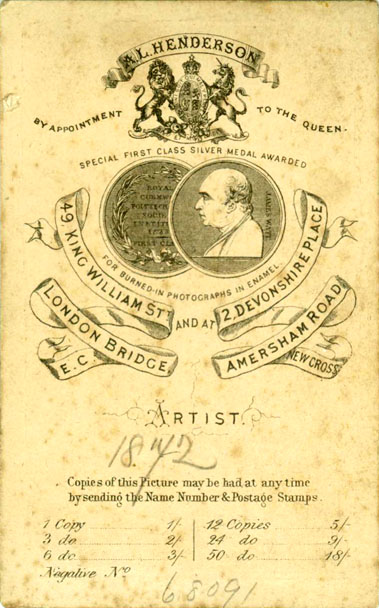
1872 carte de visite mount by A.L. Henderson of London

It is also informative to compare this advertised price with the 5s./doz from the well known and prolific A.L. Henderson of London in 1872, and a similar 5s./doz from F.W. Broadhead of Leicester in 1887. It seems likely that Smith catered for the lower to middle section of the market, perhaps one step above an itinerant photographer whose name might be absent from the card mount. Certainly his portraits do not have quite the professional finish that studios such as those of Pollard Graham and W.W. Winter.

References

Jay, Bill (1980) Prices of Photographs, from Bill Jay On Photography

Robert Hirsch (2009) The Carte de Visite and the Photo Album, in Seizing the Light: A Social History of Photography, Second edition (McGraw-Hill, 2009), Chapter 4, Section 5, reproduced on Luminous Lint.

Payne, Brett (2007) The carte-de-visite - fit for the Queen and commoners alike, on Photo-Sleuth, 28 August 2007.

Payne, Brett (2011) Sepia Saturday 70: A boy and his toy, on Photo-Sleuth, 15 April 2011.

Saturday, 16 April 2011

Sepia Saturday 70: A boy and his toy

Image © and collection of Brett Payne

This boy's parents may have scrimped a little on Christmas presents by putting off buying him a new suit, but they spared nothing in acceding to his demands for the latest in locomotory accessories. I exaggerate a little, of course, since most of the several hundred Google images of "antique horse tricycles" are full-bodied models, close cousins to the fancy rocking horse featured in a previous Photo-Sleuth article, and far more elaborate than this pared down version. Judging by the number of horse tricycles that seem to have survived, they were not that uncommon. Sadly, the identity of the proud young lad, caught in the moment before he escapes down the driveway to show it off to his friends, is unknown.

Image © and collection of Brett Payne

The photographer's name, on the other hand, is clearly displayed on both the front and reverse of the card mount. By the time he took this photograph, perhaps in the mid- to late 1880s, Frederick William Broadhead (c1846-1925) was a well established Leicester photographer, although the bulk of his commissions were conventional studio-based portraits, rather than outdoors shots. This example was clearly taken outdoors, but whether outside the studio premises or in the boy's own garden is unknown. It is perhaps a useful reminder that we should always examine the background to such outdoors photographs in our family collections for clues as to their location.

Image © and courtesy of Christies
"View of Castle Cornet St Peters Port Guernsey Taken from the Hights" by F.D. Broadhead, oil on panel, c.1870
Image © and courtesy of Christies

Broadhead's father Frederick Dodson Broadhead (c1812-1878) was a portrait and landscape artist, and the son also occasionally advertised as an artist. Although he was born in Kennington in London, Frederick William's family moved frequently, so that by the time he started work aged 14 as a lithographer in Litchurch, Derby, they had already lived in London, Bath and Nottingham, where his father presumably found commissions.

The Broadhead family moved again in the late 1860s to Leicester. Frederick junior was working as a photographer by November 1869, when he announced his removal to "more convenient premises [at] 14 Welford road." Cartes de visite were advertised from 6s per dozen, and portraits in oil from one guinea upwards. It is not clear whether the portraits were photographs finished in oils or miniature oil paintings, although I suspect the latter, as an article in the Leicester Chronicle in 1876 reported his having painted "a pair of life-size bust portraits of Mr. and Mrs. Thornton."

According to a newspaper article in 1879, F.W. Broadhead was one of the early practitioners in the use of artificial light in studio photography.

Leicester Chronicle & Leicestershire Mercury, 11 January 1879.
Night Photography.
Mr. Broadhead, of 65 Welford road, has secured a patent luxograph, by means of which portraits can be taken at night, and by which daylight and the sun's rays are not rendered indispensable accessories to the production of a good picture. The process is apparently very simple; the principle upon which it is worked being the concentration of the rays emitted from a series of carefully arranged reflectors directly upon the sitter. The light is produced by the ignition of chemical powders, and is of pale blue colour. Although for an instant its brilliancy is rather dazzling, it softens down into a soft mellow hue, void of all garishness, and rather pleasant to the eyes than otherwise. By this artificial means a portrait can be taken in from seven to twqelve seconds, and even this period is decreased to about five seconds when it has to be taken on a ferrotype plate. At present there are only two or three machines in use throughout the kingdom, but when its properties are well known they cannot fail to be highly appreciated.

Image © University of Leicester and courtesy of Historical Directories
Barker & Co.'s Directory for Leicestershire & Rutland, 1875

Trade directories, census, Royal Photographic Society registrations, newspaper entries and advertisements provide a detailed record of his studio addresses during the thirty years he was in business:

1869: 84 Humberstone Rd
Nov 1870-1875: 74 Welford Rd
1876-1877: 72 & 74 Welford Rd
1877-1885: 65 Welford Rd
1884-1892: 55 Welford Rd
1888: 24 Gallowtree Gate
1892: 44 London Rd
1895-1896: Stanley Chambers, 30 Gallowtree Gate
1898: Stockdale Terrace, 19 London Road
1900: 55 Chestnut St & 102 Welford Rd

Image © and collection of Brett Payne

Directory entries and designs on the reverse of his card mounts demonstrate that he also operated periodically in the nearby towns of Loughborough and Market Harborough, although the evidence for his presence in these places is more patchy. It appears that he may merely have visited periodically, as an 1883 trade directory entry indicates weekly attendance:

Broadhead Fdk. Wm., artist and photographer, High street (attend Tu.), Market Harborough

Image © University of Leicester and courtesy of Historical Directories
Leicester Chronicle & Leicestershire Mercury, 10 June 1882

In addition to opportunistic shots of Royal processions and general views of the town and local tourist spots, Broadhead was not averse to seeking other photographic commissions away from his studio premises:

Leicester Chronicle & Leicestershire Mercury, 16 August 1879.
The Leicestershire Volunteers in Camp ... at Willesley Park ... Mr. F.W. Broadhead, Welford-road, Leicester, camped out with the volunteers all the week, and took a great variety of views of the camp, and of the men when on parade, by an instantaneous process, and he appeared to do a "roaring" trade under his "special appointment as a photographer to the camp.

Image © University of Leicester and courtesy of Historical Directories
Wright's Directory of Leicestershire, 1887-88

Leicester Chronicle & Leicestershire Mercury, 8 July 1882.
The Australian Cricketers. Mr. F.W. Broadhead, photographer, of Welford-road, has produced a pair of excellent group portraits of the Australian and Leicestershire teams who took part in the match lately played on the Aylestone-road Ground. The work has been carefully executed in variou-sized photographs, and give a life-like representation of the players ... No doubt a large number of these photographs well be secured in commemmoration of Leicestershire having played so well against the antipodeans.

He also gave evidence regarding photographic matters to the Leicester courts on several occasions.

Leicester Chronicle & Leicestershire Mercury, 12 April 1884.
Charge against a photographer ... according to the evidence of Mr. Broadhead, photographer, it was impossible for Daniels to have taken the photo from the condition of the camera and under the circumstances detailed by Mrs. Glover and the groom who attended prisoner. Mr Broadhead, however, admitted that the camera would take a negative, but it would not be passable .... Frederick William Broadhead, photographer, said that he had tested the lenses in question, and found that the lens produced perfectly fitted Professor Colton's apparatus.

Records of the Copyright Office, Stationers' Company:
Photograph of the Mayor & Council of Leicester, consisting of 50 persons including the Mayor". Copyright owner and author of work: Frederick William Broadhead, 35 Welford Road, Leicester. Form completed 12 November 1892. Registration stamp: 14 November 1892.

Image © University of Leicester and courtesy of Historical Directories
Wright's Directory of Leicestershire, 1889-90

In 1889 he celebrated his twentieth year in business. He appears to have retired not long after moving to Coalville a decade later. Frederick W. Broadhead died in 1925 at Farnham, Surrey, aged 78. He was married twice, and had two sons and two daughters with his first wife Sarah Ann Fisher, who died in 1898. His second wife Leah Reeves died in 1935.

This is my contribution to this week's Sepia Saturday. For more in a similar vein, head off there for a browse - I won't say quick, because you're likely to be there for a while!

References

Heathcote, B.V. & P.F. (1982) Leicester Photographic Studios in Victorian & Edwardian Times, Royal Photographic Society, The Photohistorian supplement.

Tuesday, 28 August 2007

The carte-de-visite - fit for the Queen and commoners alike

The early 1860s saw the rapid popularization of the carte de visite as the photographic medium of choice. Although the method had been invented and patented by Andre Disdéri in 1854, it was not until Queen Victoria and Prince Albert had their portraits taken that it began to catch on. John Mayall in London and Oliver Sarony in Scarborough were said to have made small fortunes selling portraits of the royal family and other famous people. The main reason for the popularity was its low production cost, a result of being able to produce a number of photos on a single plate, which brought down the price to a level affordable to most, as is shown on the reverse of this 1872 carte de visite.


1 Copy ............1/- | 12 Copies ............5/-
3 do .............2/- | 24 do ...............9/-
6 do .............3/- | 50 do ..............18/-


This photo of an elderly woman in a rather ordinary looking dress is marked in pencil on the reverse, "1872 - 68091." The latter is the negative number, and 1872 appears to be the year in which it was taken - apparently, because it is important to be careful with any inscriptions on old photographs. They may have been written by anyone, and at any time since it was originally produced. The clothes worn by the woman, the card mount shape (square corners), thickness of the card, and card design, all point to a date of the early 1870s.

PhotoLondon's online database of London photographers shows Alexander L. Henderson (1838-1907) as working from a studio at 49 King William Street, London Bridge between 1860 and November 1887, and from a second premises at 2 Devonshire Place, Amersham Road, New Cross, Deptford between 1864 and 2 January 1873. After 2 January 1873, that branch moved to 3 Amersham Road, New Cross. This confirms that the photo probably was taken in or around 1872.

References/Further Reading
A History of Photography: Carte de visite, by Robert Leggatt
A Brief History of the Carte de Visite, by the American Museum of Photography
Join my blog network
on Facebook