Showing posts with label rounded corners. Show all posts

Tuesday, 31 May 2011

Mr Beeson’s Academy and Studio

This is a slightly unusual carte de visite for several reasons. The intricately decorated surround which frames the cameo portrait is of a style that I’ve not seen used on English mounts, the top corners are rounded while the lower corners are not (and I don’t think the bottom edge has been trimmed), and the motif on the reverse was probably a “one off” - it could have been designed by the photographer himself.


Portrait of unidentified child, c.1873-1876
Carte de visite by J.W. Beeson of Wirksworth
Image © and collection of Brett Payne

The portrait is of a young unidentified child partly covered by what looks to be a very light coloured, possibly white, crocheted shawl or something similar. It may even be a christening dress. The central oval cameo has an artificial "shadow" to the lower right, which makes it seem more prominent, and is surrounded by a fancy scrollwork design that renders it rather grander than an ordinary carte de visite might appear.


J.W. Beeson’s “bee-sun” motif
Image © and collection of Brett Payne

The motif on the reverse contains a bee in the centre of a stylised sun, obviously derived from the photographer’s own surname (Beeson = Bee-Sun). Although I have seen such personalised designs before, they are fairly uncommon.

Wirksworth is a town and parish in central Derbyshire. Its people and history are dealt with in some considerable detail by John Palmer on his Wirksworth web site, an admirable study which incidentally inspired my own South Derbyshire genealogy pages a decade ago.


The Derby Mercury, 10 July 1850

James William Beeson (1827-1879) arrived in Wirksworth in mid- to late 1861, where he established the Excelsior boarding and day-school in Coldwell Street. He was 34 years old, and had already been operating a "classical, mathematical and commercial academy" in Derby for over a decade. He was born in 1827, the son of a Derby publican Thomas Beeson and his wife Hannah née Buxton, and had married Anna Henchley at Ashbourne in 1850, before settling at No 7 Wilmot Street in Derby.


The Derby Mercury, 17 August 1853

Besides the academy, for which regular advertisements appeared in The Derby Mercury, he was also a money lender, somehow connected with life assurance, and occasionally offered his services "in office work of any kind" to architects, builders, engineers, surveyors, solicitors, etc.


The Derby Mercury, 16 January 1861

In early 1861 James Beeson announced in the local press that he had "given up school-teaching, and commenced business as a law stationer, writer, and accountant, house, estate and general agent and collector, architectural, mechanical, engineering, and artistical draughtsman, private teacher, &c." References can be found in the newspapers to "illuminated" documents which Beeson had prepared for special presentations around the county, but by December that year he had moved to Wirksworth.


Bookplate from Walter Meller’s Cashbook, 1861
© and courtesy of John Palmer & Wirksworth.org.uk

He opened a new academy in Coldwell Street, Wirksworth not long after his arrival, and was soon offering a variety of educational services. A double-entry book-keeping ledger probably used for exercises by Walter Meller, a student at Beeson’s Academy, contains entries dated January 1st to May 17th, 1861, and was most likely created later that year.


John Dean’s Chart of the Solar System, 1866
© Nigel Aspdin and courtesy of Wirksworth.org.uk

Fellow photo-sleuth Nigel Aspdin has in his family collection a "Chart of the Solar System" created in 1866 by a distant relative John Dean, aged 13, under the tutelage of Mr J.W. Beeson at the Excelsior Boarding & Day School. This private educational institution clearly did not restrict itself to accounting, scientific pursuits and drawing; in a 19 July 1871 report in The Derby Mercury a Mr Field states, “I have been a teacher of music for three years at Mr. James Beeson's, Wirksworth."


James Beeson appears to have been a late comer to the art of photography, and possibly left little in the way of a photographic legacy. Until my purchase of this carte de visite portrait recently, there was no mention of him in my index of Derbyshire photographers, and Wirksworth expert John Palmer was unaware that Beeson had done any photographic work. Such is often the case with those practitioners who dabble in the profession for relatively brief periods, and are unfortunate enough to be missed by both the decadal census enumerator and intermittent trade directory compilers.


The Derby Mercury, 29 April 1874

However, a thorough search of The Derby Mercury unearthed a single 1874 advertisement for James W. Beeson’s large format panoramic photographic view of Wirksworth, from the Gilkin, and a corresponding advertorial article in the same issue.
Mr. James Beeson has recently issued a panoramic picture of the fine old town of Wirksworth, one of the oldest, most important, and certainly most interesting, of the towns in the county of Derby. The picture reflects the highest possible credit on its producer. It is 32 inches in length by 7 inches in depth, and is therefore of extraordinary size, as with its proper margin the picture is no less that 38 inches by 12 inches. We recommend this picture to our readers - See advt.
The 1874 date corresponds well with the carte de visite. The personal motif on the reverse and the decorative framing on the front, being rather unusual, and perhaps not following general design trends, are not particularly useful for dating. However another unusual feature, the combination of rounded upper corners and square lower corners may suggest that it is from the period when card designers were in the process of converting from square to rounded corners. Having rounded corners made it far easier to slide the cartes de visite into album slots, and I have previously come across combination examples like this from the mid-1870s.

Newspaper extracts from his years in Derby demonstrate that Beeson was quite capable of turning his hand to many skills, and of making the most of opportunities that presented themselves. Perhaps his interests moved on from photography to other things. I think it more likely, however, that he found the business was not as remunerative as he had hoped. The phenomenal growth the industry experienced during the 1860s was not sustained through the 1870s, and many photographers either practiced photography as a side-line, or only stayed in business for very short periods, finding the competition just too stiff for the business to be profitable or to sustain a regular income.

The last trade directory entry for the academy in Wirksworth was in 1876, and when James William Beeson died on 29 April 1879 at Duffield, he was described as a "bookkeeper, late of Wirksworth." He left a wife Anna Maria Beeson (1829-1880), son Walter James Beeson (1857-1835) and daughter Ida Marion Beeson, later Bland (1863-1927).

Monday, 4 August 2008

William Collie of Blenheim

William Collie was a well respected photographer who lived and worked in Blenheim for many years, starting possibly as early as 1858 as a bookseller, and as a photographer in 1860. The Auckland Library's Photographers Database states that he initially employed William Henry Macey as a manager, entering into a partnership (Collie & Macey) with him in 1870. After 1874, the business in Blenheim was bought out by Macey, but Collie operated under his own name until c. 1880. It is not clear whether the W. Collie of Napier (1866-1880s) listed by Hardwicke Knight in New Zealand Photographers - A Selection (publ. 1881 by Allied Press) is the same person, but it does seem likely.

Image © and collection of Brett Payne

The vignetted head-and-shoulders carte de visite portrait of a middle-aged woman shown above, taken in William Collie's Blenheim studio, is very obviously from the mid- to late 1870s. The woman's clothing style, with rounded shoulders, elaborate lace collar (there is possibly a second, larger, dark lace collar underneath) is typical of the early to mid-1870s; the vignetted cameo portrait was also became very popular in the early to mid-1870s; the design on the reverse of the card mount (see below), as well as the fact that it has rounded corners, suggest rather a date of mid- to late 1870s. Reading the text on the back of the mount (187...) confirms that it was at least printed for use in the 1870s.

Image © and collection of Brett Payne

Thursday, 6 September 2007

Another Burton cdv - a word of caution about inscriptions

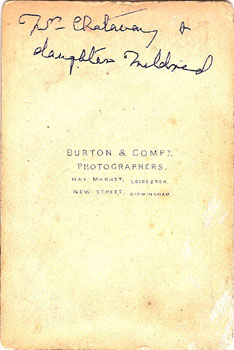
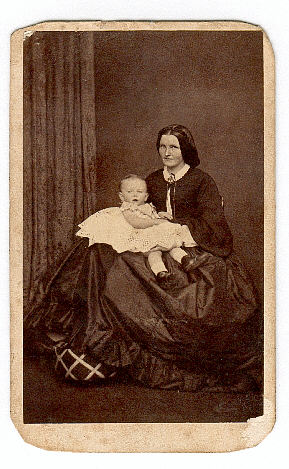
This image of an early carte de visite by John Burton & Compy. of Leicester and Birmingham was sent to me by James Morley, and was the subject of some discussion on the UK-Photographers Rootsweb Mailing List. I include it here, not only as a very early example of this well known photographer's work - see my previous posting about this firm - but also because it shows the dangers in taking inscriptions on photographs at face value.

Mother and young child, by Burton & Compy., Photographers of Hay Market, Leicester & New Street, BirminghamMother and young child, by Burton & Compy., Photographers of Hay Market, Leicester & New Street, Birmingham


James originally posted this photo on the WhatsThatPicture site. Reading the entries posted there and on the mailing list will tell the full story. It was originally thought that the young child apparently identified on the reverse of the mount as "Mildred" could have been the Mildred Chataway (born c. 1870), daughter of the Rector of Peckleton, Thomas E. Chataway, and his wife Catherine. However, several features of the photograph and mount suggest that it was taken perhaps a decade earlier than this interpretation would suggest:

  • The full length seated pose is one which was commonly used in the 1850s, with daguerreotypes and ambrotypes, and 1860s, but the angled view - rather than direct frontal - is more characteristic, in my experierence, of the early 1860s. It is worth comparing it with this photo of a mother and child from London in Roger Vaughan's collection, dated 1862.
  • Her hair completely covers her ears - another feature which points to the early 1860s. By the mid-1860s, ear lobes could often be seen, particular those of younger women, and they were fully exposed to the elements by the late 1860s. Also common in the early 1860s was the drawing back of the hair into a bun on the back of her head - almost, but perhaps not quite, a snood.
  • The very wide sleeves and crinoline dress with velvety bands and very full skirts are characteristic of the early to mid 1860s, typified by the dress worn by the woman in another of Roger's photos, also from c. 1862. The wider sleeves tended to disappear by c.1864, exept on older women.
  • The simple text with no adornment or logo on the reverse of the card mount points to a very early date. It was obviously produced after the opening of the branch studio in New Street, Birmingham (given by Sandy Barrie as 1861) and possibly before the Derby & Nottingham studios were opened in 1862 or 1863. Other early examples on my site are unfortunately not accurately dated, although estimates provided by David Simkin give c. 1861-1863. They all have more ornate logos than this one.
The rounded corners are unusual for the early 1860s, as is the shape of the carte de visite. The possibility has been considered that the rounding was produced by wear (in James Morley's words):
As for the rounded corners, I am in two minds. Some do look damaged, but top-left seems almost too perfect a curve. At the same time all four corners are very similar, whereas I would normally expect any damage to be uneven, particularly top-to-bottom.
The card mount measures 64 x 96 mm (photo 52.5 x 86 mm), which is somewhat shorter than the usual 64 x 104-106 mm for a carte de visite of that era. It is possible that it was an experimental format being trialled by Burton. The "Burton & Compy." on the reverse may have some significance. It has been suggested that the firm started using the name "Burton & Sons" with some regularity from about 1864, and it seems likely that the "& Compy." suffix was used before John Burton's sons became formally recognised as part of the business. However, I don't have evidence for this. As Sandy has pointed out, production of new card mounts was erratic, particularly in the early days, and it is dangerous to interpret too much from the "& Compy." Now that we have a date of c. 1860-1864 for the photograph, a further investigation can be made into the inscription. The 1871 Census indexed by Ancestry only shows one Mildred Chat(t)away, aged 10 months, in Peckleton, Leicestershire. I used wildcards in the search parameters (Mild* and Chat*w*y) to cater for alternative spellings, but there is always potential for transcription errors, so other candidates can't be ruled out. However, the FreeBMD index to birth, marriage and death records, which has almost 100% coverage of the period in question, only shows one Mildred Chat(t)away born in England between 1850 and 1880: - Births Sep Qtr 1870 : Chataway Mildred Market Bosworth Regn Dist, Vol 7a Pg 61 This makes it very unlikely that the child in the photo is Mildred Chataway, and it the possibility needs to be considered that the inscription was made at a much later date, and in error. The 1871 Census entry for this family shows a number of other older daughters of Rev. Thomas and his wife Catherine: 1871 Census: The Vicarage, Peckleton LEI Ref. RG10/3240/7/7-8/40: Thomas E. CHATTAWAY / Head / M / M / 44 / Rector of Peckleton / WAR Birmingham Catherine S. CHATTAWAY / Wife / M / F / 37 / - / WOR Redditch Katherine A. CHATTAWAY / Dau / - / F / 13 / Scholar / NTH Ecton Agnes G. CHATTAWAY / Dau / - / F / 7 / Scholar / NTH Ecton Margaret A. CHATTAWAY / Dau / - / F / 6 / - / LEI Peckleton Christiana M. CHATTAWAY / Dau / - / F / 4 / - / LEI Peckleton Ella B. CHATTAWAY / Dau / - / F / 3 / - / LEI Peckleton Mildred CHATTAWAY / Dau / - / F / 10m / - / LEI Peckleton Catherine CHATTAWAY / Mother / Wid / F / 81 / Annuitant / WAR Coventry Jessie M. GORHAM / Board / U / F / 23 / Governess / KNT Tunbridge Cecile C.V. KERR / Board / U / F / 14 / Scholar / Gibraltar Mary BARWELL / Serv / U / F / 33 / Cook Domestic / LEI Carlton Lucy LUCAS / Serv / U / F / 28 / Nurse Domestic / NTH Church Stone? Hannah JACQUES / Serv / U / F / 21 / Housemaid Domestic / STS Walsall Emma BENT / Serv / U / F / 20 / Housemaid Domestic / LEI Peckleton Martha AMOS / Serv / U / F / 14 / Under Nurse / NTH Badby
FreeBMD demonstrates that the birth of the oldest daughter, Katherine Ada Chataway, was registered in early 1858 in the Wellingborough Registration District, which includes the village of Ecton. I estimate an age of between two and three years for the girl, so Katherine might be a potential candidate if the photograph was taken, as suggested between 1860 and 1864. Birth locations of the children shown in the above census extract indicate that the family moved from Ecton (Northamptonshire) to Peckleton (Leicestershire) some time between the births of Agnes Georgina, in late 1863, and Margaret Anne, in early 1865. If indeed this picture is of members of the Chataway family, and that is by no means certain, then it is unlikely to have been taken prior to late 1863, by which time Katherine would have been almost six years old. In that case, it is more likely to have been a different daughter, perhaps Fanny Mabel, who was born at Ecton in early 1861 and died at Peckleton, aged 5, in the first half of 1866.

Many thanks to James Morley for permission to use the images of this photograph, to James, Sandy Barrie and Marcel Safier for their interesting and informative contributions to the discussion, and to Roger Vaughan and David Simkin for examples used.
Join my blog network
on Facebook