Several regular visitors from Sepia Saturday have in the past commented on the length of some of my articles and asked how long it takes me to compile them. The short answer is
How long's a piece of string? because some (e.g
SS173) are off the cuff, while others are years in the making, gestating slowly either in my mind or as an accumulating collection of notes on the computer's hard disk. This week's contribution is one of the latter, a culmination of some four years of research, the publication of which has been triggered by a fortuitous find in the
Tauranga Heritage Collection's store of cameras and photographic paraphernalia, and Alan's
image prompt featuring coin-operated machines.

Photobooth self portraits by Andy Warhol, c. 1963
Gelatin silver prints, each 36 x 196 mm
Image courtesy of The Metropolitan Museum of Art
I've long had a fascination with the idea of photobooths, although by the time Andy Warhol turned them into tools of pop art and culture in the 1960s, they were well past their heyday. I don't remember ever seeing one, let alone having my portrait captured in one, during my youth in the 1960s and 1970s, but admittedly I was living in a former colonial backwater.
What made this style of portrait unique, at least until the advent of digital cameras and the ubiquitous camera phone, and no doubt the main attraction for the average joe (
Hofman, 2011) as well as Warhol and like-minded celebrities, was that its composition was placed firmly in the hands of the subject.
For Warhol, the photo booth represented a quintessentially modern intersection of mass entertainment and private self-contemplation ... In these little curtained theaters, the sitter could adopt a succession of different roles ... Here, Warhol has adopted the surly, ultracool persona of movie stars such as Marlon Brando and James Dean, icons of the youth culture that he idolized.(Anon, 2000)

Photobooth portraits of Surrealist figures
Photomontage by André Breton, 1928
He was not the first to use the photobooth in such a manner, the French surrealist André Breton having reputedly persuaded various contemporaries, including Salvador Dali, Max Ernest and Rene Magritte, into entering recently installed Photomaton booths on the Champs-Élysées in Paris, the products of which he then compiled into the slightly disturbing photomontage above (Bloch, 2012).

Portrait of two unidentified men, one in soldier's uniform, c.1915-1916
Taken at Sidney Boultwood's Stickybacks studio, 66 St Peter's St, Derby
Image © and collection of Brett Payne
While I don't intend to recount the origins and early history of the photobooth here, I will recommend Mark Bloch's
Behind the Curtain and David Simkin's
Automatic Portrait Photographs, which do exactly that, in an authoritative, concise manner. For a more detailed account, try Näkki Goranin's recently published and well received book,
American Photobooth. Although there were various attempts at mechanisation and automation of the photographic portraiture process from the late 1880s onwards, including Spiridione Grossi and Abraham Dudkin's
Stickybacks in the United Kingdom (Simkin,
2013a &
b), none appear to have met with significant commercial success until the mid-1920s.

Anatol Josepho with his Photomaton booth
Image © Modern Mechanics and courtesy of modernmechanix.com
Then in 1925 Anatol Josepho, a distant relative of Abraham Dudkin, patented the first reliable coin-operated automatic photobooth, the
Photomaton. Advertised as producing a strip of eight cheap, good quality photographs in 8 minutes, the first Photomaton booths in New York were spectacularly successful, reputedly attracting "
280,000 customers in the first 6 months." Two years later Josepho sold the Photomaton machines and patent rights to Henry Morgenthau for a staggering million dollars and future royalties (Kneen, 1928 & Bloch, 2012).


William Rabkin's 1937 Photomatic Patent Application No. 2,192,755
Images courtesy of Google Patents
Throughout the 1930s there were numerous copy-cat efforts and refinements, but the most significant development took place in 1934, after William Rabkin bought out both Photomaton and the
International Mutoscope Reel Company. He improved the design of the photographic apparatus, transformed the exteriors with
art deco styling and changed the name to the
Photomatic. A new wave of photobooth popularity ensued, perhaps due to the chic styling available at a low cost during the peak of the Great Depression.

Original Photomatic photo booth, Machine No. DP 3
Image © and courtesy of The Powerhouse Museum
Photomatic booths were manufactured in enormous numbers, in almost any colour you could think of, and shipped to all corners of the world. The remarkably intact apparatus in the image above from Sydney's
Powerhouse Museum, apparently one of the few examples that have survived, was probably used in Queensland around 1935 to 1938.

Instruction plate from a Photomatic photo booth, c.1935-1940
Image © and courtesy of Tauranga Heritage Collection
This rather grimy Photomatic booth instruction plate from the
Tauranga Heritage Collection (above, Machine No. DP 220) is all that's left of a seemingly identical apparatus, suggesting that the machines may also have been exported to and used within New Zealand. Wellington's
Evening Post carried an advertisement in January 1940 (below) calling for the services of a "smart young girl" to operate a Photomatic machine at the New Zealand Centennial Exhibition.

Advertisement, Evening Post (Wellington, New Zealand), 23 January 1940


Portrait of unidentified woman, 14 October 1938
Silver gelatin print in crimped metal frame with printed card backing
Taken by Photomatic booth at Detroit Bus Station
The feature differentiating Photomatic portraits from those produced by competitors was that the customer received a print "already framed." Constructed of a thin strip of sheet metal, the frame was crimped around the silver gelatin print and a printed card backing. Early Photomatic frames were all silver in colour and the backing designs simple, allowing for a date and place taken to be written by the customer. The card itself followed the art deco theme, and was usually a shiny silver colour.

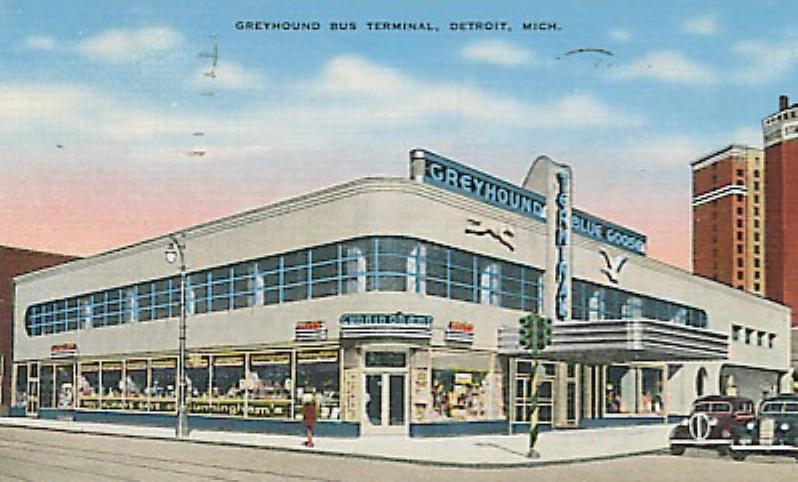
Postcard of Greyhound Bus Terminal, Detroit, Michigan
Image © and courtesy of Donald Coffin's Greyhound Bus Memories
The Photomatic booth where the 1938 portrait above of a woman in her smart hat and furs was taken would have matched the sleek lines of the Greyhound Detroit Bus Terminal exterior perfectly.


Portrait of unidentified woman, undated
Silver gelatin print in crimped metal frame with printed card backing
Taken by Photomatic booth on the NYNHH Railroad
Image © Marc Frattasio and courtesy of the New Haven RR H&T Assn
Photobooth concessions were operating in public places country-wide, and the backing card stock soon carried the names of the locations or concessions. The portrait of the woman above was probably taken by Photomatic booth located on a station platform or in a waiting room similar to that shown at Boston's South Station, below.

Photomatic booth in waiting room, South Station, Boston
Image © Marc Frattasio and courtesy of The New Haven Railroad Historical and Technical Association, Inc.


Portrait of unidentified man, 6 November 1938
Silver gelatin print in crimped metal frame with printed card backing
Taken by Photomatic booth at Plankinton Arcade, Milwaukee, Wisconsin
This taciturn young man and his somewhat oversized cap paused long enough in the Photomatic booth in the busy Plankinton Arcade to record his passing through in the autumn of 1938. Wherever there were throngs of people, the
International Mutoscope Reel Co. installed their Photomatic booths.


Portrait of unidentified soldier, 13 January 1942
Silver gelatin print in crimped metal frame with printed card backing
Taken by Photomatic booth in Washington, D.C.
Image © Brian and courtesy of Photobooth.net
A little over three years later, and the booths were filled with very different looking subjects. After the Japanese attack on Pearl Harbour on 7 December 1941, the United States was at war and tens of thousands of uniformed servicemen all wanted a photo before they shipped out. Five weeks after the Declaration of War, this soldier was probably both excited and nervous when he posed with a cupid-style caricature cut-out in Washington D.C. in January 1942.


Portrait of unidentified US Marine, 25 February 1944
Silver gelatin print with magenta card frame & printed card backing
Taken by Photomatic booth in Newark, New Jersey
Image © and collection of Brett Payne
In 1944 and 1945, possibly due to shortages of metal, Photomatic portraits were produced with thick coloured satin-finish card "Photoframes." This example from early 1944 shows a marine home on furlough in Newark, New Jersey.


Portrait of unidentified woman, September 1945
Silver gelatin print with blue card frame & printed card backing
Taken by Photomatic booth in New York City
These wartime issues had no special place on the back for the place and date to be filled, but some helpful subjects wrote them anyway. This happy bespectacled woman in a striped blouse was presumably caught up in the euphoria that swept New York after the Japanese surrender on 14 August:
In the summer of 1945, New York was a city riding a wave of triumph ... It was a time of unbridled self-confidence. The city had contributed 850,000 servicemen to the war effort. The war had transformed New York into the capital of the world.(Roberts, 1995)


Portrait of unidentified woman, 8 June 1947
Silver gelatin print with red metal frame & printed card backing
Taken by Photomatic booth in New York
After the war ended, Photomatic reintroduced metal frames, and for a couple of years they were enamelled in a variety of colours, including white, red, pale blue, lime green and orange. However, the frame itself had a slightly different profile, as shown in a modified patent application filed by Rabkin in 1948 (below), and included a fold-out stand.

William Rabkin's 1948 Photomatic Patent Application No. 2,647,834
Image courtesy of Google Patents


Portrait of unidentified US soldier, undated
Silver gelatin print with silver metal frame & printed card backing
Taken by Photomatic booth in unidentified location
Image © and collection of Brett Payne
Eventually the enamelling was dispensed with, and the standard issue frames returned to either plain silver or, more rarely, gold. I suspect this young man's uniform is not military (Correction: this is a US Army cap badge, thanks Mike), but he was proud of it and it's sad that he didn't take the time to record a message on the back. It is probably from the late 1950s.


Portrait of two unidentified women, 13 July 1953
Silver gelatin print with silver metal frame & printed card backing
Taken by Photomatic booth in unknown location
Image © and collection of Brett Payne
This image of two young women was taken in July 1953 and bears the caption, "
Dig this". Comparing their clothing and hairstyles with an old
Life magazine from that date, it seems likely that they'd been out shopping or to the hair stylist. They do seem rather pleased with themselves.

Portrait of Beth's mother, 17 July 1945
Silver gelatin print with silver metal frame & printed card backing
Taken by Photomatic booth at Grand Central Station, New York City
Image © and courtesy of musicmuse_ca & Flickr
It is a sad reality that many of the subjects of such found photos and the places where they were taken will never be identified, let alone the context or situation be deduced. However, browsing the internet for examples of Photomatics, one soon appreciates that many of them are still
in situ, so to speak, and form an important part of family history. This image on
musicmuse_ca's Flickr photostream shows her mother on her wedding day.
This is the shot my mother took on the day she got married to her first husband Fred. It was taken on a photomatic photo machine in Grand Central train station in NYC.
He got a job working for the Canadian Press in NYC. He had been dating my mother since 1939, and they had virtually lived together for several years in Toronto. He asked her to marry him and they took the train from Toronto to NYC.
The marriage to Fred did not last more than 5 years, but my mother's love affair with NYC lasted from 1945 until her death in Manhattan in January of 2003.
These words and further background to the story (
Truth, Lies and Betrayal 9/1939) make it a material symbol, despite its inauspicious beginnings in the hustle and bustle of New York's Grand Central Station.


Portrait of unidentified woman, undated
Silver gelatin print with red plastic frame & printed card backing
Taken by Photomatic booth in unknown location
By the late 1950s, the design of the frame had changed again, the crimped metal being replaced by much more the much more versatile, rust-proof and cheaper ubiquitous plastic. The characteristic art deco styling of the Photomatic brand was gone forever.

Unidentified couple, Long Beach Pier, Los Angeles, California, undated
Snapshot by unidentified photographer
The Photomatic was also facing stiff competition from rivals. Bloch (2012) suggests that it was outclassed by the superior technological, marketing and distribution techniques of companies such as Auto-Photo Co. One should not ignore the fact that more and more people owned their own cameras. This snapshot, probably from the mid- to late 1950s, shows a sailor and his sweetheart, the latter with a camera in a leather case around her shoulder. They are posing in front of a Penny Arcade at Long Beach Pier, an unoccupied photobooth clearly visible in the background.

Photomatic photobooth, candy and cigarette machines, Kansas, 1959
Image © and courtesy of These Americans Archive
I get the impression that Photomatic booths, despite attempts at rebranding and restyling, were slowly being relegated to the amusement arcades and drugstores where their predecessors had originated a quarter of a century earlier. This 1959 booth, perched between the candy and cigarette machines, boasts a brand new look and a comely invitation to "
Take your photo ... now!" but I detect a whisper of hesitation. Perhaps she, like Jeannette below, is waiting for the right man to come along.

"Jeanette" and Elvis Presley, undated
Photobooth portrait at unidentified location
References
Photobooth.net, by Brian and Tim
International Mutoscope Reel Company, from Wikipedia.
The History & Progression of the Photo Booth, from
Green Cheeze's Blog.
Andy Warhol, lyrics by David Bowie, 1971
Photographic booths, 1930-1940, from
The Powerhouse Museum.
Anon (1934)
Business & Finance: Pin Game, 24 December 1934, TIME Magazine.
Anon (1935)
Science: Photomatic, Monday, 4 February 1935, TIME Magazine.
Anon (2000) "
Andy Warhol: Photo Booth Self-Portrait (1996.63a,b)," in
Heilbrunn Timeline of Art History, New York: The Metropolitan Museum of Art, 2000. (October 2006)
Anon (2004)
The "PhotoMatic" Photo Machines, New Haven Railroad Historical and Technical Association, Inc.
Anon (2013)
Say 'cheese in the photobooth, from Diario de Una Pin Up Frustrada, 24 January 2013.
Bloch, Mark (2012)
Behind the Curtain: A History of the Photobooth.
Goranin, Näkki (2008)
The history of the photobooth, 7 March 2008,
The Telegraph, Extract from
American Photobooth by Näkki Goranin, publ. by W.W. Norton & Company.
Griffiths, Katherine (2011-2013)
- Photobooth Journal: A life in a photobooth.
Hofman, Juli (2011)
Photomatic Pics of my Grandpa: D*** It Feels Good To Be a Gangsta, posted 5 Dec 2011 on
The Williamson Vampires blog.
Kneen, Orville H. (1928)
Penniless Inventor Gets Million for Photo Machine, in
Modern Mechanics and Inventions, November 1928.
Linderman, Jim (2011)
Mat Mugs! The Wonderful Photomatic Photograph Machine and Mutoscope. William Rabkin Fast Talking Genius of the Photomatic Machine and the Claw, posted in April 2011 on the
Dull Tool Dim Bulb blog.
Roberts, Sam (1994)
NEW YORK 1945; The War Was Ending. Times Square Exploded. Change Was Coming. in
The New York Times, 30 July 1995.
Simkin, David (2013a)
Automatic Portrait Photographs: The Sticky Backs Studio, Spiridione Grossi, Abraham Dudkin, Anatol Josepho and the Photomaton, on
Sussex PhotoHistory.
Simkin, David (2013b)
Sidney Boultwood and his Stickybacks Studios, on
Sussex PhotoHistory.