Showing posts with label negative numbers. Show all posts

Friday, 24 April 2015

Sepia Saturday 276: Barr Brothers and Portland Studios, Nottingham

Sepia Saturday by Marilyn Brindley & Alan Burnett

Inspired by Marilyn's recent post of a newspaper article on Sepia Saturday's Facebook page about the dilemma of whether or not to save photos of unknown relatives, my contribution this week presents a series of cabinet portraits that have been "saved" from the skip, and may yet be identified, thanks to the habits of an early 20th century photographer.

Although certainly not unique (see W.W. Winter and Pollard Graham, both of Derby), it is rare to find a photographer who meticulously recorded the negative number and surname of every customer on the back of each portrait print that he supplied, but the Barr Brothers seemed to have just done that - at least with all 7 examples in my collection.

William Banister Barr was born in 1877, one of eight children of a Liverpool ironmonger. In early 1897 he briefly tried his hand as an apprentice merchant seaman aboard the ship Irby out of Liverpool. He later joined up as a gunner with the Royal Horse Artillery, but by March 1901 was a patient at the Royal Herbert Hospital in Woolwich, adjacent to the artillery barracks, presumably recuperating from some illness, as it appears unlikely he served with the unit in the Anglo-Boer War.

Image © copyright and collection Brett Payne
Cabinet card by Barr Bros, Portland Studio, Nottingham & Cardiff, c.1905
inscribed "15786 Dalby" - taken c. 1905-1907
Image © copyright and collection Brett Payne

In the 1911 census, only two male children with the surname Dalby and appropriate ages are recorded as living in the town of Nottingham:
- William Hector Dalby, aged 13, son of Frank John Birch Dalby, a builder's foreman
- Samuel Dalby, aged 10, son of Edward Dalby, a builder's labourer
Could one of these two be him, I wonder?

In early 1904 he was working as a photographer, with premises at 1 Portland Road, Nottingham. By the time the above cabinet portrait of a young boy in a smart velvet suit was taken around 1905-1907, slightly let down by the studio's scruffy pot plant and rustic chair, it appears his younger brother Harold Cowper Barr (1879-1958) had joined him in the business. The card mount lists a branch studio at 47 Queen Street, Cardiff, which was operating in a building known as City Chambers for several years between 1907 and 1911. Harold was living in Cardiff in April 1911, and had presumably operated the southern arm of the business for some years.

Image © copyright and collection Brett Payne
Cabinet card by Portland Studios, Leicester & Nottingham
inscribed "26794 Gregory" - taken c. 1906-1907
Image © copyright and collection Brett Payne

Unfortunately Gregory was just too common a surname in Leicester and Nottingham (at least 13 of approximately the right age) for me to come up with any decent candidates for this woman.

In July 1905, when William was married at Fairfield, Lancashire, he was living in Birmingham and had studio premises in 52 New Street. He moved to 213 Moseley Road, Aston in 1906 and his first two sons were born there in 1906 and 1907. Within a couple of years, the "Barr Brothers" name was dropped from card mounts, and it simply became known as the Portland Studio, although the stylised ornate "B" monogram remained and they continued the use of their surname in trade listings. In 1908 William moved again, occupying a studio at 46, Imperial Buildings, Dale End.

Some time between 1904 and c.1908 they also briefly operated a studio at 68 Craven Park Road, Harlesden, London N.W.

Image © copyright and collection Brett Payne
Cabinet card by Portland Studios, Leicester & Nottingham
inscribed "32708 Tomlinson" - taken c. 1907-1908
Image © copyright and collection Brett Payne

There were even more candidates for Ms. Tomlinson, so all I can hope for is that someone, someday, will recognise her.

In 1908 a trade directory listed "Barr Bros" with premises at 20 Granby Street, Leicester, but despite the number of examples using the address in my collection it could not have lasted for very long, since by 1909 a photographer named Harry Clare was operating from that address. Of course it is conceivable that Harry Clare had previously been working for the Barr Brothers.

Image © copyright and collection Brett Payne
Cabinet card by Portland Studios, Leicester & Nottingham
inscribed "34562 Widdowson" - taken c. 1907-1908
Image © copyright and collection Brett Payne

The Widdowsons were likewise prolific in Nottinghams and Leicester, making any identification of this slightly older woman difficult, if not impossible, without further information.

The Barr Brothers had established a branch studio at 83a Bold Street, Liverpool as early as 1908, mosing to 103 Smithdown Road the following year. The Nottingham studio appears to have closed in 1908 or early 1909, and by 1910 listings for the Cardiff studio showed the head office of the business, presumably under the hand of William, as being located in Liverpool. William's third son was born at Hoylake, Cheshire in July that year, and by April 1911 the family was living at 107 Smithdown Road, Liverpool. William Barr described himself as a "master photographer" and an employer.

Image © copyright and collection Brett Payne
Cabinet card by Portland Studios, Leicester & Nottingham
inscribed "34683 Tomlinson" - taken c. 1907-1908
Image © copyright and collection Brett Payne

A second portrait of Ms. Tomlinson, a few months after the first, and this time it is full length.

Barr Bros. disappear from sight for the next few years, but the existence of branches in Belfast (109 Donegall Street) and London (132 Dalston Lane, N.E.) is suggested by the addresses on cabinet card mounts deduced to be from the pre-War period. I have also seen a postcard portrait of a merchant seaman, probably pre-War, that is blind stamped, "Portland Studio, 250 High St, S. Tottenham."

Image © copyright and collection Brett Payne
Cabinet card by Portland Studios, Leicester & Nottingham
inscribed "34772 Ellis" - taken c. 1907-1908
Image © copyright and collection Brett Payne

Young Mr Ellis could be any one of a number of candidates.

William Barr enlisted in the army in June 1916, and was called up for service for months later, at which time he gave his occupation as "photographer." Almost forty years of age, he spent the war in England with various units and was finally demobilised in March 1919.

Image © copyright and collection Brett Payne
Cabinet card by Portland Studios, Leicester & Nottingham
inscribed "35159 Pack (or Park)" - taken c. 1908-1909
Image © copyright and collection Brett Payne

I found a James Park, aged 21, working as a shoe hand in the Lasting Department of a factory in Leicester, in the 1911 census.

I have no firm evidence that William Barr returned to the photographic profession after the war. He died at Liverpool in 1949.

A list of studios known to have been operated by the Barr Brothers, not necessarily complete, so if you have any further information, please email me.

1904William Banister Barr, 1 Portland Road, Nottingham
c.1905-1908Barr Brothers, 1 Portland Road, Nottingham (Portland Studio)
1905-1906William Banister Barr, 52 New Street, Birmingham
1905William Banister Barr, 17 Lawrence Hill, Bristol
c. 1906-1907Barr Brothers, 68 Craven Park Road, Harlesden, London N.W.
1906-1907William Banister Barr, 213 Moseley Road, Aston, Birmingham
c. 1907-1909Barr Brothers, 109 Donegall Street, Belfast
c. 1907-1909Barr Brothers, 138 Dalston Lane, London N.E.
1907-1911Barr Brothers, City Chambers, 47 Queen Street, Cardiff (Queen Studio)
1908William Banister Barr, 46 Imperial Buildings, Dale End, Birmingham
1908Barr Brothers, 20 Granby Street, Leicester
1908Barr Brothers, 83a Bold Street, Liverpool
1909-1918Barr Brothers, 103 Smithdown Road, Liverpool
1910Barr Brothers, 39 (or 33) High Street, Merthyr Tydfil
1910Barr Brothers, Market St, Llanelly
1910Barr Brothers, 29 High Street, Newport
1910-1914Barr Brothers, 79 Taff St, Pontypridd
c.1912-1914Barr Brothers, 250 High Street, S. Tottenham
1913Barr Brothers, Regent Street, Wrexham (Queen Studios)
1913Barr Brothers, 88a Church Street, St Helens

References

Alderman, Mari (2006) Victorian Professional Photographers in Wales, 1850-1925, publ. online by GENUKI

Aston, C.E. John, Hallett, Michael & McKenna, Joseph (1987) Professional Photographers in Birmingham, 1842-1914, Supplement No. 116 to The PhotoHistorian, publ. Royal Photographic Society Historical Group.

Heathcote, Bernard & Heathcote, Pauline (n.d.) Pioneers of Photography in Nottinghamshire, 1841-1910, publ. by Nottinghamshire County Council.

Heathcote, Bernard V. & Heathcote, Pauline F. (n.d.) Leicester Photographic Studios in Victorian & Edwardian Times, publ. Royal Photographic Society Historical Group.

Hicks, Gareth (2003) Glamorgan Photographers (database), publ. online by GENUKI

Holland, Paul (n.d.) Chester & North East Wales Photographers, personal web site.

Jones, Gillian (2004) Lancashire Professional Photographers, 1840-1940, publ. by PhotoResearch.

Vaughan, Roger (2003) Bristol Photographers, 1852-1972, personal web site.

Thursday, 6 October 2011

Annie Orchard's crowning glory - An opalotype from Derby

Some years ago Karen Cross sent me these images of what Marcel Safier eventually identified as an opalotype. Although I have displayed the images previously on my web page for the Derby branch of A. & G. Taylor's huge network of studios it's worth revisiting them, not only because it is an unusual example from that studio but, in keeping with the series of images I've discussed recently, it has been hand coloured. I have also delved a little further into the background of the family, and unearthed one of those coincidences which happen to many of us who have ancestors who lived in one area for a number of generations. It turns out she's closely related to someone else that I've researched for Photo-Sleuth, and in fact discussed at great length in a previous article. More of that later.

Image © and courtesy of Karen Cross
Annie Goodwin née Orchard, c. 1880-1882
Opalotype (165x215mm), A & G Taylor, 63 London Road, Derby
Created from copy negative or print c.1889-1890
Image © and courtesy of Karen Cross

The following is what I originally received from Karen:
The subject is Annie Goodwin née Orchard, twin sister of my great-grandmother Fanny Orchard. They were born on 27 February 1863 at Holy Trinity, Burton-upon-Trent, Staffordshire. She seems fairly young in the portrait so it may have been her eighteenth birthday or done so her twin could bring the picture with her to Australia. My great-grandmother Fanny married Arthur John Kidd of Kings Bromley and immigrated to Queensland Australia in 1882. They lived in Emerald until her death in 1946. The photo came into my family's possession through my grandmother Edith Annie Francis (née Kidd).
This vignetted studio portrait shows a young woman, probably in her late teens, with her very long hair worn loose and down at the back, a fashion which was popular for unmarried girls up to the age of about 18, but not usually acceptable for married or older women. Geoff Caulton - on his British Photo Detective web site - refers to this style in Edwardian times being called a woman's "Crowning glory." The clothing appears to be roughly equivalent to the fashions from the early 1880s.

Image © and courtesy of Karen Cross
Detail of opalotype

The soft nature of the image, an effect largely due to the white glass used as a backing and often compared to watercolours or pastels, is demonstrated well in this example. Enlargement of the image demonstrates that the photograph has not only been coloured, but also significantly retouched, with much of the texture of her hair and the fabric of the clothing having been overpainted. Her lace collar has been very thickly embellished resulting in a three-dimensional effect. She may be wearing some kind of thin silk head covering.

Opalotypes - also known as opal types or milk glass positives - were introduced by Joseph Glover and John Bold of Liverpool, who patented their invention in 1857, but a number of methods of preparation were in common use by the mid-1860s (Towler, 1866; Waldack, 1865). They were made by applying photosensitised emulsion to the surface of an opal glass substrate, usually with a gelatine binder layer. The plate was then exposed to the negative either by contact printing or by use of a specially designed copying camera, and the image developed. The surface of the print was often colour-tinted by hand, and they were often cased in the same way that daguerreotypes and collodion positive portraits (ambrotypes) had been previously. Whitman et al (2007) describe opalotypes being produced until the 1940s, although the process was never very popular, perhaps due to the relatively high cost.

Image © and courtesy of Karen Cross
Reverse of opalotype, reproduced c. 1887-1890
Image © and courtesy of Karen Cross

The back of the opalotype shows several notable features, as follows.
- It has an underlying beige-coloured patina, worn away in places to reveal the milky white, translucent glass forming the base on which the photograph was made.
- A small rectangular label is affixed to the top right hand corner of the back, inscribed "Derb 22468" in handwritten pencil, probably a negative number from the Derby branch.
- The remains of four pieces of printed trade label are affixed roughly centrally on each edge, perhaps used to hold it within a frame or mount at some stage in its history.
- At intervals around the edges are what appear to be yellowed tape marks, perhaps also used for framing or mounting, but more recently than the trade label fragments. The serrated leading edges and residue are typical of those produced by sellotape.
- Written on the patinated surface in what appears to be blue ball point pen, is: " Miss Annie Goodwin (Grandma Kidds twin Sister."

Image © and courtesy of Karen Cross Reconstructed trade label, A. & G. Taylor, 63 London Road, Derby

I've managed to reproduce an image of three quarters of the trade label using digital reconstruction, and this is enough to show that it was for A. & G. Taylor's branch studio at 63 London Road, Derby, operated by managing partner William Middleton, who also controlled branches in Sheffield, Nottingham, Goole, Doncaster and Barnsley. Although not definitive proof that the opalotype was made there, in conjunction with the negative number of presumed Derby origin ("Derb 22468"), one could certainly make a strong case for it.

The address of the Derby branch changed from 57 London Street to 63 London Road some time between October 1887 and October 1888, although I am fairly sure that this reflected a renumbering exercise and street name change rather than a physical move of the studio premises. It remained open until at least 1903. The Sheffield branch studio was at Furnival Chambers, 101 Norfolk Street from 1879 till 1904, while the Nottingham branch address was at 107 Parliament Street - also known as West End Chambers, Chapel Bar - from around 1882 until at least 1901. Victoria Street, Goole was home to a branch for a relatively short period between 1889 and 1891. Doncaster also had a branch at 32 Scott Lane from 1881 until 1889, and Osman (1996) records W. Middleton being a partner c. 1890. The only recorded date for a Barnsley branch (Sheffield Road) is 1904.

If one excludes Barnsley, the only period when all five remaining branches were open simultaneously was from 1889-1890. Although this dates the trade label rather than the opalotype itself, it is likely that the latter was produced around that time. The following comments were made by fellow photo researcher David Simkin, who very kindly looked the image:
The evidence seems to suggest that the photograph was originally taken around 1881/1882 in Derby (perhaps at A. & G. Taylor's studio in 57 London Street and at a later date (late 1880s/early 1890s) the image was transferred to [opal glass] by the studio that still held the negative or a copy photograph.
A number of reasons could account for wanting to transfer the image to a ceramic plaque - one that cannot yet be discounted is that Annie died young and the plaque was a sort of permanent memorial. If she wanted to send a copy of her photograph to Fanny a number of years after she had departed to Australia, why not a more recent photograph and why on a relatively heavy and fragile base? It would have been easier to send a cabinet or carte de visite portrait on a card mount. Alternatively, another relative could have brought the ceramic photo to Australia, or it could have been collected if Fanny ever returned to England for a visit to her family.
In April 1881, at around the time this portrait was originally taken, Annie Orchard was living with her widowed mother Harriett (née Goodwin) at 185 Newton Road, Winshill, Derbyshire, on the opposite bank of the River Trent from the Staffordshire brewing town of Burton-upon-Trent. Her twin sister Fanny was employed as a nurse in the household of Robert Ratcliff - partner in the famous Burton brewing firm of Bass, Ratcliff & Gretton - and his wife Emily née Payne (my 3g-grandfather's frst cousin) at Newton Park, Newton Solney. The girls' father had died in 1866, leaving Harriet with four children under the age of six to bring up alone. Her youngest child, a boy named Samuel, died in 1871.

Although I've been unable to locate Annie in the 1891 Census, in 1901 she was single and living in Kensington, London, where she worked as a parlour maid for a brewery manager. It is tempting to conclude that she found this position through brewery trade contacts in Burton. Her elder brother William was still living in Winshill and working as a brewery labourer in 1891 and 1901. Her unmarried status is a little difficult to reconcile with Karen's description of her as "Mrs Annie Goodwin née Orchard," although she may well have married after 1901.


Orchard-Botham-Smith outline tree
Click to enlarge

Finally, I discovered during the course of my research that Annie's father Henry Orchard (1826-1866) was second cousin to Jacob Botham Smith (1840-1925), who featured in a series of articles on Photo-Sleuth two years ago, entitled "A mystery marriage in Barton-under-Needwood."

Image © and courtesy of Karen Cross Image © and collection of Brett Payne
Annie Orchard (left), the wedding party of Jacob Botham Smith & Mary Ann Hoult (right)

References

Osman, Colin (1996) The Studios of A. & G. Taylor, the Largest Photographers in the World, Supplement to The PhotoHistorian, No. 111, March 1996.

Payne, Brett (2008) A. & G. Taylor of the Royal Studio, 57 London Street and 63 London Road, Derby, Derbyshire Photographers' Profiles.

Towler, J. (1866) The Silver Sunbeam: A Practical and Theoretical Text-Book on Sun Drawing and Photographic Printing, New York: Joseph H. Ladd, 5th Edition, p. 392-403.

Vaughan, Roger (2004) The Studios of A. & G. Taylor, Victorian & Edwardian Photographs.

Waldack, Charles (1865) Treatise on Photography, Cincinatti: H. Watkin, 4th Edition, p. 247-251.

Whitman, K., Osterman, M. & Chen, J.-J. (2007) The History and Conservation of Glass Supported Photographs, George Eastman House, Advanced Residency Program in Photograph Conservation, p. 25-26.

Friday, 16 September 2011

Sepia Saturday 92: All aboard the Bournemouth Queen for the Isle of Wight

When in 1914 Uncle Hallam and Aunt Sarah Payne handed over the family grocery and off-licence at 83 St James' Road, Derby to his younger brother Fred and retired to live Dale Cottage, Ingleby, they were only in the mid-forties. Hallam's mother had died in February that year, his father seven years earlier, and he had inherited a number of residential properties in Derby, from which he must have received a reaonable income.

What did they do to occupy themselves, apart from collecting - and presumably reading - the piles of newspapers and books which filled much of their house? Well, the photographic record suggests that they regularly spent at least a part of their summers visiting various seaside resorts. In Sidewalk Photographers I presented a series of "walking pictures" taken of them with various other family members in Great Yarmouth (1931, 1937 and 1938) and Bournemouth (1932 and 1933).

Image © and courtesy of Barbara Ellison
Passengers aboard the Bournemouth Queen, 15 September 1923
Image © and courtesy of Barbara Ellison

This snapshot was also taken by a professional, but is not a "walkie." Here the photographer has opted to capture his tourist clientele en masse, conveniently gathered together on the top aft deck of an excursion boat. The boat appears to be tied up on the western side of the Bournemouth Pier, the characteristic Dorset cliffs being visible in the background, and possibly the Bournemouth beach huts and amusement arcade at the foot of the cliff. In some respects, it could be considered the same genre of commercial portrait to that of a charabanc outing that my Dutch grandparents had on the Isle of Wight, also in the early 1920s.

Image © Martin Parr and courtesy of Google Books
Mobile sales tent for Bailey's postcards
Image © Martin Parr, Photography: a critical introduction, Liz Wells
Courtesy of Google Books

Provided the excursion was long enough, as soon as the boat departed the photographer would have time to nip into his dark room, possibly even a small booth on or close to the pier, develop the negative and have a couple of dozen postcard prints of each on display and for sale by the time the boat returned.

Image © and courtesy of Barbara Ellison

The negative was inscribed in black ink - reversed to white on the print, of course - with "Queen 15.9.23" at the lower left, the latter being the date of the photograph, 15th September 1923, and the number "1999" on the funnel, presumably a negative number. An enlargement of the lifebelt hanging over the railings shows that the boat was the Bournemouth Queen registered at Southampton.

Image © and courtesy of Alwyn Ladell
Red Funnel Steamers postcard of Bournemouth Queen
Image © and courtesy of Alwyn Ladell

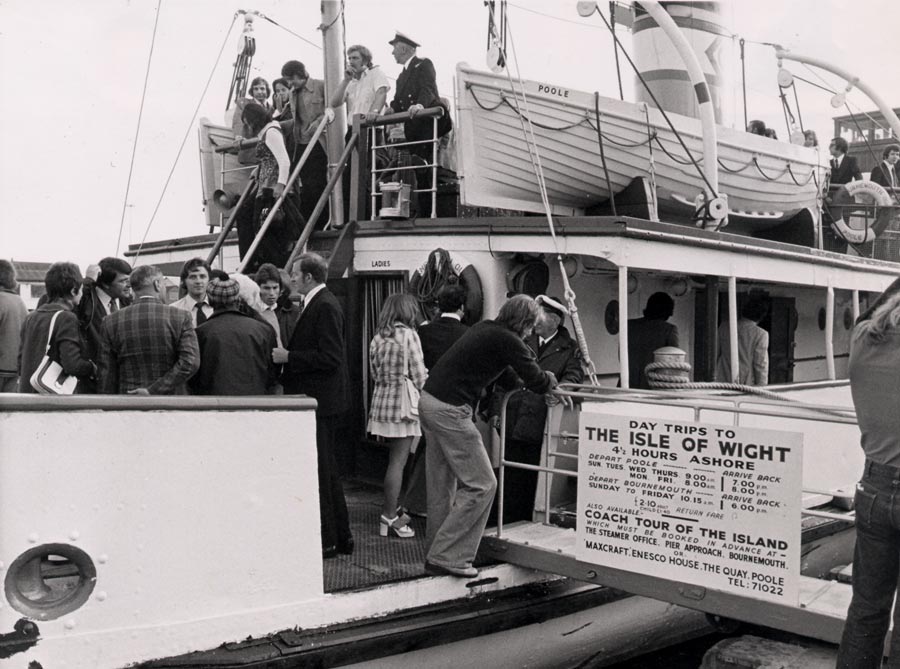
According to Ian Boyle's comprehensive web site Simplon Postcards, devoted to passenger ships, the Bournemouth Queen was a paddle steamer of the Red Funnel Line serving as an excursion ship out of Bournemouth for most of its lengthy career, which included service in both world wars, before being finally scrapped in 1957. There was another Bournemouth Queen based in Poole who also operated on the Bournemouth-Isle of Wight run from 1968 to 1973.

Image © and courtesy of Ian Boyle/Simplon Postcards
Bournemouth Queen advertising signboard
Image courtesy of Ian Boyle/Simplon Postcards

This photograph of the later ship taking on passengers shows a signboard on the gangway advertising daily trips to the Isle of Wight departing from Bournemouth at 10.15 a.m. and returning at 6 pm, with the opportunity to spend 4½ hours ashore, and coach tours of the island available if booked in advance. Granted this was several decades later, but it indicates that there would have been plenty of time for photo developing and printing before the customers returned.

Image © and courtesy of Barbara Ellison

The back of the postcard reveals the photographer to be "Bailey, 228 A Christchurch Rd., Bournemouth." Alwyn Ladell tells me that Ernest Benjamin Bailey operated first from 240/242 Old Christchurch Road, then later at Glen Fern Chambers/Glen Fern Studios in Bournemouth, and the range of dates that I've seen on similar postcards extends from 1914 to 1940. The negative number clearly visible on most examples could be used to order copies at a later date. This might suggest that negative numbers could therefore be used to establish a date sequence, and thus lead to an estimation of the number of photographs he was taking.

Image © Brett Payne
Analysis of postcard negative numbers, Bailey of Bournemouth, 1914-1938 © Brett Payne

However, after a preliminary analysis of the numerous examples of Bailey's postcards available on the net - a selection can be seen on Alwyn Ladell's Flickr photostream - there doesn't appear to be a single sequence of negative numbers, and it's possible he started a new series each season.

Image © and courtesy of Barbara Ellison

My aunt has inscribed the reverse of the postcard in blue pen, with the suggestion that her father (CLLP) is seated 5th from left in the front row, and "Sarah & Hallam also CVP right of funnel ... three rows behind," CVP being CLLP's father and Hallam's older brother. I've had a good look at a higher resolution image of the postcard and, while Sarah and Hallam (shown above) are unmistakeable, I don't think either CLLP or CVP are on that boat.

Image © and courtesy of paghamwanderer.wordpress.com
Passengers aboard the Bournemouth Queen, 16 August 1923
Image © and courtesy of "Billy Voak, The Pagham Wanderer"
paghamwanderer.wordpress.com

This postcard, also by Bailey and taken only a few weeks before Uncle Hallam and Aunt Sarah were in Bournemouth, shows the same vessel but is a far more interesting view of passengers on the foredeck. Apart from the wonderful detail of the excursionists sporting a fine array of hats, clothing and accessories, there is a magnificent view of the holidaymakers arrayed in their deckchairs or promenading past the beach huts and amusement arcades on Bournemouth beach, a few ankle deep in the water, some even preparing to board a smaller pleasure boat. What a different feel it has to the one showing Uncle Hallam and Aunt Sarah, where all are dressed in heavy overcoats, the sun does not appear to be showing its face, and there is no action in the background to liven things up.

Image © and courtesy of Scott Henderson/Striderv
Passengers disembarking from Bournemouth Queen, 25 April 1935
Postcard by Bailey, Glen Fern Studios, Bournemouth
Image © and courtesy of Scott Henderson/Striderv

Sometimes he would photograph the passengers disembarking from the steamer, presumably on their return from the Isle of Wight. Perhaps they were given tickets by an assistant, printed with the negative number, and told they could return the next day for the prints.

Image © and courtesy of David Gregory/Postcards of the Past
Coloured Postcard view of Bournemouth Pier from the West Cliff, n.d.
Image © and courtesy of David Gregory/Postcards of the Past

This early postcard view from the West Cliff by an unknown publisher - possibly James Valentine or Photochrom - shows the popular beach and the pier, and a paddle steamer moored beside the latter.

Image © and courtesy of Doreen Smith
Postcard photo, Bailey, Glen Fern Studios, Bournemouth, 1939
Image © and courtesy of Doreen Smith

As shown by the photograph above of an exuberant group of swimmers at the beach, and another of more sedate beachgoers occupying deckchairs below, Bailey did not restrict himself to the pier, and when there were no excursion boats to be serviced he no doubt touted for business along the waterfront.

Image © and courtesy of David Vickers/Reminiscene
Postcard photo, Bailey, Glen Fern Studios, Bournemouth, n.d.
Image © and courtesy of David Vickers/Reminiscene

Image © and courtesy of Dorset Coast Digital Archive
Pier Approach, Bournemouth, 20 August 1935
Postcard view by Bailey, Glen Fern Studios, Bournemouth
Image © and courtesy of Dorset Coast Digital Archive

A further postcard by Bailey of the Pier Approach, Bournemouth is of a different genre, which indicates that he also produced more general views, and probably had them on sale along with his specific excursion oriented group shots at the tent shown earlier.

Don't forget to head over to Sepia Saturday to be entertained by more photographs, perhaps along a similar theme to either this one or Alan Burnett's image of a London & North Western Railway Co. office in Waterford, Ireland.

Saturday, 10 September 2011

Photographic Ephemera: Posting envelopes and their relevance

Image © and courtesy of Graham Pare
Portrait of young man by Pollard Graham of Derby
Mounted print 250 x 350mm

Last week I wrote in the article "Which sibling is it?" about the importance of dating photographs in the process of identification of subjects. Today I return to this topic with an image sent to me three years ago by Graham Pare, who provided some background to the photograph:
It is the only photo I have from this area - my father's family were from Derbyshire, my great grandfather was Francis Willoughby Pare born Belper 1909 and his father was Robert Stanley Lee Pare, born Ripley 1887 - I guess it could be either of them, depending on your estimated year? There again it could be neither of them!
Image © and courtesy of Graham Pare
Imprint: Pollard Graham & Co, Head Office 108A Friar Gate, Derby
Negative number 68770

My response was as follows:
I believe that it was taken just before or during the First World War, perhaps between 1911 and 1916. This is from a comparison of the young man's clothing with other photos in my collection, as well as the number 68770 which you quoted from the reverse, and which I think must be a negative number. I have a post card photo of my own family by this studio with the negative number 70932, which is accurately dated at 13 Jul 1917, and I think yours must have been taken not too long before this date. I think it must therefore be the father, Robert Stanley Lee Pare, born in 1887, as the son would have been a maximum of seven years old, while the father was somewhere between 24 and 29. Does this fit with any conclusions you might have come to?
Image © and courtesy of Graham Pare
Portrait of young man by Pollard Graham of Derby
Mounted print

Then two years later I heard from Graham again with an update on the portrait:
I have now discovered that it is from my mother’s side of my family and not my father’s, as I originally thought. My brother had the same photo, but smaller, in his collection, and it was still in its original envelope!
Image © and courtesy of Graham Pare
Photograph envelope used by Pollard Graham of Derby

The envelope from Pollard Graham & Co. with Head Offices and Works at 108a Friar Gate, Derby is addressed to "Mr. S. Harding, The Rookery Cottage, Brixworth, Nr. Northampton," with a Derby postmark dated 31 July 1914, and the hand written negative number 68770.
The gentleman in the photo we now believe to be Sidney Harding, my grandfather’s brother. At the outset of WW1, Sidney enlisted as a Private, regimental number 25220, with the South Wales Borderers (formerly 8145 Army Cyclist Corps) at Northampton, where he was working as an engineering apprentice. He spent periods attached to 229 Company Royal Engineers and the Machine Gun Corps. Sid was born in Wendover, Buckinghamshire, on 4th February 1894 and would have therefore been around 20 years old at the time of this photo.
How nice for Graham to have not only an approximate date for the photograph, but also an address and a positive identification for the subject. I would be a little bit wary about the date, though, because the smaller mounted print posted within the envelope may have been an additional copy ordered after the original portrait had been received.

For me, however, the second portrait and the envelope with which it is associated provide additional information, rarely seen because these envelopes often don't survive.


View Pollard Graham Studios 1878-1932 in a larger map

Firstly it demonstrates that in mid-1914, on the eve of the British declaration of war on Germany, Pollard Graham & Co. was operating, in addition to the Derby studio, seven branches in Coventry, Northampton, Burslem, Longton, Rotherham, Luton and Lincoln simultaneously. This appears to have been the peak of a rapid period of expansion for the firm, commencing around 1904. Between then and 1905 Pollard Graham opened new studios in Peterborough, Burnely, Leigh, Wigan and Northampton. Around 1910, he went into partnership with Albert Hutchinson - hence the "Pollard Graham & Co.." The Peterborough and Burnley branches were closed, followed by Leigh in 1911 and Wigan in 1913, balanced by the opening of several branches in other, presumably more attractive, towns elsewhere in the Midlands.

As discussed in a previous article, lack of business due to wartime hardships quickly caused the closure of all the branches, and the partnership between Graham and Hutchinson was formally dissolved in March 1915. The Derby studio appears to have remained in business for much of the war's duration, judging by the number of portraits of servicemen taken there (see Pollard Graham portfolio), although the number of customers was no doubt significantly reduced.

Image courtesy of Rod Jewell's Yesterday's Derby and its Districts
Environs of 108A Friargate, Derby, c.1912, by F.W. Scarratt
Image courtesy of Rod Jewell's Yesterday's Derby and its Districts

Secondly it indicates that the exposed negatives of portraits taken at the branch studios, in this case the Northampton branch, were sent to the firm's Derby headquarters for printing. I had already suspected this, since they included the words "Head Office and Works" in their card mounts from c.1910 to 1915, and because most, if not all, of the negative numbers used between 1895 and 1922 appear to fit into a single sequence. However, it's good to have confirmation that it was happening in July 1914. Presumably increased efficiencies in the postal service of the time made it feasible, and both economies of scale and the reduced capital requirement for individual branches made it worthwhile.

Sending large numbers of glass plate negatives from around the Midlands by post to the Derby Works in Friargate seems to me a venture fraught with risk. Perhaps I'm underestimating the transport methods available at the time, but I can't imagine that even a small proportion of losses due to breakage would have been acceptable to either the firm or their clients. I wonder, therefore, if they were by this stage using roll film rather than dry-plate glass negatives, rapid developments having been made in roll film technology on the 1890s and early 1900s. Kodak introduced 9 new roll film sizes - from 3½" x 3½" up to 7" x 5" - to the commercial market in 1898 alone. I appreciate that glass plates still provided higher quality prints, and remained popular for some years. It's clear that this subject needs more research, but perhaps a reader or two can help with some in depth knowledge of the cameras used by studios at that time.

Friday, 2 September 2011

Which sibling is it? The importance of a detailed date

Image © and courtesy of Barbara EllisonImage © and courtesy of Barbara Ellison
Portrait A - Carte de visite, Burnley-Leigh-Peterboro-Derby, #15008

Probably the most common problem I'm asked to solve by clients is to identify which of several family members the subject of a photograph could be. Is it the father or the son, the mother or the daughter, or which of several brothers or sisters could it be? Sometimes it's as easy as estimating the approximate age of the subject and which decade he or she visited the studio.

Image © and courtesy of Barbara EllisonImage © and courtesy of Barbara Ellison
Portrait B - Cabinet card, Derby-Burnley-Peterboro-Leigh, #15008

All too often though, and particularly in the case of sibling identification, a more accurate date and a firmer handle on the age are required. Age evaluation is a subjective process, and I usually leave open the widest possible margins for error. When the subjects are younger, I usually ask my own teenage children what they think - they seem to have a better idea than I do, probably because they are closer to the ages of the subjects. I very rarely offer an opinion when asked about potential similarity of facial characteristics between family members - that's a minefield best left to the family themselves to ponder on.

Image © and courtesy of Barbara EllisonImage © and courtesy of Barbara Ellison
Portrait C - Carte de visite, Burnley-Leigh-Peterboro-Derby, #16706

There are many aspects of a portrait which can be used to estimate an approximate date, but I concentrate here on one which can often provide the most accurate dates of all. A good understanding of photograph types and formats, together with a knowledge of clothing styles and hair fashions, will usually get you to the right decade, perhaps even down to a five-year period or so. Detailed documentation of a photographer's career, including the addresses of his various studios and any negative numbers he may have used during that time, can in some cases be used to narrow the time frame right down to a year or two. A word of warning, though - it's usually the most time consuming of all the techniques available, and it doesn't always yield satisfactory results.

Image © and courtesy of Barbara EllisonImage © and courtesy of Barbara Ellison
Portrait D - Cabinet card, Derby-Leigh, no negative #

Anyway, I thought I'd give readers an example of how this can work well. I recently completed a detailed study of Derby photographer Pollard Graham, culminating in the compilation of a new profile and gallery, including several dozen new images that have been sent to me by visitors to my Derbyshire Photographers web site over the last three years.

Image © and courtesy of Barbara EllisonImage © and courtesy of Barbara Ellison
Portrait E - Cabinet card, Derby-Burnley-Peterboro-Leigh, #16790

This analysis resulted in the identification of at least 38 distinct card mount designs and photograph formats used during a career which spanned five decades. I've put forward a provisional sequence in which these card designs and photo formats were used, together with a dating guide, although the paucity of accurately dated portraits with which to anchor the sequence means that it must be considered, at best, tentative.

Image © and courtesy of Barbara EllisonImage © and courtesy of Barbara Ellison
Portrait F - Carte de visite, Burnley-Leigh-Peterboro-Derby, #18359

The six Pollard Graham portraits that accompany this text are from my aunt's collection. As can be seen from the annotations on the reverse of the card mounts, there is some confusion in the identification of the subjects. However, it is almost certain that they are one or more of the daughters of Henry Payne (1842-1907) and Henrietta Christina Benfield (c1842-1912). I left them out of my analysis inadvertently, but can now use this to some advantage, by comparing them with the dating study to see whether (a) they fit well into the proposed sequence, (b) approximate dates can be estimated, and (c) the subjects can be identified with any greater certainty.

Image © and courtesy of Barbara EllisonImage © and courtesy of Barbara Ellison
Portraits A & B - #15008 - Taken c. early 1906

The first pair of portraits, a carte de visite and a cabinet card with the same negative number, are from the same negative. The mounts used are Types 14 and 15 in my Pollard Graham classification, probably used between 1905 and 1908. The hat appears to be somewhere between the cartwheel amd merry widow hats described by Geoff Caulton in his excellent guide to Edwardian and later fashions, Photo Detective, confirming a date of between 1905 and 1908. I think this is Helen Payne (aka Nellie), who was born on 18 October 1883 and would have been in her early 20s at the time.

Image © and courtesy of Barbara EllisonImage © and courtesy of Barbara Ellison
Portraits C & D - #16706 - Taken July 1906

The next pair, likewise a cdv and cabinet, are also clearly from a single negative, even though one of them is unnumbered. The mounts used are Types 15 and 16, from c.1905-1908 and c.1908 respectively. I note that this negative number is immediately adjacent to that on a portrait of Sarah Emma Payne née Parker, sister-in-law of the Payne girls (see pgraham38), suggesting that the subject may have visited the studio together with Sarah. That photograph is dated July 1906, so we have known point around which to anchor the negative number sequence - the previous sitting was possibly earlier in 1906, or late the previous year.

This young woman looks a little older than Helen, and her clothing is perhaps a little more mature, fashion-wise. The straw boater is typical of the Edwardian era, but not as wide-brimmed as they would become later in the decade. I think the caption on the reverse correctly identifies her as Lucy Mary, otherwise known as Maggie. She was born on 29 November 1876, therefore 29 years old when she visited the studio, and would marry Robert Nathan Chadwick in February the following year.

Image © and courtesy of Barbara EllisonImage © and courtesy of Barbara Ellison
Portrait E - #16790 - Taken c. late 1906
Portrait F - #18359 - Taken c. 1907

The fourth and fifth portraits in the sequence have negative numbers suggesting they were taken slightly later in 1906 and in 1907, respectively. Both hats are closer to the typical merry widow hat, although lacking in extravagant ostrich feathers usually seen with that style, so perhaps tending towards a swaithed hat, which became popular around 1910. The subject looks like Helen again. There is a possibility that it is Lily, who was only 19 months older than Helen, but in the only other photograph that I have of Lily from that period, she looks more like Maggie than like her younger sister.

Image © Brett Payne
Pollard Graham's Negative Number Sequence, 1905-1922

Pollard Graham only started annotating the card mounts of his portraits with negative numbers when he opened his branch studio in Burton-upon-Trent around 1895. He appears to have used this same sequence more or less continuously from then until around 1922, after which a new sequence may have been started. The lowest and highest negative numbers in the sequence found thus far are 34 and 92985 respectively. This suggests an average rate of roughly 3400 and 3500 sittings per year, or just under 300 sittings a month.

Due to the paucity of accurately dated examples from this photographer, it is difficult to gain an accurate picture of how the "production rate" varied over time. That there was some variation, I have little doubt. The business brought in during the pre-War heyday from 1906 to 1914, when they had eight branches operating simultaneously, for example, would have been drastically reduced during the war. This hiatus appears to be reflected in a flattening out of the "curve" around 1914-1917 in the provisional chart above.

Image © and courtesy of Barbara Ellison
Payne family members and friends, Derby, c.1900-1903

Plotting the negative numbers of the above six portraits on this chart confirms that they were probably all taken within a short period of time, between 1905 and 1907. I can therefore make tentative identifications of the subjects with a much greater confidence, knowing how old the three Payne sisters would have been at the time. Unfortunately the only photograph that I know of which shows all three sisters in the same portrait is the out-of-focus, probably amateur, group portrait of Payne family members and friends taken a few years earlier, around 1900 to 1903, in the garden of 83 St James' Road (New Normanton, Derby).

Image © and courtesy of Barbara Ellison
Detail of group portrait showing, from left to right, Lily, Helen, Aunt Sarah, Lucy Mary and my grandfather Leslie (aged about 8-11 yrs)

The facial similarities between Lily and Lucy Mary are evident in here, although all three understandably look very alike.

The ability to narrow down the dating of a portrait to under a year depends on many factors, not the least of which is a good knowledge of the photographic studio's history. Of course only a tiny proportion of individual photographers have been studied in much detail. Apart from my own work on Derbyshire photographers, there are several other online works in progress, such as David Simkin's Brighton Photographers and Sussex PhotoHistory, Peter Stubbs' EdinPhoto, the photoLondon database, and several ongoing projects by Ron Cosens, including a Photo Dating Wizard.

However, lists have been prepared of photographers/premises/dates for most areas of the United Kingdom, for example, by the Royal Photographic Society Historical Group, as supplements to their quarterly publication, The PhotoHistorian. These supplements are available from the RPS - a full list and contact details are provided here. They, and many other studies of photographers worldwide, are also listed in Richard Rudisill and Peter E. Palmquist's annotated bibliography, Photographers: A Sourcebook for Historical Research.
Join my blog network
on Facebook