Showing posts with label Germany. Show all posts

Thursday, 9 April 2015

Sepia Saturday 274: A Grand Tour of Europe, 1904

Sepia Saturday by Alan Burnett & Marilyn Brindley

A year ago in Vacation Days are Kodak Days I featured a few images from a collection shared with me by Bill Nelson, scanned from a series of nitrocellulose negatives taken by an as yet unidentified amateur photographer on a European tour in 1904, probably using a No 3 Folding Pocket Kodak camera. Most of these high quality shots were taken in locations that were, even in 1904, relatively well known tourist destinations, but with an eye for composition and a technique that betrays not inconsiderable experience.

Today, given this week's Sepia Saturday image prompt of a poster of a coal cart drawn by two horses, I'd like to show you a few more of these images. I was initially struck by how many scenes included carts, carriages, wagons and other vehicles drawn by animals, wondering whether the photographer had intentionally focused on them, but in those pre-motor days, such methods of conveyance were a normal facet of everyday life in Europe, and our photographer would have used at least some of these during his journey.

Image © and courtesy of Bill Nelson
Horse-drawn omnibuses, London, England, 1904
Nitrocellulose negative film, 3¼" x 4¼", 118-format
Image © and courtesy of Bill Nelson

The journey appears to have started in bustling London, where the wide and still unpaved streets were full of pedestrians dodging a variety of horse-drawn hansom cabs, carriages and omnibuses, overshadowed by the tall buildings of the city. A deluge of advertisements flood the viewer with admonishments to buy Horlick's Malted or Nestle's Milk and Fry's Cocoa, or to watch the latest show at the Adelphi or Wyndham's theatre.

Image © and courtesy of Bill Nelson
Organ grinder tableau, possibly in London, England, 1904
Nitrocellulose negative film, 3¼" x 4¼", 118-format
Image © and courtesy of Bill Nelson

In a quieter suburban street, with a background of sash windows drawn up to let in the languid afternoon air, he captured this engaging image of an organ grinder busy shutting up shop at the end of a day's performances. His hat is perched jauntily on the back of his tousled head, a monkey balances on the organ and his daughter poses between the shafts of the hand cart, totally absorbed by the photographer setting up his apparatus on a tripod. Almost as an afterthought, a pedestrian in a straw boater walking along the pavement, perhaps on her way home from shopping, is momentarily distracted by the tableau.

Image © and courtesy of Bill Nelson
Suburban scene, possibly in London, England, 1904
Nitrocellulose negative film, 3¼" x 4¼", 118-format
Image © and courtesy of Bill Nelson

A less well framed, and yet just as charming, scene captured in a slightly upmarket residential area appears to record a visit to a private house. The upstairs windows are neatly framed by chintz curtains and underscored with an ornate wrought iron balcony. A hansom cab waits at the kerb, a horse impatiently champing at the bit and stretching its neck against the pull of the reins, while a group of young boys loitering on the pavement ham it up for the camera.

A woman wearing an enormous pancake hat, so characteristic of the mid-1900s, pauses on the threshold, in front of the already open doorway, while the somewhat disembodied lady of the house and a uniformed house maid peer as if taken unawares over decorated flower boxes through an open window. A scullery maid, caught as if by accident while having an rare break from her daily drudgery, leans wearily against the railings on the steps leading down to the servants' quarters in the basement.

Image © and courtesy of Bill Nelson
Outside the Blue Ball Inn, Countisbury, Lynmouth, Devon, England, 1904
Nitrocellulose negative film, 3¼" x 4¼", 118-format
Image © and courtesy of Bill Nelson

In Somerset the photographer visited several locations popularised by Romantic poets, such as in R.D. Blackmore's Lorna Doone (published in 1869), including Lynmouth, Countisbury and Porlock. Here a coach drawn by six horses prepares for departure from the Blue Ball Inn, which still operates to this day as a bed and breakfast.

Image © and courtesy of Bill Nelson
Donkeys outside the New Inn, Clovelly, England, 1904
Nitrocellulose negative film, 3¼" x 4¼", 118-format
Image © and courtesy of Bill Nelson

The tiny but picturesque fishing village of Clovelly in North Devon, brought to public attention by Charles Kingsley's 1855 novel Westward Ho! was another destination visited. Its steep cobbled streets, wattle-and-daub cottages, donkeys with pannier baskets and crusty old characters provided fertile ground for photographic procrastinations.

Image © and courtesy of Bill Nelson
Dog cart in the Netherlands, 1904
Nitrocellulose negative film, 3¼" x 4¼", 118-format
Image © and courtesy of Bill Nelson

A journey on one of the many ferries crossing the Channel took our photographer to Normandy, where the lives of peasants and fishermen on the pebbly beaches around Étretat caught his attention for a while, and then to the Netherlands, where he photographed this young man selling wares from a small dog cart parked in a leafy avenue.

Image © and courtesy of Bill Nelson
Smock mill Sanssouci Park, Potsdam, Germany, 1904
Nitrocellulose negative film, 3¼" x 4¼", 118-format
Image © and courtesy of Bill Nelson

The ubiquitous Dutch windmills and canals were photographed too, but it was this huge smock mill in Sanssouci Park, Potsdam (just west of Berlin, Germany) that caught my eye, particularly because of the marked contrast presented by the bizarrely shaped horse-drawn van. Unfortunately I can't quite make out the name of the business painted on its side, and the banner-shaped sign on top is facing the wrong direction, but I wouldn't mind buying a frankfurter or an ice cream from him, should either of those be on offer (perhaps not a frankfurter in Berlin).

Image © and courtesy of Bill Nelson
Oxen and wagon, Austria, 1904
Nitrocellulose negative film, 3¼" x 4¼", 118-format
Image © and courtesy of Bill Nelson

In Austria a group is just visible taking refreshments in the cool shade of a leafy arbour in the village square, although the camera catches a woman washing laundry in the cherub-adorned fountain, while two oxen harnessed to a four-wheeled cart wait patiently nearby.


Possible itinerary for Grand European Tour, 1904

A possible itinerary drawn up for the unknown photographer's 1904 Grand Tour through Europe is somewhat fanciful, given that we don't have a clear picture of the order in which the photos were taken, but it does give an impression of the large amount of ground covered. One of the most intriguing aspects to this story is that a contact print of one of the negatives has been discovered in an archive in Bayreuth, Germany, suggesting that the films were being developed and printed along the way. How would this have been feasible for an amateur in 1904? For an answer to that we must start by looking at the camera which produced these fine photographs.

Image © and courtesy of David Purcell
No 3 Folding Pocket Kodak DeLuxe Camera, modified Model AB, c.1902
Image © and courtesy of David Purcell

118-format roll film, with individual frames measuring 3¼" x 4¼" was introduced by Eastman Kodak specifically for the No 3 Folding Pocket Kodak camera first offered for sale in April 1900. By 1904 this camera was available in its fifth version, the Model C-2, with an array of shutter and lens options. Given the high quality of the images, it seems likely that our photographer was using a recent version with high quality lens and shutter, perhaps similar to the modified AB Deluxe model with Persian morocco leather case, brown silk-covered bellows and an engraved silver nameplate, advertised in the 1903 Kodak catalogue for a pricey $75 (compared with $17.50 for a standard model).

Image © and courtesy of Bill Nelson
Negative album and index card for 3¼" x 4¼", 118-format rollfilm
Image © and courtesy of Bill Nelson

The negatives in this collection, some with slightly uneven edges suggesting they were cut using a pair of scissors, are housed in a negative album containing 100 thick paper pockets in a thick green cloth-covered card folder, advertised in Kodak's 1903 catalogue for $1.00 (below).

Image courtesy of the Digitized Kodak Catalog Project by Rob Niederman and Milan Zahorcak
Eastman's Negative Film Albums, extract from 1903 Kodak catalogue
Image courtesy of the Digitized Kodak Catalog Project

Each 118-format transparent film cartridge with 12 exposures cost 70 cents, and supplies were available from Kodak outlets in, amongst several other cities, London, Paris, Brussels, Berlin and Vienna. Several dozen rolls must have been used during the trip, since there are multiple negatives in each sleeve.

Image © and courtesy of Geoff Harrisson
Kodak 118-format roll film
Image © and courtesy of Geoff Harrisson

The opening pages of Kodak's 1902 catalogue focused on their daylight-loading film cartridge, which utilised a strip of black paper along the back of the film strip to exclude light, making "pocket photography practical and ... it possible to do away with the dark room in loading and unloading the camera." This technology was already a decade old, invented by S.N. Turner of the Boston Camera Manufacturing Company for his Bull's Eye camera, then licensed and later purchased by George Eastman for the Pocket Kodak range.

Image courtesy of the Digitized Kodak Catalog Project by Rob Niederman and Milan Zahorcak
Eastman's Kodak Developing Machine, extract from 1903 Kodak catalogue
Image courtesy of the Digitized Kodak Catalog Project

By the time their 1903 catalog was released, however, the emphasis had taken a leap forward as Kodak announced, "The Dark Room is abolished" with the introduction in August 1902 of the Kodak Developing Machine, an idea brought to Eastman a few months earlier by its inventor A.W. McCurdy. The Kodak slogan had made a radical change, from "You press the button, we do the rest" to "You press the button, then do the rest."

Image courtesy of the Digitized Kodak Catalog Project by Rob Niederman and Milan Zahorcak
Eastman's Kodak Developing Machine, extract from 1903 Kodak catalogue
Image courtesy of the Digitized Kodak Catalog Project

With this tank (the Style E sold for $7.50, which included a wooden carrying case with leather handle) and a Kodak Developing Outfit (containing chemical powders and various other equipment needed, for another $1.60) our photographer would have been set for his expedition. According to The Kodak Story, a press photographer took one of these portable developing tanks with him to the front of the Russo-Japanese War in 1905, and was able to send developed negatives back to Collier's magazine for quick printing and publication.

Image courtesy of the Digitized Kodak Catalog Project by Rob Niederman and Milan Zahorcak
Cover of 1903 Kodak catalogue
Image courtesy of the Digitized Kodak Catalog Project

Even with some presumed failures, our photographer must have been extremely competent, and I think we must examine the motives for this tour. Was he or she merely recording the adventure for posterity, as some snapshots of people in gardens and on board ship attest to, or were some of the photographs intended for some other purpose? Eastman Kodak Ltd sponsored a huge international contest open to amateur photographers, and many of the winners were featured in The Grand Kodak Exhibition, a spectacular travelling photographic show which toured Britain in 1904 and America in 1905.

Image © and courtesy of Bill Nelson
Men and Girl on the Docks, Marken, Netherlands, 1904
Nitrocellulose negative film, 3¼" x 4¼", 118-format
Image © and courtesy of Bill Nelson

It is possible that our photographer was inspired by seeing this exhibition in England. Compare the images taken in Marken and Volendam in the Netherlands with those graphics used to illustrate Kodak marketing material and it's hard to deny their similarity. With such a serious commitment to photography, some considerable previous experience and, in the light of both contest and exhibition, was our photographer hoping to enter his own photographs in a subsequent competition? Or perhaps there was a hope of selling scenes to a postcard publisher?

Image © and courtesy of Bill Nelson
The Streets of Volendam, Netherlands, 1904
Nitrocellulose negative film, 3¼" x 4¼", 118-format
Image © and courtesy of Bill Nelson

Marken, Volendam and Alkmaar have long been tourist destinations, just as they were when I visited my Dutch grandparents in Holland in my youth, and likewise other European destinations like Oxford, coastal Devon, Bayreuth, Potsdam, Prague and Vienna. The itinerary was one already well worn by generations of travellers as attested to by any number of Baedeker guides from that era. A new century in which transatlantic travel was much easier and quicker presented huge marketing opportunities for the firm of Eastman Kodak, and they had already made it clear they welcomed contributions from skilled amateurs.

Acknowlegements

Many thanks to Bill Nelson for the opportunity to study his collection of nitrocellulose negatives and reproduce scans of them, and for an ongoing conversation from which much more may eventually emerge.

I'm indebted to Rob Niederman and Milan Zahorcak for their extremely useful Digitized Kodak Catalog Project, which has cast such light on the background to Bill's collection, not to mention Rob's kind responses to my questions and sharing of his extensive knowledge of the history of old cameras.

Thank you also to David Purcell and Geoff Harrisson for permission to use the photographs of items in their private collections, which help to round out the photohistorical story.

References

Coe, Brian (1978) Cameras: From Daguerreotypes to Instant Pictures, United States: Crown Publishers, 240p.

Coe, Brian (1988) Kodak Cameras: the First Hundred Years, East Sussex, United Kingdom: Hove Foto Books, 298p.

Collins, Douglas (1990) The Story of Kodak, New York: Harry N. Abrams, Inc., 392p.

Hannavy, John (Ed.) (2013) Encyclopedia of Nineteenth-Century Photography, Routledge.

Niederman, Rob & Zahorcak, Milan (nd )Digitized Kodak Catalog Project

Saturday, 5 January 2013

Sepia Saturday 158: Bill Ball and Work Camp 9, Stalag XXID

I'm taking advantage of a longer than usual break from work in the Solomon Islands to catch up with some long overdue blogging on Photo-Sleuth, starting with an entry for my favourite weekly theme/meme/photo prompt - call it what you will - Sepia Saturday.

Sepia Saturday 158, courtesy of Alan Burnett

The Sepia Saturday prompt this week is one of several photographs on the National Library of Scotland's Flickr photostream depicting Scottish soldiers, complete with kilts and khaki Balmoral bonnets, in the midst of New Year celebrations somewhere on the Western Front during the Great War. Outside a wooden hut, presumably their billet, carrying bagpipes, a drum, bottles and kegs, presumably containing alcohol, and even a football, they are probably far enough away from the front lines that they can enjoy their festivities without too much interference from "the Hun."

Image © and collection of Brett Payne

My own contribution (a recent eBay purchase) likewise shows a group of thirteen military men in front of a wooden hut, but there are few clues in the photograph itself as to the date, event or location.

Image © and collection of Brett Payne

The reverse of this postcard format photograph, however, reveals a great deal more. Apart from the address, a brief message and a date (January 31st 1942), there is a purple frank which indicates that it was posted from Stalag XXID/9. A series of 18th Century forts in and around Poznan, Poland (Posen was used during the German occupations), together with several labour camps in the surrounding countryside, were used to house prisoners of war (POWs) by the Germans during WW2 and collectively referred to as Stalag XXID.

Image © and courtesy of Anthony Ball
William Leonard Ball (1914-1945)
Courtesy of Anthony Ball

William Leonard Ball (pictured above) is the "Bill" who wishes Mrs JC Robertson of Ashford Common "all the best" on the back of the postcard, and he is the soldier third from right in the back row of the group, his cap peak partially obscuring his face. His nephew Tony Ball very kindly sent me some background information. Bill was with the Queen's Royal Regiment (West Surrey) when ...
... he was captured by the Germans on the retreat back to Dunkirk on the 13th June 1940 and spent the rest of the war as a POW in two camps, Stalag XXID, and Stalag VIIIB. When the war was nearing its end the Germans marched all the POW's [including Bill] across Germany on what was called the "Great March or Death March." On the 29th April 1945 the marching POW's sighted the Yanks and were liberated.

The bulk of Bill's incarceration appears to have been at Stalag XXID. Although the central camp was housed in Fort Rauch, on the east bank of the River Warthe, several other forts were used, and there were numerous other work camps operating at various times during Stalag XXID's existence.

Image courtesy of Jim Wicketts & WWII Memories.co.uk
The Prisoner of War, April 1943, Vol. 1 No. 12, p. 9
Courtesy of Jim Wicketts & WWII Memories.co.uk

I've not been able to determine the location of Work Camp 9, denoted by the franking on the postcard, but there are references to it (and a photograph) in the April 1943 edition of The Prisoner of War, the official journal of the Prisoners of War Department of the Red Cross and St. John War Organisation in London. One of the occupants writes in a letter home, obviously passing under the censorial eyes of the German authorities:
To Morayshire B.R.C.
Stalag XXID/9. 16.1.43.
"Our spirits here are very high; everybody has a nice smile for his neighbour, but should the Red Cross cease to exist I am afraid it would be a very different story. We occasionally hear of negotiations that have to be made so that you can send us food and clothing, and I assure you everyone appreciates it."

Image courtesy of Stalag Luft I Online by Mary Smith and Barbara Freer
Stalags XXID (Poznan) & VIIIB (Teschen), western and southern Poland
Courtesy of Stalag Luft I Online by Mary Smith and Barbara Freer

Like Bill Ball, Alan Forster of the 1st Battalion Tyneside Scottish (Black Watch) was a POW at Stalag XXID from 1940 to 1944. He was moved to Stalag VIIIB in southern Poland, where he worked on a coal mine before being forced to march westwards through Bohemia to Regensburg in Bavaria in the early months of 1945, ahead of the Soviet advance.

Image courtesy of Bill Forster
British POW working party and German guards, near Fort Rauch, Posen
probably c. taken early 1942, Courtesy of Bill Forster

Bill Forster has transcribed his uncle's diaries and these are available on the BBC web pages, WW2 People's War. They are well worth a read, as they give a good feel for the harsh conditions in the working parties at Stalag VIIIB and on the bitterly cold Long March.
He records day by day what at the time seemed most important: food (or the lack of it), the weather, work, Red Cross parcels, letters received from his fiancee, "Bunty" Hancock, and his family ....
Image courtesy of The Pegasus Archive
A column of British POW's, April 1945
from The War Behind The Wire, by Patrick Wilson (Leo Cooper, 2000)
Courtesy of The Pegasus Archive

Once the trek west began he records the places they stopped, the distance covered, the night's billet, rumours, etc. There are references to bombing raids and occasional atrocities committed by the guards to keep the column of prisoners moving away from the advancing troops of the Red Army.
Alan Forster describes the moment of liberation, which must have been very similar to the experience of Bill Ball and many thousands of other POWs:
Monday April 30
This is the Day!! I shall remember this anniversary all the rest of my life for this morning the Americans arrived to free us. The time was 8.30 ... it is now 7.15 pm & I can't yet quite realise just what's happened to me. We have eaten as we liked, bacon, eggs, milk - all those things which we've starved for in 5 long years. It's more than strange to be able to walk around the fields a free man, to do what one likes without a guard's interference - oh to do everything one wishes, only stopped by one's sense of right & justice.
Image courtesy of Imperial War Museums
Lancaster B Mark III carrying liberated British POWS back to the UK, prepares to take off from Lubeck, Germany
Courtesy of Imperial War Museums

From Regensburg Bill Ball's group boarded trains which took them through southern Germany to Juvincourt airfield in north-eastern France. There the ex-Prisoners of War waited to board Lancaster bombers for the flight home, part of the evacuation exercise termed "Operation Exodus."

Image courtesy of Commonwealth War Graves Commission
Clichy Northern Cemetery, Hauts-de-Seine, France
Courtesy of Commonwealth War Graves Commission

Lancaster Bomber 111, serial number RF230-JI-B, one of ten bombers from 514 Squadron commenced the return flight to Waterbeach, England from Juvincourt in France at 12.15 hrs on the 9th May 1945. Not long after take-off the plane crashed into a wooded area 2 miles east-south-east of Roye-Amy and was destroyed by fire, killing all on board. William Leonard Ball and all the other 24 passengers and 6 crew are buried at Clichy Northern Cemetery, on the northern edge of Paris.

Image courtesy of Anthony Ball
Group of POWs at Stalag XXID, Working Camp 9
Bill Ball standing 2nd from left, back row
Courtesy of Anthony Ball

Returning to the postcard group portrait taken at Stalag XXID/9, and armed with a fuller understanding of the conditions prevalent in the camps, it's possible to interpolate further information about the subjects, and more specifically on the day the portrait was taken. A further two group portraits (above and below) include Bill Ball, and were presumably taken on the same occasion.

Image courtesy of Anthony Ball
Group of POWs at Stalag XXID, Working Camp 9
Courtesy of Anthony Ball and The Pegasus Archive

Reports from inmates (see POW Stories) and Red Cross officials indicate that these uniforms, a motley assemblage of tunics, greatcoats and caps, were supplied somewhat sporadically by the Red Cross and German authorities. It is intimated that these group portrait sessions were taken by visiting photographers by arrangement with the camp officials as a PR/propaganda exercise to show how "well" the POWs were being treated. This is from Private George Charlton at Stalag VIIIB/344:
The Germans photographed us and sent the photo home to show that we were still alive.
Sapper Tom Carpenter was at Stalag XIB:
It was about this time that a civilian photographer appeared at our compound. We were each given a board and in turn, our photos were taken with a few details - name, rank and number ... How long before the Red Cross people, family and friends at home would have to wait before notifications of this new status we had no idea, but at least we were now on record as a being.
Both extracts are courtesy of The Pegasus Archive.

Image courtesy of Anthony Ball
Bill Ball (right) and friend, snow under foot, wearing Polish greatcoats at an unidentified POW camp, undated
Courtesy of Anthony Ball and The Pegasus Archive

For me, the poignancy attached to this photographic artefact lies mainly in the fact that it originated, unlike the vast majority of portraits that we see, in such an extraordinary situation, the likes of which most of us are never likely to fully appreciate, let alone experience. Many of our family members who endured such hardships such as service in the front line trenches of the Great War, or internment in POW camps in the Second World War, rarely talked about their experiences, except to fellow servicemen or inmates, and these photographs may be all that we have left. The task of extrapolating the experiences of others - such as the reminiscences on The Pegasus Archive, WWII Memories and the BBC's WW2 People's War - into an authentic story for our own family members is not an easy one, but it is important if we are to understand what made them the people we knew.

Friday, 20 May 2011

Sepia Saturday 75: Hospital Blues

Alan Burnett’s photo prompt for this week’s edition of Sepia Saturday is a most atmospheric postcard view of the interior of a building in Oxford, taken from the collection of the Woodrow Wilson Presidential Library Archives. Forgive me if I reproduce a portion of it here, but it is particularly germane to my own submission.


Although the precise location is not immediately evident, it seems to be an orchestra room in the Town Hall, with a large pipe organ forming a grand backdrop. There are eighteen men seated and standing around the room, apparently watching the final play in a game of snooker or billiards. Apart from the postcard’s caption, which refers to the 3rd Southern General Hospital, the main clue to who these men are lies in their clothing. Six of the men are wearing ordinary suits, the remaining twelve are garbed in what are generally termed “hospital blues.”


An image of this postcard view is included within the Oxfordshire County Council’s Photographic Archive, the location described as St Aldate’s, Oxford, and a further view which includes the billiards table on the stage in the background demonstrates that the entire Town Hall was converted, even the stalls. The Woodrow Wilson Archive has a similar view with somewhat better definition. A post on the Great War Forum suggests that the Town Hall Section had 205 beds reserved for malaria cases amongst the Other Ranks. The single stripe on the arm of the man about to strike the ball with his cue confirms that he was a Lance Corporal, and indeed an “other rank.”


"I look pretty thin, Eh!"
Paper print, Collection of Barbara Ellison, Coloured by Andre Hallam

My grandfather Charles Leslie Lionel Payne (1892-1975) and his younger brother Harold Victor Payne (1898-1921) both spent time wearing hospital blues. My grandfather served in the Canadian Expeditionary Force (CEF), having immigrated to Canada in 1912, initially with the Canadian Army Service Corps (CASC) and then with the Canadian Machine Gun Corps (CMGC). Harold joined the British Army in England towards the end of the war and served with the Tank Corps. The photograph above, accurately coloured by Andre Hallam with the expert historical assistance of various members of the Great War Forum, shows Harold (sitting at centre) and friends wearing hospital blues at an unknown location. “I look pretty thin, Eh!” is handwritten in pencil on the reverse.


"Wounded Soldiers - I've met 'em. Yes sir."
Paper print, Collection of Barbara Ellison

Unfortunately his British Army service documents did not survive the Blitz - some 60% of the British Army’s Great War service records were destroyed by German bombs in 1940, and the remainder badly damaged – so it is difficult to be sure of his movements. A postcard sent to his family in Derby in November 1919 shows that he was then "in Cologne awaiting demob[ilization]" from the British Army on the Rhine (BAOR), was “quite well” and recorded hopefully, “guess I shan’t be long now.” I suspect that he took ill shortly after, before he could be demobilised. He died on 1 May 1921 at Derby. His mother was devastated, and although she would outlive him by a decade, I get the impression that she never really recovered from the shock. I have yet to order his death certificate, which may provide clues to his illness, and state whether or not he was still in the Army at that time.


Sgt. Leslie Payne, Winter 1918/1919
Paper print, Collection of Barbara Ellison
Sgt. Leslie Payne, CMGC, Winter 1918/19, in England or Canada

My grandfather’s CEF service records, on the other hand, have survived more or less intact although, sadly, I have no photographs of him wearing hospital blues. The portrait above, in which he wears his army greatcoat adorned with sergeant’s stripes, was probably taken in the Winter of 1918/19, after his recuperation had ended. I obtained a copy of his records from the Library & Archives of Canada some years ago. From this treasure trove of shorthand scribblings, indecipherable abbreviations and obtuse acronyms, and together with transcripts of the CMG Corps history and the War Diaries for his unit, I was eventually able to piece together a detailed itinerary of his movements.


Constance May Hogg, Christmas 1913
Postcard, Collection of Barbara Ellison

By the spring of 1918, my grandfather had been in the Canadian Army for almost three and a half years, two and a half years of this on the Western Front, and two years as a machine gunner. He had fought at the Battles of St. Eloi Craters (April 1916), Mount Sorrel (June 1916), Flers-Courcelette (September 1916), Vimy Ridge (April 1917), Lens (June 1917) and Passchendaele (November 1917) and appears to have survived unscathed – at least physically - with not a single day of sickness or other misadventure recorded. During a period of rest and recuperation Leslie was granted two weeks of leave on 26th November, and he lost no time in heading home. Four days later, having been granted permission to do so by his Commanding Officer, he married his sweetheart “Con” at Chester, and was back with his unit by 14th December.


Canon de 380 m/m capturé par les Australiens près de Chuignes et destiné au bombardement d'Amiens
Postcard with 1930 postmark, Collection of Barbara Ellison

On 20th April 1918, as part of the overall reorganization of the CMGC being undertaken at that time, Leslie was promoted to the rank of Sergeant, and thus put in charge of a machine gun section, comprising two Vickers machine guns with crews. On 9 July he was sent to the Canadian Corps School on a four week long training course. He probably returned to his unit just in time to participate in the very successful Battle of Amiens, on 8th, 9th and 10th August.


AMIENS - AUG 11 1918 - STATION PLATFORM BUFFET
Paper doily, Collection of Barbara Ellison

No. 2 Company of the 2nd Battalion CMGC was relieved and withdrawn from the line into reserve at Caix, allowing Leslie and his crew to enjoy the luxury of real food in Amiens on the evening of 11th August. After a week of rest, during which time the ranks were brought back up to strength by very welcome, but green, reinforcements, the entire Canadian Corps was moved back to the Arras Front. Leslie’s company arrived at their billets in the village of Monts-en-Ternois at noon on the 21st, and was bussed to the front lines the following day.


According to the corps history, the massive task of the Canadian Corps was to drive in south of the Scarpe towards Cambrai, to break the Quéant-Drocourt Line and, once the Canal du Nord was reached, to swing southward behind the Hindenburg Line.  No. 2 Company was, as usual, to be in support of the 6th Canadian Infantry Brigade on the right front, the attack scheduled for the 26th.

The machine gun crews were assigned positions on high ground near Telegraph Hill, from where they would form part of a series of 16 batteries putting up a creeping barrage of indirect fire to cover the infantry’s advance.  One machine gun was all0tted to every 35 yards of front. Zero hour was at 3 a.m., when the barrage commenced. By 6 a.m. reports of casualties and guns put out of action - by the German counter-barrage - were coming in from crews hampered by thick mist and smoke from the artillery barrage.


Testing a Vickers machinegun, September 1916
Image © and courtesy of Library & Archives of Canada

Some time during the day Leslie was hit in the left shoulder, probably by a machine gun bullet, although it could have been a piece of shrapnel. He was not the only one, the 2nd Battalion CMGC suffering its greatest number of casualties of any single attack in the war up to that point, with a total of 27 men killed and 183 wounded between 26th and 28th August. The CO’s report stated:
Lack of stretchers was very pronounced. In some cases our wounded lay out for over 12 hours and in all cases it was most difficult to evacuate our casualties or to attend to them in the absence of stretchers or bearers.


Hospital Ship Princess Elizabeth
Image © and courtesy of Ian Boyle/Simplon Postcards

He was stretchered first to the nearest first aid post or dressing station, then to No 42 Casualty Clearing Station, where it was ascertained that the "foreign body" was still lodged in his shoulder. Later that day he was evacuated to No 4 General Hospital in Camiers, on the coast. As soon as space could be found in the transports, he was shipped across the Channel aboard the Hospital Ship Princess Elizabeth, a converted Isle of Wight paddle steamer, arriving at the County of Middlesex War Hospital, Napsbury St Albans on 30th August.

An examination at Napsbury the following day is reported on his Medical Case Sheet, in the usual almost indecipherable handwriting:

Entry 2" internal to point of acromion. F.B. (Foreign Body] palpable mid way between this + axilliary fold on post surface. Clean.
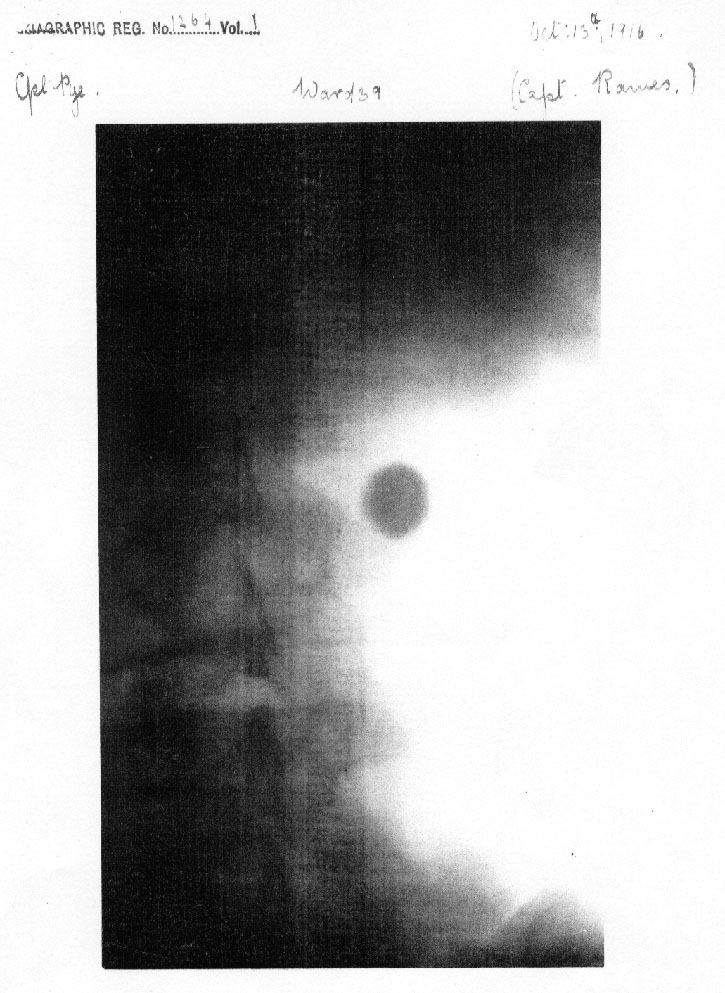
An X-ray examination report described a "Bullet present subcutaneous," and a notation makes it clear that he was a "walking," rather than "stretcher" or "chair," patient. Although no X-ray image appears to have survived in his records, the image of a skiagraphic above, extracted from a fellow soldier’s service record, shows a similar lodged bullet. On 6th September an operation was conducted and the doctors successfully removed the offending piece of lead.


Patients and nurses at Napsbury St Albans, 1917
Image © Rohan Price and courtesy of Hertfordshire Genealogy

The subsequent entries on his medical records indicate that he "returned from auxilliary, healed" on 4th October, and was discharged to the Canadian Military Convalescent Hospital at Woodcote Park, Epsom three days later. He was given a final medical examination on 8th October which pronounced him fit “Di” and, after recuperating for another week, he was discharged on Monday 14th and sent on furlough for ten days.


154 Almond Street, Normanton, Derby
Image © & courtesy of Google Maps Street View

Of course Leslie headed straight home to Derby but when he arrived he found Con very ill. She succumbed to influenza at 154 Almond Street, Normanton, Derby on Sunday 20th October. It was the second major wave of the “Spanish” flu epidemic in the United Kingdom, with hundreds of thousands dying, and Leslie’s distress during the journey back to the Canadian Machine Gun Depot at Seaford, Sussex on the 24th must have been acute. The regulation requirement to report to the Paymaster that his wife was deceased, and therefore he was no longer entitled to separation pay, would no doubt have added insult to injury, the loss of $25 a month being the least of his concerns.

At 11 a.m. on 11th November 1918, the day that Leslie received his final TAB inoculation, the armistice between the German and Allied Forces came into effect, and the war was suddenly over. Without Con, Les must have looked at peace time with mixed emotions. Who knows what their plans had been? Would they have gone back to Winnipeg together, where Leslie had a decent clerk’s job at Eaton’s department store waiting for him? It seems likely. He was eventually demobilised in Canada in February 1919, after a prolonged stay at Kinmel Park in Wales and a trip across the Atlantic on the S.S. Olympic, but that’s a story for another time.


Leslie Payne, Summer 1915 (left) and Winter 1918/19 (right)
Paper prints, Collection of Barbara Ellison

I find it telling how much he changed in that short space of time. He was a fresh-faced 22 year-old when he enlisted in the CEF in November 1914, and a haggard 26 on discharge. He looks at least a decade older in the later photo, not just three or four years, and I’m sure it was not just his appearance that was different. I've been told that Grandpa hardly ever talked about the war, at least not to anyone who ever felt comfortable to share such confidences with others, and from what I can tell this was not uncommon amongst Great War veterans.

How should he communicate and explain such a kaleidoscope mish-mash of contradictory emotions and experiences in which they had been suddenly immersed on the Western Front, in Leslie’s case, for 2 years, 11 months and 14 days? Their subjection, after rudimentary initial training, to a totally unfamiliar environment, the exhausting slog of marching and carrying supplies to the front, the tedium and discomfort of life in the trenches, the camaraderie eventually engendered between members of a machine gun crew who lived every moment of every day together, often within inches of each other, for months on end, and the anticipation of death at any moment, from any quarter, in the trenches, eventually replaced with mind-numbing resignation – all these would have been incomprehensible to their families and friends back home.

I hope that he was eventually able to dispel at least some of the dark thoughts, but I am sure there were many others that he could never forget. And nor should we.

Thursday, 21 April 2011

Photo buttons

Image © and collection of Brett Payne

In my personal family collection is a small button, 12.4 mm or half an inch in diameter, with a photograph on it of my great-uncle Willem Hendrik Schipper (1882-1932), dressed in his Dutch merchant navy uniform. I've not seen many of these around, so I thought I'd do some research on when they were popular and how they were produced. It would also be nice to know how many others have examples in their collections.

Image © and collection of Brett Payne

Judging from a comparison of this photograph with others of Willem in an old album which belonged to my great-aunt Tante Gien, it was taken in his mid- to late twenties, say between 1906 and 1912. He was eventually Chief Engineer on several ships belonging to Royal Dutch Lloyd, but I imagine that at this time he was of a more junior rank.

Image © and collection of Brett Payne

This photo button was designed with a pin on the reverse, presumably so that it could be worn on clothing.

The first cameras specifically designed to produce photo buttons appear to have been the rather unwieldy Takuquick (1902) and Taquta (1905), both using dry ferrotype plates loaded into a separate compartment which, after exposure, were dropped into a developing and fixing unit [1].


Wonder Automatic Cannon camera, c.1910

Two brothers Manuel and Louis Mandel, operating as the Chicago Ferrotype Company, started selling a variety of "one-minute picture-taking machines in 1907 [2].

Image courtesy of Google Patents
Louis Mandel's Magazine Developing Camera, Patented Dec. 22, 1908

They introduced their first commercial camera, the Mandel-ette, capable of taking direct positive photographs using a 2½" x 3½" card format, in 1909, and followed that with the Wonder Automatic camera, originally patented in the United States 1908 as a "Magazine Developing Camera," shortly after [3]. This condensed the photographic apparatus into a much smaller and handier package.

Image courtesy of Mike Butkus

In 1910 an improvement marketed as the Wonder Automatic Cannon camera was being sold, capable of producing eight button photographs per minute, a complete outfit being priced at $23.30. This enabled a very low production cost, and a reasonable profit from selling the photo buttons at 5 cents each [4]. One inch diameter sensitised blanks were loaded into the cannon, the shutter was operated by squeezing the rubber bulb, and a bolt-operated device dropped the exposed button into a developer tank in the base. After 30 seconds the button was removed from the tank, rinsed and inserted into a pinback frame [5]. It was patented in England in 1911, and presumably sold there after that date.


Errtee button tintype camera by Romain Talbot, Berlin, 1912


Telephot by British Ferrotype Co., Blackpool, c.1913
Image courtesy of Early Photography

Several other similar photo button cameras were produced, including the Errtee and Wundergranate by Romain Charles Talbot of Berlin, Germany (1910), and the more telescope-like Telephot from the British Ferrotype Co. of Blackpool, England (1913) [1,6].


Räderkanone by Romain Talbot, Berlin, c.1912
Image courtesy of John's Rollei Collection

The Räderkanone (Romain Talbot, c.1912), operating with the same prionciples but fashioned in the shape of an artillery cannon, was commonly used by itinerant photographers at fairs, carnivals and other tourist attractions [7].


I found images of several different types of photo button on the net, sometimes with ornate or decorated frames, and often with the name of the type (Rapid Pinback), manufacturer (Granley Photo Button Mfg. Co., 4109 Wabash Avenue, Chicago; Indianapolis Photo Button Co., No 8½ E. Wash. St.) or photographer (W.T. Ross, Appleton, Wis.) printed inside the back, and in one case even a possible date (May 31, 98.).

I'd be keen to see other varieties, and perhaps even some dated examples. It suggested by some authors [1] that these button cameras continued to be used into the late 1930s, but it would be nice to see some dated examples or advertisements. Please feel free to send me some scans or, even better, blog about them yourself and post a link in the comments.

References

[1] Cameras: From Daguerreotypes to Instant Pictures, by Brian Coe, Crown Publishers, 1978, p.181-183.

[2] Chicago Ferrotype Company History, by Historic Camera History Librarium.

[3] Magazine Developing Camera, Louis Mandel, Patent Application filed 7 July 1908, Granted 22 Dec 1908, Courtesy of Google Patents.

[4] Photographic Advertising from A to Z Ads from 1888 to 1940's, by Mike Butkus.

[5] Camera: A History of Photography from Daguerreotype to Digital, by Todd Gustavson, New York: Sterling Publishing Co., 2009, p. 303-304.

[6] Telephot, by Early Photography.

[7] Historically Important Cameras, by John's Rollei Collection.
Join my blog network
on Facebook