Showing posts with label Thomas Frost. Show all posts

Tuesday, 21 October 2008

Portrait of a young man in Derby, by Milton ... or perhaps Frost?

This carte de visite comes from the collection of my aunt, Barbara Ellison, and was scanned by my brother and I during the course of several visits there in October last year.

Image © and courtesy of Barbara Ellison

The photograph, a vignetted head-and-shoulders portrait, appears from the gilt printing on the glossy dark green card mount to have been taken by William Milton at the Victoria Studio, St Peter's Street, Derby. Adamson (1997) shows Milton to have worked from these premises from 1898 until 1900, although as discussed in a previous article on this blog, I have shown that Thomas Frost was already occupying the studio by February 1900. Certainly, by April 1901 Milton appears to have abandoned the photographic profession and was working as a railway clerk in Peterborough.

Image © and courtesy of Barbara Ellison

However, the carte de visite appears to have been supplied in the pre-printed semi-transparent envelope shown above, which has the name of Thomas Frost, who succeeded Milton at the Victoria Studio, 26½ St. Peter's Street, Derby in late 1899 or early 1900. This suggests the possibility that the portrait may have been taken shortly after Frost took over, and that he used a card mount from Milton's old stock, disguising it with a far cheaper envelope printed with his own name. The cdvs shown below are two examples of the card mounts used by Frost when he did get his own printed (courtesy of Marilyn McMillan), and they are fairly similar in design to the one used by Milton.

Image © & courtesy of Marilyn McMillanImage © & courtesy of Marilyn McMillan

This seems to have happened fairly often, and is understandable. When a photographer took over a studio, he would not only be investing in the location, but would often inherit the collection of glass negatives built up by the previous proprietor and, if his predecessor had been any good, a certain amount of goodwill. Another example is shown by the case of the Victoria Chambers, owned by Clement Rogers and then taken over by J.W. Price who used identical card mounts (see previous article). It is interesting to note that Rogers took his remnant stock of Derby card mounts with him, and had them overprinted with the address of his new premises in St Leonards on Sea.

Back to the portrait in question, which was therefore probably taken in late 1899 or early 1900. It shows an unidentified young man in a smart white shirt with stiff collar, jacket and tie. Unfortunately, he was not recognised by my aunt. He appears to have the shadow of a nascent moustache on his upper lip, and I suspect that he is in his late teens. The most obvious candidate would be my great-grandfather Charles Vincent Payne's youngest brother, Fred Payne (1879-1946), who was still living with his parents at 139 St James Road, Normanton (Derby) at this time, even though he is shown as a "grocer and shopkeeper" operating on his "own account" in the 1901 Census.

Image © and courtesy of Barbara Ellison

The cabinet card portrait shown above, also from my aunt's collection, has a glossy dark brown card mount with no studio name or any identifying marks whatsoever. However, the subject looks so similar to that of the Milton/Frost portrait that I think it must be the same person, albeit a couple of years later, by which time his hair has grown somewhat.

Image © and courtesy of Barbara Ellison

The earliest positively identified photograph that I have of Fred Payne was taken three deacdes later, and is displayed above, showing him with a hat, possibly taking notes, at left, on the lawn at Dale Cottage (near Ingleby) in August 1933. Dale Cottage was for many years the home of his older brother Charles Hallam Payne (1870-1960), who is shown in the middle, and the latter's wife Sarah Emma Parker (1870-1946). Fred's second son, Clarence Benfield Payne (1907-1982) is standing at the right. An enlarged view of Fred (below) suggests, at least to me, that it could well be the same person as the young man shown in the earlier portraits discussed above.

Image © and courtesy of Barbara Ellison

Unfortunately Fred's grandson, who I met in Derby last year, has no pictures of his grandfather and, as he was only four when Fred died, is unlikely to have many memories of what he looked like. However, it may be worthwhile sending him some copies of these photographs to see if they ring any bells.

References

Indexed images of the 1841-1901 Census from Ancestry and the National Archives
Adamson, Keith I.P. (1997) Professional Photographers in Derbyshire 1843 - 1914, The PhotoHistorian, No. 118 Supplement, September 1997, ISSN 0957-0209.
Kelly's Trade Directories for Derbyshire, University of Leicester's Historical Directories
Craven, Maxwell (ed.) (1993) Derby Photographers 1852-1952, in Keene's Derby, Breedon Books, Derby, pp. 200-202, ISBN 1-873626-60-6

Friday, 13 June 2008

Thomas Frost, photographer of St Peter's Street, Derby

David Lamb recently sent me this portrait of the family of Reuben and Ellen Holmes of Derby, taken at the studio of Thomas Frost of 26½ St Peter's Street, Derby.

Image © & courtesy of David Lamb

Standing at the back are: John William (1879-1948) and Ernest Reuben Holmes (1881-1967). Seated are: John's wife Selina Holmes née Bull (1876-1937), who is holding their daughter Florence May, born at Derby on 22 May 1900 (d. 1956). Next are Reuben Holmes (1855-1929) and his wife, Ellen Holmes née Alton (1856-1937). Seated at the extreme right is Ethel Holmes (1887-1975), and at the front is Arthur Holmes (1891-1948). This entire family left Derby c. 1903 and moved to Toronto.

The 1901 Census, enumerated on 31 March that year, shows Reuben and Ellen Holmes living at 57 Bridge Street, Derby, with their three younger children Ernest, Ethel and Arthur, aged nineteen, thirteen and ten, respectively. Their eldest son John William Holmes, by then aged 21, was living with his wife Selina and their ten month-old daughter Florence May at 25 Milton Street, Derby. Neither are very far from the centre of Derby, where Frost's St Peter's Street studio was located, but they may well have taken a tram to get there, so as to avoid getting their clothes dirty. The baby looks to me to be about nine or ten months old and I estimate, therefore, that the Holmes family visited the studio in about March 1901, at almost exactly the time the census was done. If the family emigrated to Canada not long after this date, then the photograph may even have been taken in preparation for that event. I have come across quite a few instances of this, presumably done in order to leave some sort of permanent, and personal, mementoes or keepsakes with family that they were leaving behind.

According to Maxwell Craven (in Keene's Derby, published in 1993 by Breedon Books, Derby, pp. 200-202, ISBN 1 873626 60 6, courtesy of Sonia Addis-Smith), Thomas Frost trained with photographers Gervase Gibson & Son (of Derby & Nottingham) before setting up his own studio at 26½ St. Peter's St. These premises had previously been occupied by William B. Pearson until shortly before his death in 1885, but Frost only appears to have taken them over in 1899 or 1900. Gibson & Son's studio premises in Derby were situated at 30 St Peter's Street; the studio was certainly operating by 1895 (Source: Professional Photographers in Derbyshire 1843-1914, by Keith I.P. Adamson, publ. as Supplement No. 118 to The PhotoHistorian, September 1997), and possibly as early as 1893.

Image © & courtesy of Jane Porter

The Gibson & Son carte de visite above, of that approximate date, shows the addresses "8 Peck Lane, Nottingham" - which closed in 1895 - and "30 St Peter's Street, Derby," making it clear that the Derby studio had opened prior to the closure of the Peck Lane premises. Derby Electoral Registers (obtained on microfilm through the LDS church FHC network) for the years 1898-1900 show John Gibson - one of Gervase Gibson's three sons - with a studio in St. Peter's Street, while he lived first at Colyear Street, then in Drury Lane, suggesting that he was probably running the studio.

Thomas Frost was originally from Nottingham, but he arrived in Derby around 1896, after a brief sojourn in the United States. He was certainly living in Derby in the late 1890s (Source: Birth registrations of three children between late 1897 and early 1901, FreeBMD), but is not listed in Kelly's 1899 trade directory (Historical Directories), so was probably working for Gibson & Son at the time of the directory's compilation, c. late 1898. Adamson (1997) states that the studio of "Gibson & Son" at number 30 closed in 1900. The directory, and Adamson (1997), show that photographer William Milton was at 26½ St Peter's Street from 1898 until 1900.

Image © the British Library & courtesy of Gale CENGAGE Database

It is around this time that we find the first mention of Thomas Frost working on his own behalf. On 28 February 1900 an article in The Derby Mercury (Courtesy of the British Library & Gale CENGAGE Database) mentions Thomas Frost, photographer of St. Peter's Street, as the "master" of a "traveller on commission." Then, on 31 March the following year, the census shows Frost living at 1 Sacheverel Street, Derby, and describes himself as a "portrait photographer (employer)." His younger brother, Robert Ernest Frost, who was living at 60 Randolph Rd, Normanton, described himself as a "photographers agent," and it seems likely that he was employed by Thomas at this time, perhaps as a replacement for the unreliable agent, Charles Bridge.

Image © & collection of Brett Payne

Frost probably worked from these premises until 1902, but in 1903 he appears to have moved to another studio at number 92 St. Peter's Street, where is listed by Adamson (1997). However, it is known that Frederick Beeston, who had previously worked as a photographic assistant in Nottingham, probably also for Gibson & Son, had the studio briefly around 1903, using some of Frost's card mounts with his name pasted on, as in the cabinet card shown above. "Gibson & Sons" then took over number 92 St. Peter's Street, and operated it from 1903 until at least 1907.

Wednesday, 5 September 2007

Identification of photo subjects - Lessons to be learnt

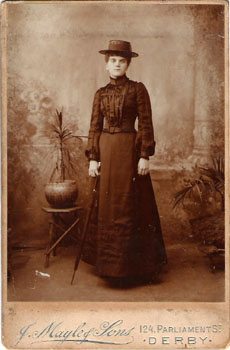
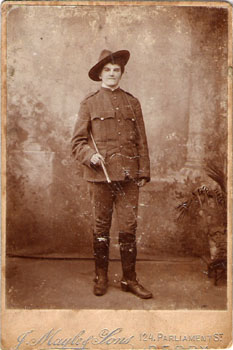
In January this year, Kevin Rhodes sent me a batch of images, among which were these two cabinet cards, taken by John Mayle & Sons of 124 Parliament Street, Derby.

Lucy Saddington (1884-), taken by John Mayle & Sons in Derby, c.1900-1905.Lucy Saddington (1884-), taken by John Mayle & Sons in Derby, c.1900-1905.

Kevin had the following to say about them:

These presumably are siblings taken at the same time. I am unsure of the ill-fitting uniform and the sex of its wearer. I have wondered about the possibility of this being a male-impersonator outfit from the music-hall. The uniform certainly has no insignia on it and by the address on the card we are well before both the First World War and the Boer War.

As I had no clues as to the identity of the subjects, I posted the images in the Portfolio section of my profile of this photographer, and thought nothing more of them. Then, a fews days ago, I heard from Kevin again:

A comment on the ones I previously sent at Mayles photographers - census records of the family only show four sisters in the family, and the two people in the pictures have hands and fingers that are identical; leading me to think they both are of Lucy Saddington, of whom I have later studio photos with no photographers identity on them (poss trimmed off on purpose). Also, of the three sisters Mary is older, Jane had straight hair, and Edith was much younger.

So, I had a better look at the images, in particular the faces and hands of the subject(s):


They are indeed very similar, if the absence/presence of the grin is taken into account, and the ring is present in both cases. From the similarity of the studio setting and props, the portaits were probably taken on the same occasion. Kevin had more to say on the provenance of the photographs:

Last year, on the death of two elderly relatives, I came by two photo collections. The first belonged to my Mother Betty Rhodes née Rankin (1925-2006) (daughter of Mary, the elder Saddington sister), and includes the pictures from Mayle & Sons and a carte de visite by (Thomas) Frost of Derby (see below). These were clearly of a relative of Mary, but identifying her was difficult.

Lucy Saddington (1884-), taken by Thomas Frost in Derby, c.1898-1900.

The second collection was from Edith "Edie" Falconer née Smith (1912-2006), the daughter of Lucy Saddington. Amongst these photos was a studio cabinet photo of Lucy Saddington with her husband George Smith, and a postcard picture of George in uniform (presumably during the First World War.)
George & Lucy Smith, by an unidentified photographer, probably in Derby, c. 1906-1908.George Smith, Lucy's husband, a postcard portrait taken during the First World War.

Lucy Saddington married George Smith in 1906 and had Edie in 1912, but died of unknown causes whilst Edie was young. I have a photo of Edie as a child (see below) with a lady which could be Lucy but I am unsure. It was of course the photo of George and Lucy together which helped me in the identification process, not only tying up with George in uniform, but also if you look carefully she is wearing the same brooch as in the earlier Frost picture from my mother’s collection, and although no proof in itself, doesn’t the skirt look like the work of a proud young tailoress!
Lucy(?) & Edie Smith, by an unidentified photographer, probably in Derby, c. 1914-1915.

This is an excellent account of careful detective work which resulted in the provisional identification and tying together of a whole series of pictures from separate inherited family collections. It demonstrates the usefulness of examining photographs together with other family photos, and in the light of their provenance.

It also illustrates the importance of being cautious about making assumptions without reasonable cause. For example, the wearing of what appears to be a military uniform doesn't necessarily mean that the subject actually served in the military. Although the photo probably was taken during or shortly after the Boer War, it is obvious that Lucy never served in the army.
Join my blog network
on Facebook