
Showing posts with label Blackpool. Show all posts

Saturday, 11 July 2015

Sepia Saturday 287: Picturing the Shape of an Immigrant Family

Sepia Saturday by Alan Burnett and Marilyn Brindley

Last week I introduced the Henschel and Gifford families, likely original owners of an old photo album that came into my possession a few years ago. This week's Sepia Saturday theme image suggests group portraits, and is convenient because I will follow on with the cabinet portrait of an unidentified group of young women that I used last week.
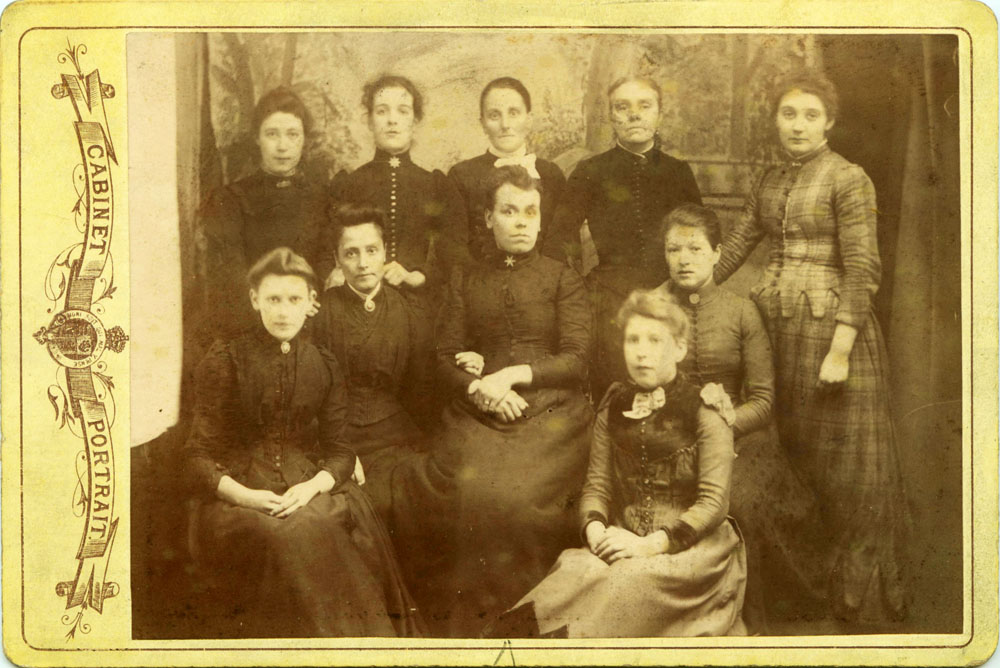
Image © and collection of Brett Payne
Cabinet portrait of unidentified group of women, c.1889-1893
Image © and collection of Brett Payne

As explained in more detail in the previous article, these young women are as yet unidentified and we can't even be sure who the woman at the centre of the group, marked with an arrow pencilled in the lower margin, might be. What we can say with a fair degree of certainty, due to a pencilled notation on the back of the card mount, is that either Herbert Henry Henschel (1888-1982) or his wife Agnes Hammersley née Gifford (1888-1967) of Cleveland, Ohio ordered an vignetted enlargement of this woman's portrait, probably between 1907 and 1913. It seems likely that the subject of the vignette was Agnes's mother Ellen (Nellie) Gifford née Slater, who emigrated from England to the United States with her husband Frederick (Fred) Thomas Gifford (1862-1932) and infant daughter in February 1893.
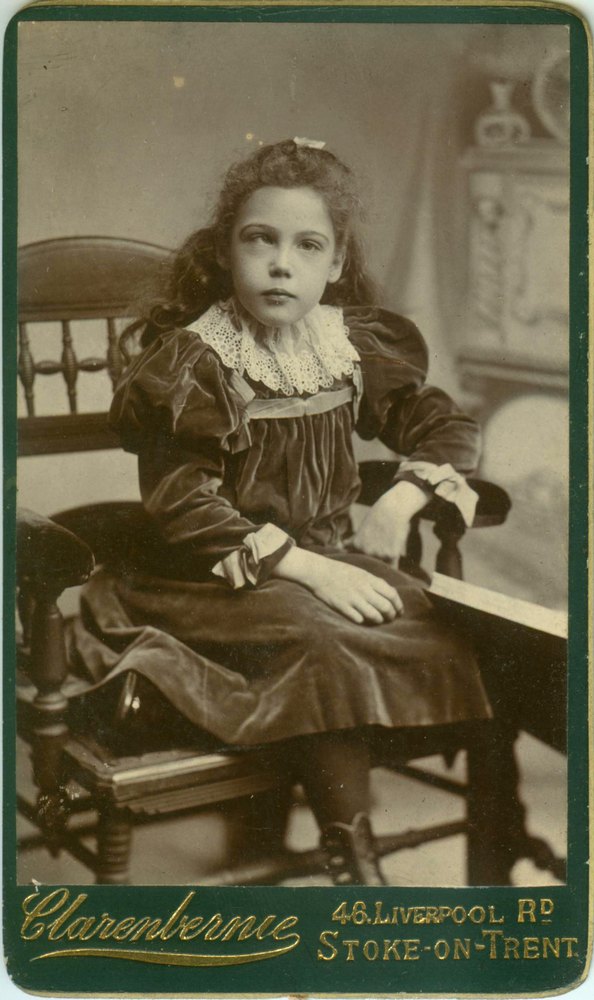
Image © and collection of Brett Payne Image © and collection of Brett Payne
Unidentified girl, taken c. 1900-1903
Carte de visite by R. Clarenbernie, 46 Liverpool Rd, Stoke-on-Trent
Images © and collection of Brett Payne

The preponderance of portraits in the album taken by studio photographers in Staffordshire (9) and Derbyshire (10) (see geographical distribution here), even taken after the Gifford family's emigration to Cleveland in 1893, points to the existence of a wider family network, some of whom may have remained in England. There are two further carte de visite portraits in the album which have inscriptions on the reverse, the first of which is clearly handwritten in black ink, "Fred & Nellie." Jones (1994) handily lists the photographer R. Clarenbernie working at this address in Stoke-on-Trent only from 1900 to 1903, providing us with a good date estimate for the portrait of a young girl.
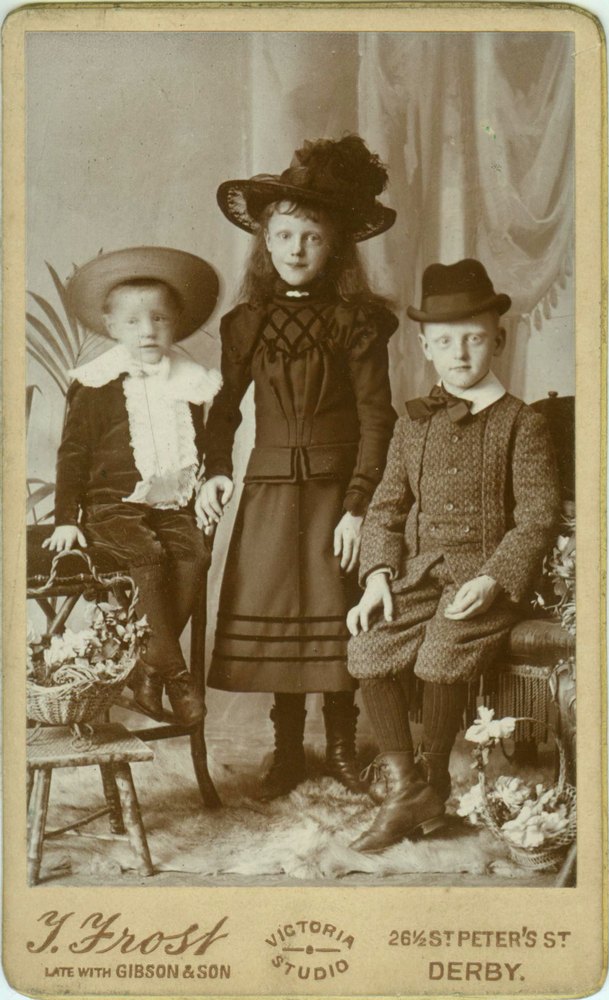
Image © and collection of Brett Payne Image © and collection of Brett Payne
Three unidentified children, taken c. 1898-1901
Carte de visite by Thomas Frost, Victoria Studio, 26½ St Peter's St, Derby
Images © and collection of Brett Payne

The second portrait of three pre-teen children (probably a girl and two younger brothers, judging by their facial similarities) was taken by Derby photographer Thomas Frost, whom I know from my own research was active at that address from c.1896 to 1903. The card format (in particular the words, "late with Gibson & Son") indicate that it was probably used prior to c. 1901, while the clothing (specifically the girl's sleeves and the boys' lace collars) suggest a date of very late 1890s or early 1900s. In this case, the inscription reads, "for Nellie with best wishes."

Although pretty meaningless until the recent discovery of the Henschel-Gifford family connection with the album, these two inscriptions now tell us a great deal, because we can be certain that they were taken in England several years after Fred and Nellie had departed for North America. In other words, they must have been sent to them by family back in the old country, and it appears likely that the subjects were nieces and nephews, in other words children of siblings of either Fred or Nellie Gifford. The existence of both photographs in this album also strongly suggests that the album may at one time have been owned by Fred and Nellie Gifford.

Image © and courtesy of Frank Bates Image © and courtesy of Frank Bates
James Gifford (1829-1902) and Ann née Hammersley (1832-1926)
From the Ancestry.com family tree & collection of Frank Bates

So off I went to Ancestry.com to look for Fred and Nellie's respective families, tracing them through census, GRO, parish and other records to build up a detailed picture of their immediate families, and in particular to determine what happen to their parents and siblings. I found several family trees uploaded and made publicly available by others, some of whom are clearly related, which made my job a lot quicker and easier. I am particularly indebted to the research done by Frank Bates of Eastlake, Ohio, who is descended from Fred's sister Elizabeth Matilda Gifford (1869-1952). Of special interest are the photographs of Fred Gifford's parents, James Gifford (1829-1902) and Ann née Hammersley (1832-1926), which I have displayed above.
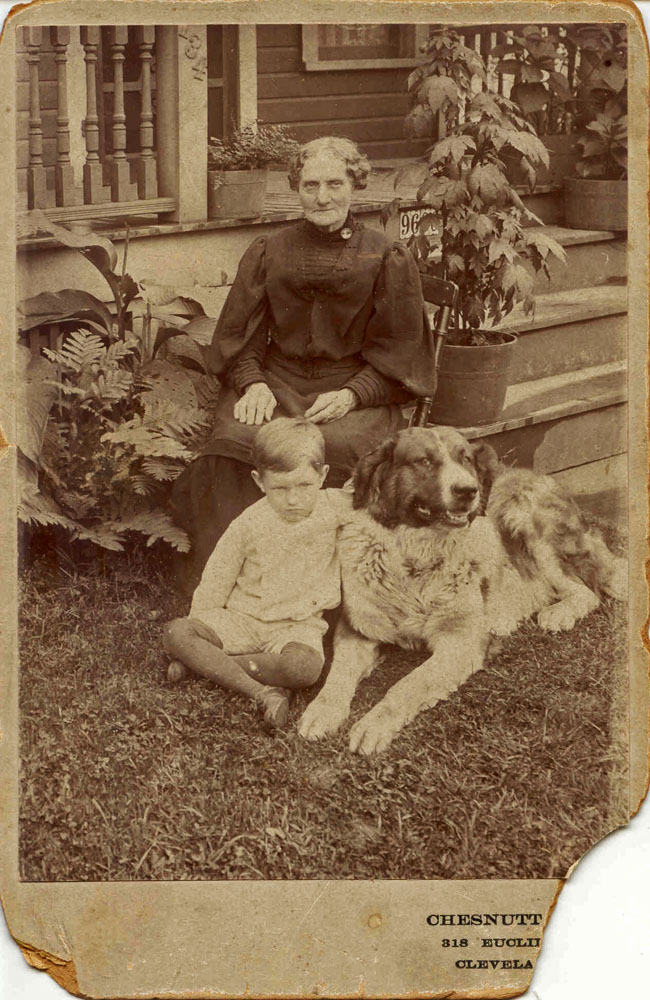
Image © and courtesy of Frank Bates
Ann Gifford née Hammersley, Frank Bates and "Butch," taken c. 1909
Cabinet card by Chesnutt Bros (Lewis H & Andrew J), 318 Euclid Ave, Cleveland, Ohio
From the Ancestry.com family tree & collection of Frank Bates

James Gifford married Ann Hammersley at Stoke-on-Trent in 1853, where they lived and had eight children, four boys and four girls. Their last child Agnes Hammersley Gifford was born in late 1879 and died before her third birthday. All seven of their remaining children married, and six of those couples in due course had children of their own. In the mid-1880s, after most of their children had left home, the Giffords moved to Denbigh, a small town in North Wales. James Gifford died in Denbigh in June 1902, and in 1905 his widow crossed the Atlantic to live with her daughter and son-in-law, which is presumably where the portrait with her grandson and his dog (above) was taken.
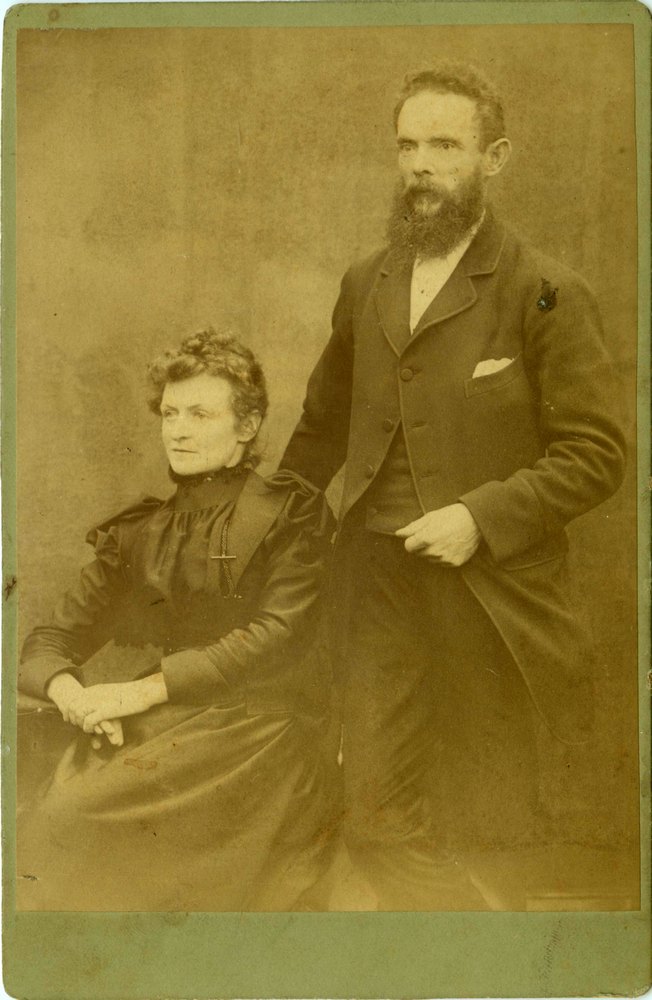
Image © and collection of Brett Payne
Unidentified middle-aged couple, c. 1879-1882
Cabinet card by W.H. Smith of Crickhowell, Breconshire, Wales
Image © and collection of Brett Payne

It didn't take much time to find a portrait in the album depicting a middle-aged couple who look very much like younger versions of James and Ann Gifford. Judging by the tight sleeves of the woman's dress, with a large full puff at the top sitting high on the shoulders, I estimate this portrait to have been taken in the very late 1870s or early 1880s (Blum, 1974). They would have been in their early forties at the time, a few years before they moved permanently to live in Denbigh.
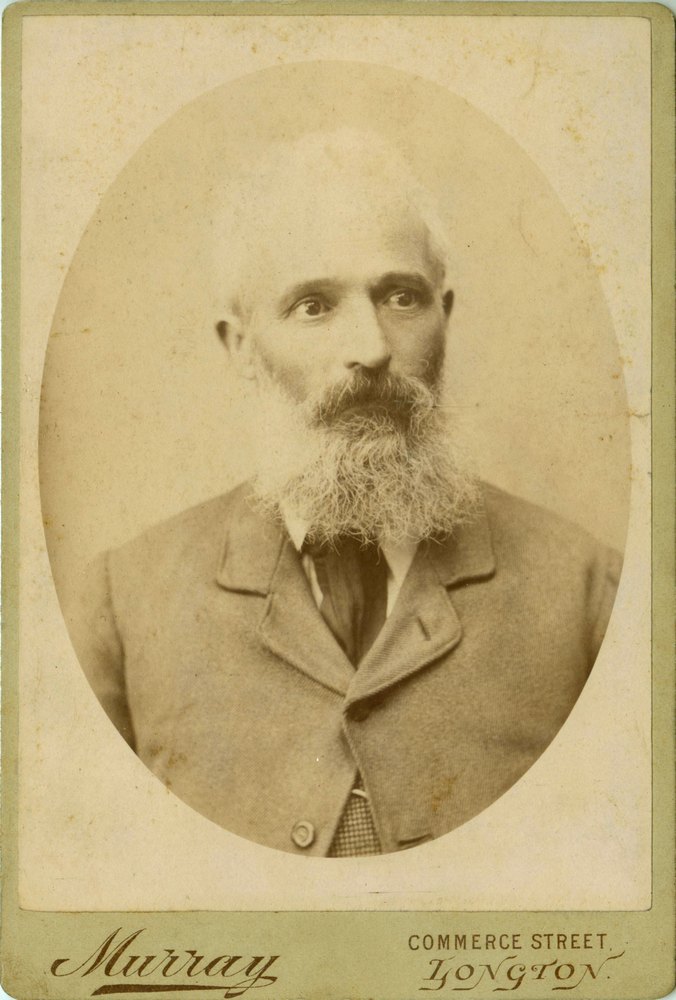
Image © and collection of Brett Payne
Unidentified middle-aged man, c. 1889-1891
Cabinet card by James Murray, Commerce Street, Longton
Image © and collection of Brett Payne

This portrait, taken roughly a decade later in Longton (Staffordshire), also appears to be of James Gifford, although his hair is by now completely white.
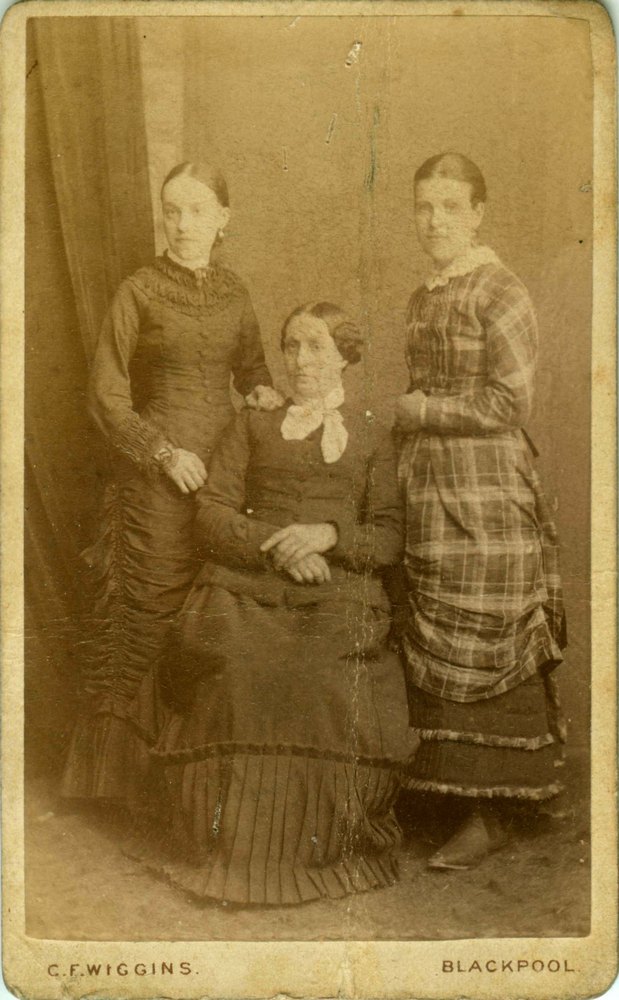
Image © and collection of Brett Payne
Three unidentified women, c. 1885-1888
Carte de visite by C.F. Wiggins, Imperial Studio, 27 Talbot Rd, Blackpool
Image © and collection of Brett Payne

There is also a carte de visite portrait of one older and two younger women, taken in Blackpool in the mid- to late 1880s. The older woman looks very similar, in both facial features and hairstyle, to the black-and-white portrait of Ann Gifford above. The two younger women in the portrait are most likely her daughters, but which ones? For an answer to this question, it is necessary to widen our view across the whole Gifford family, and this is where it starts to get difficult because of the number of children they had.
- James Gifford (1853-) married Mary Worrall in 1875
- William Edgerton Gifford (1856-1940) married Mary Ann Haywood in 1877
- Frederick Thomas Gifford (1862-1932) married Ellen Slater in 1887
- Mary Ann Gifford (1864-) married Alfred Maiden in 1887
- Charles Gifford (1867-1922) married Jane Grocott in 1892
- Elizabeth Matilda Gifford (1869-1952) married George Bates in 1892
- Cecilia Gifford (1875-1974) married Fred George Ham in 1899
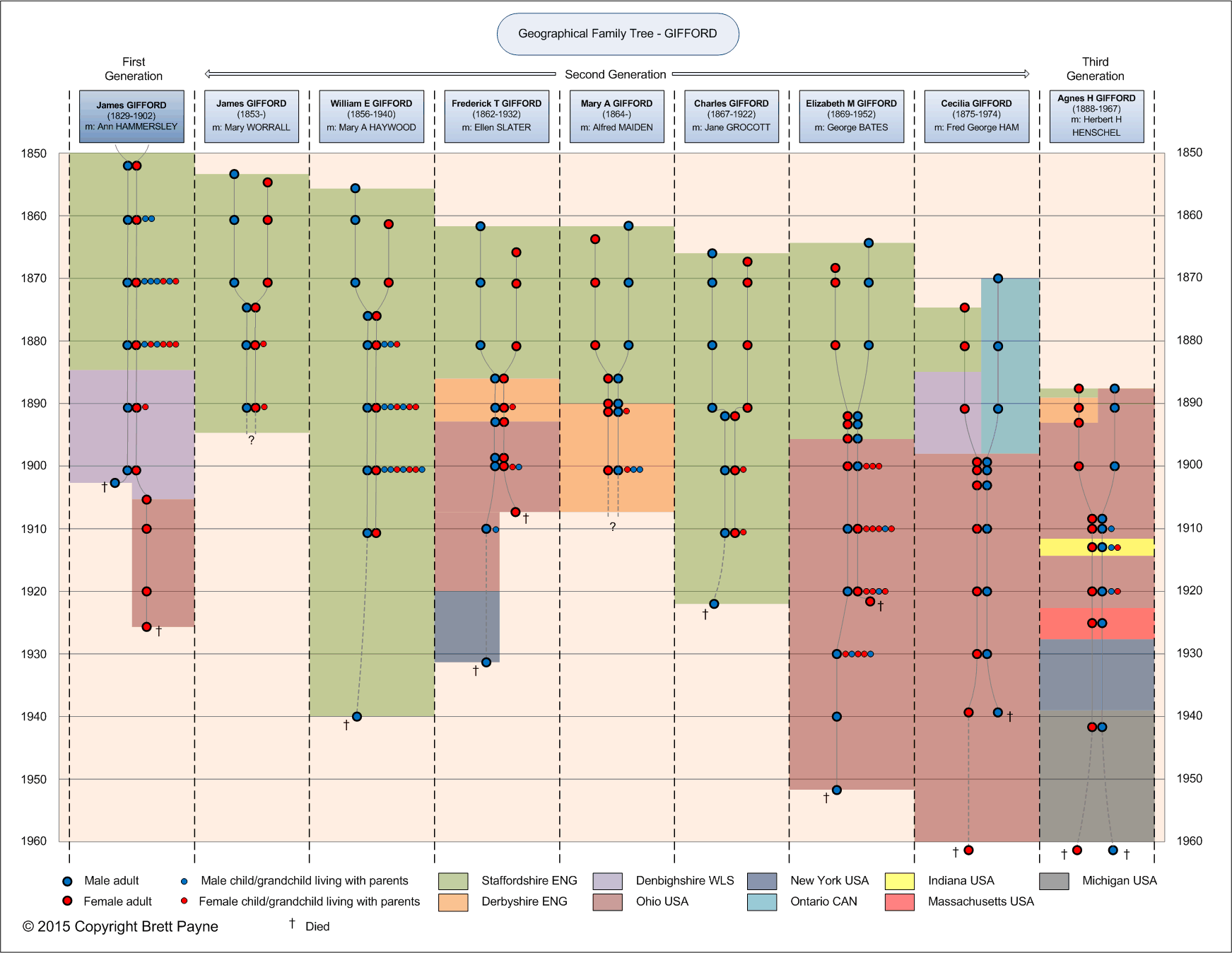
Image © 2015 Brett Payne
Gifford Geographical Family Tree, Click to enlarge
Image © 2015 Brett Payne

The need to be able to visualize the locations of the various branches of the Gifford family through time has led me to design a novel type of family tree, which attempts provide a graphical solution to a problem that I have experienced many times when attempting to research family photo albums. This is its first airing, and since it is really just a prototype, I'll hope you'll bear with me if there are a few hiccups and inconsistencies. To be able to see the full version image at the same time as reading my explanation, I suggest that readers right click with their mouse button on the image above, choose to "open in a new window," and then adjust the size of the browser windows accordingly so you can see both at the same time, assuming your screen is big enough.

Each column on the chart represents a different Gifford family group, with the "first" generation of James and Ann Gifford on the far left, then the seven children of the second generation, and finally Agnes Gifford & Herbert Henschel, who were in the third generation. The vertical axis represents time, and extends from 1850 to 1960, with the decades marked by horizontal rules.

Individuals are marked on the chart by a series of coloured dots (blue for males, red for females, naturally) connected with lines from their birth date, through marriage (where a male and female line will merge), having children (slightly smaller dots) until their death (marked by a small cross). Underlying the family lines are colour fills representing the locations where they were living at the time, for example pale green for Staffordshire (England), pale purple for Ohio (United States), etc. The key to these colours is at the base of the chart.

Image © and collection of Brett Payne Image © and collection of Brett Payne
Portraits taken in Stoke-on-Trent, Staffordshire, c. 1900-1903 (left)
and Derby, Derbyshire, c. 1898-1901 (right)
Images © and collection of Brett Payne

The intention, therefore, is that if the location and approximate date of a photographic portrait are known, and the age(s) of the subject(s) can be roughly estimated, then the chart can be used to determine which members of the family were living in the right place at the right time, and were the right age, to be candidates for the portrait.

Perhaps readers would like to try their hand at doing this for themselves with the two cartes de visites shown above, to see if (a) the chart works as intended, and (b) whether you come up with the same candidates as I have? In other words, if we assume that these children are daughters and sons of one of Fred Gifford's siblings, which second generation family do they belong to? I'd be very grateful if you'd leave your deductions in the comment box below. If you find the chart too difficult to understand, have some questions or suggestions for improvements, or indeed any other comments, I'd likewise be pleased to hear from you.

Post Script 14 July 2015

These are my interpretations of who the subjects of the two carte de visite portraits might be:

(1) Clarnbernie portrait of girl with a wall-eye
The girls looks to be aged around 8-10 years, which implies a birth date of c. 1890-1895 if my date estimate for the portrait is correct. Three of the second generation Gifford families were living in Staffordshire during this period: James & Mary Gifford, William & Mary Ann Gifford and Charles & Jane Gifford. All three had daughters, but only Charles & Jane had a daughter of the right age. She was Agnes Annie Gifford born in 1892 at Stoke-on-Trent.

(2) Frost portrait of three children
The only family living in Derby around the turn of the century was Alfred and Mary Ann Maiden, who had three children: Florence Amelia Maiden, born in 1890 and therefore aged c. 8-11, Alfred James Maiden, born in 1891 and hence aged c. 7-10, and Harry Maiden, born in 1896 and aged 2-5.

References

Alderman, Mari (2006) Victorian Professional Photographers in Wales, 1850-1925, publ. online by GENUKI.

Blum, Stella (1974) Victorian Fashions & Costumes from Harper's Bazaar, 1867-1898, New York: Dover Publications, 294p.

Harbach, Mike (2014) Staffordshire Photographers Index, publ. online by GENUKI>

Jones, Gillian A. (1994) Professional Photographers in North Staffordshire, 1850-1940, The PhotoHistorian, No. 103 (Winter 1994), Royal Photographic Society Historical Group.

Jones, Gillian A. (nd) Professional Photographers in South Staffordshire, 1850-1940, The PhotoHistorian, No. 105, Royal Photographic Society Historical Group.

Jones, Gillian (2004) Lancashire Professional Photographers, 1840-1940, Watford: PhotoResearch, 203p.

Friday, 19 June 2015

Sepia Saturday 284: Panel Prints and Coupon Prints

Sepia Saturday by Alan Burnett & Marilyn Brindley

My contribution for Sepia Saturday this week features a photographic format that was popular for only a brief period, and which often receives only cursory attention in photohistory texts, even though they are fairly commonly seen. In the late 1890s and early 1900s, more or less at the same time as amateur photography was taking off, a profusion of new formats were introduced, presumably in an effort to entice customers away from buying their own cameras and back into the studio.

Image © and courtesy of Colin Harding/Photographica World
Charles Howell's early studio at Pleasure Beach, Blackpool, undated
Image © and courtesy of Colin Harding/Photographica World

Among these were the panel print and its smaller sibling the coupon print, which appeared shortly after the turn of the century, had their heyday between 1905 and 1915. Initially the new tall, thin shape was probably a draw, but I have little doubt that their low cost proved the main attraction for both studios and their customers. At half a dozen for sixpence from Charles Howell's beachfront studio in Blackpool, they were half the price of the already wildly popular postcard portraits.

The examples featured below include a few from my own collection, and may not represent the full range that were available, but at least they give a fair idea of the format. I've attempted to keep the colours as accurate as possible, and on my screen they are displayed actual size, although they may appear differently to you, depending on the device being used to view this page. I've also provided a number of references to Geoff Caulton's very useful PhotoDetective 1901-1953 pages, which gives many examples of the rapidly changing fashions in hair, hats, clothing and accessories during that period.

Image © and collection of Brett Payne Image © and collection of Brett Payne
Two unidentified young women, c.1914-1918
Panel prints (56 x 121 mm) by D.A. Maclean of Middlesboro & Blackpool
Images © and collection of Brett Payne

These two young women probably visited Maclean's popular Blackpool studio during the Great War, judging by their practical swept back hair styles, V-necked blouses and white corselet skirts typical of that period. Since I acquired them in the same batch, the appearance of identical backdrop and wicker chair suggests they may have been taken on the same occasion.

Image © and collection of Brett Payne Image © and collection of Brett Payne
Two unidentified teenage girls in costume, c.1912-1915
Panel prints (54 x 113 mm) by unknown photographer
Images © and collection of Brett Payne

The younger girl on the left has her hair swept back in a transitional hairstyle, tied with what must be one of the largest butterfly hair bows that I've seen, popular from 1912 to 1918. The older girl has her down in what was sometimes referred to as her crowning glory, although the metal wrist cuffs suggest a costume of some kind. These two panel prints also have similar poses and an identical backdrop, and I wonder if they were sisters appearing in the same stage performance. Perhaps readers more au fait with theatre of the time might be able to suggest a classical play and/or character. Troilus and Cressida is the only one that comes immediately to mind as being from that era.
Post Script Thanks to Rob from Amersfoort, we now have a probable ID for the role being acted, i.e. that of "Mercia" from Wilson Barrett's 1904 four act historical tragedy, The Sign of the Cross, as shown here and here. Thanks Rob.

The wristwatch on the younger girl's left arm is an interesting accessory. It's actually a leather-cased ladies' fob watch popular during the Edwardian era.

Image © and collection of Brett Payne Image © and collection of Brett Payne
Unidentified young women, 28 April 1913 (left) and c. 1910-1915 (right)
Coupon prints (39 x 86 mm) by unknown photographer
Images © and collection of Brett Payne

The most striking feature of these two women is their enormous cartwheel hats, no doubt kept perched in place with long hatpins and a low pompadour hairstyle. The large-buttoned and belted jackets, probably worn over hobble skirts, confirm that these were taken some time during the decade before the Great War. Also noted in the right-hand portrait is the very visible reference number (7141, reversed), probably written in ink on the negative.

Image © and collection of Brett Payne Image © and collection of Brett Payne
Unidentified young woman and girl, c.1910-1915
Coupon prints (36 x 88 mm) by unknown photographer
Images © and collection of Brett Payne

The young lady on the left again has her hair in the transitional style characteristic of the pre-war period. The portrait of the girl is more difficult to date, because her clothing and loose hairstyle could be from any time during the period 1905 to 1920. The belted dress with slightly dropped waistline is similar to some seen in the early 1920s, but the lace collar is more akin to the pre-war period.

These coupon prints were designed so that four could be made from a single postcard cut into strips. The glass plate was probably exposed four separate times, using a card inside the camera, in front of the plate, to mask off all but the desired strip. The shadowing effects across the lower part of the portraits - light in the left-hand portrait, dark in the right-hand portrait - were produced by placing a vignetting card close to the camera, between the lens and the subject.

Image © and collection of Brett Payne
Unidentified woman, c.1908-1916
Coupon print (35 x 69 mm) by unknown photographer
Image © and collection of Brett Payne

The dark, simply ornamented and middle-waisted dress worn with a high frilled collar and long sleeves is also suggestive of the pre-war period. Her hair style, however, is suggestive of a couple of years later. Detailed painted backdrops became far less common after the war, photographers, and presumably their clients, tending to prefer plain or simply ornamented patterns.

Image © and courtesy of Paul Godfrey
Unidentified man and child, c. 1918-1920s
Coupon print (38 x 70 mm) by H.O. Seaman of Great Yarmouth
Image © and courtesy of Paul Godfrey

This coupon print by Herbert Oscar Seaman, scion of the well known Chesterfield (Derbyshire) firm of Alfred Seaman and Sons, is unusual in that it has a tiny number printed at the base, apparently with the aid of some kind of counter (better visible with an enlarged version of the image).

Image courtesy of the European Patent Office
Extract from patent GB190305361(A), 16 Apr 1903, by D.B. Seaman
"Improvements relating to Photographic Cameras ..."
Image courtesy of the European Patent Office

In 1903 Herbert's older brother Dennis Benjamin Seaman applied for a patent for a camera specifically designed to produce a series of such 1½" x 2½" images on a single photographic plate (Specification), while "a smaller lens projects an image of a ticket with a number or the like." It seems likely that the coupon print produced by Herbert Seaman, and likewise several others in the collection of Paul Godfrey, were made with an apparatus very similar to that designed by his brother.

Image © and courtesy of Peter Jones
Unidentified man in front of H.O. Seaman's Parade Studio, Yarmouth
Postcard print, Image © and courtesy of Peter Jones

The postcard photo shown above depicts the storefront of Herbert Seaman's Parade Studio in Yarmouth not long after the end of the Great War, and possibly with Herbert himself standing at the front door. In the window is a sign advertising "12 LARGE MIDGETS FOR 1/-." Given that he was selling a dozen postcard prints for two shillings, it seems likely that the "midgets" were commonly referred to as coupon prints.

Image © and courtesy of Robert Pols Image © and courtesy of Robert Pols
Two unidentified woman, taken c. late 1920s
Coupon print (43 x 88mm) by While You Wait Photographs,
The Beach Studio, 12 Lower Promenade, Whitley Bay
Image © and courtesy of Robert Pols

Image © Peter Fisher and courtesy of SmugMug
Bessie Fisher, 2 August 1929
Panel portrait (unknown dimensions) by Charles Howell, Blackpool
Image © Peter Fisher and courtesy of SmugMug

The popularity of the format declined considerably through the 1920s, and by the end of the decade they were largely relegated to seaside arcades (above) and photobooths (below) as a novelty format.

Image © and collection of Brett Payne
Novelty format displaying weight of unidentified woman
Panel print (47 x 103mm) from photobooth, dated 10 September 1935
Image © and collection of Brett Payne

I'm very grateful to Paul Godfrey who has shared his collection of images, extensive knowledge and the results of his research. I'd also like to extend my appreciation to Colin Harding, Peter Jones, Robert Pols and Peter Fisher for graciously permitting me to use images from their collections in this article.

For those who find the plethora of photo formats a little confusing, I've prepared a photo format size guide as a PDF file which you can print out and use to gauge photographs from your own collection.

Saturday, 14 December 2013

Sepia Saturday 207: Happy Days at Blackpool


Sepia Saturday by Alan Burnett, Marilyn Brindley and Kat Mortensen

I'm back after a fifteen week break from Sepia Saturday, during which time I visited England, France, Spain and California, and walked the Camino de Santiago, a pilgrim route stretching for just under a thousand kilometres across northern Spain, from St Jean Pied de Port to Santiago de Compostela and Finisterre. I was also delighted to meet and spend a day getting to know charming and genial fellow Sepians Little Nell and Caminante. Marilyn wrote of our exploring the enchanting city of Burgos together in Beguiled by Burgos. I'm very grateful that she and John went somewhat out of their way to facilitate this very successful meeting of like minds, and hope that we can do it again some time, somewhere.

Writing an article or two about the trip, which may include a few carefully selected photographs from my walk through historic northern Spain, will have to wait for when I have more time. This week I'd like to share some more images from a collection of glass plate and sheet film negatives that I've featured before here on Photo-Sleuth: SS179: Fun on the Sands - The Pleasure Palaces of Southport and SS188: The Cornwall Coast in Colour. The first of these two articles dealt with photographs taken by an amateur photographer during a visit to Southport, Lancashire, probably in 1913 or 1914.

It was on a similar trip, probably at around the same time, that the photographer took several scenes of the seaside attractions of Blackpool. It may even have been during the same trip; he or she might have taken a passage there on one of the steam boats from the end of Southport Pier. There are five negatives of views identified as from Blackpool, three of which I've included here.

Image © and collection of Brett Payne
Central Pier, Tower and Ferris Wheel, Blackpool, c.1913-1914
Quarter-plate glass negative (108 x 80mm, 4¼" x 3¼")
by an unidentified amateur photographer
Image © and collection of Brett Payne

This negative shows evidence of "in camera" light leakage or over-exposure along the left hand edge, and is suffering the ravages of time in the form of oxidation or silvering of the photographic emulsion, but the main part of the image is still in good condition. The view is of the Central Pier with the Blackpool Tower, theatre building, Ferris Wheel and Promenade from left to right, taken at low tide from a point on the beach a couple of hundred metres south of the pier.


I don't yet know who the photographer was, but he or she was no slouch when it came to recording holiday trips. By the second decade of the twentieth century, not only were there cheaper and easier roll film cameras (box and folding) available, rather than the fiddly plate or cartridge-backed model he used, but this was also the heyday of the picture postcard. The selection included in the slideshow above are typical of the large range of views which were readily available for visitors to purchase, and give a good impression the wide variety of activities available at the Blackpool waterfront.

Image © and collection of Brett Payne
Rainbow Wheel, Scenic Railway & Helter Skelter Lighthouse, Pleasure Beach, Blackpool, c.1913-1914
Quarter-plate glass negative (108 x 80mm, 4¼" x 3¼")
by an unidentified amateur photographer
Image © and collection of Brett Payne

In this large collection there are also two negatives depicting illuminated night scenes. Using postcards from that era, both are identifiable as having been taken at Pleasure Beach in Blackpool. I previously wrote about Charles Howell operating a photographic studio at Pleasure Beach between the two World Wars. Pictured in the negatives are a Rainbow Wheel, the Scenic Railway, the Helter Skelter Lighthouse (all above) and the Casino (below).

Image © and collection of Brett Payne
Casino, Pleasure Beach, Blackpool, c.1913-1914
Quarter-plate glass negative (108 x 80mm, 4¼" x 3¼")
by an unidentified amateur photographer
Image © and collection of Brett Payne


A series of contemporary postcards shows the same attractions, both by day and by night. In 1879 Blackpool became the first municipality in the world to have electric street lights installed, along the Promenade. The accompanying pageants were the forerunner of the town's famous Illuminations.


Fun on the Sands, 1914

I've also found several silent movie clips from 1914, 1926 and 1934 which give a very good feel for the various attractions on Blackpool's waterfront. The first clip, Fun on the Sands, includes the Senic Railway ride and a panning shot of the Rainbow Wheel, built in 1912, and the Helter Skelter Lighthouse. For further details of the rides and other attractions, click through the links to the YouTube web site.


Happy Days at Blackpool 1926 (Part 1)


Happy Days at Blackpool 1926 (Part 2)


Blackpool Illuminations 1934

This brings me to a small request to fellow Saturday Sepians and other regular readers of this blog. I am have started a small project studying seaside photography in Blackpool, and am looking for as wide a variety of seaside portraits as I can find. If you have any in your family or personal collections that you'd care to share, I would very much appreciate scans of them, please.

In particular, I'm looking for the following types of photographs:

  • any early daguerreotypes, ambrotypes or tintypes taken in Blackpool
  • formal portraits from any of Blackpool's numerous studios, from the 1840s/1850s through to the present day, including ambrotypes, tintypes, cartes de visite, cabinet cards, postcards and a variety of paper print formats
  • portraits taken by itinerant beach photographers, of relaxing on the beach, playing games or riding the ever present donkeys
  • walking pictures, also known as "walkies," taken by professional street photographers, perhaps taken along the Promenade or elsewhere in Blackpool
  • amateur photographs taken on or near to Blackpool's piers or beaches, particularly those with recognisable landmarks in the background, such as one of the piers, the tower, or fairground attractions.
They don't have to be wonderful quality - there are several other aspects of the photographs that I'm interested in, more than having spectacular examples of the genre. Permission would of course be sought if I wanted to use any of the images online or in a publication, and all such use would be fully acknowledged. If you have any photos that you think might be of interest, please leave a comment below with contact details or email me.

For more sepian delights I can recommend a visit to the remainder of this week's Sepia Saturday contributers.

Friday, 1 March 2013

Sepia Saturday 166: Henrietta goes to Blackpool


Sepia Saturday by Alan Burnet and Kat Mortensen

My submission for this week's issue of Sepia Saturday has little to do with the themes suggested by the image prompt, I'm afraid, although I imagine it was taken at around the same time (and it does involve a dangerously long skirt). The caption for Lewis S. Hine's Paper Boxes, Binding Covers gives a rather broad date range of "ca. 1906-1938" but, judging from the frilled blouses and early bobbed hair styles, by my estimation it was taken during the Great War. I suspect it was part of Hine's documentation of the American Red Cross's relief work in Europe.

Image © and courtesy of Barbara Ellison
Henrietta Christina Payne, 19 August 1910
Postcard portrait by Y. Burns, The Studio, Victoria Pier, Blackpool
Image © and courtesy of Barbara Ellison

This is one of three surviving portraits of my great-great-grandmother Henrietta Christina, and the only one to show her alone. It was taken in the summer of 1910 at the studio of Young Burns on Victoria Pier, Blackpool, presumably during a visit there with friends or family. I have written previously about her son and daughter-in-law Hallam and Sarah Payne's regular visits to Blackpool and other seaside resort towns such as Swanage, Bournemouth and Great Yarmouth, and it is quite possible that they took her there for a short holiday.

Image © and courtesy of Barbara Ellison

The back of the photograph is a regular postcard format, with the photographer and studio location printed up the left hand edge. Young Burns (1863-1931) was the son of a Lancashire machine ganger who started off working as a solicitor's clerk in Oldham, but by 1901 had married and settled in his wife's home town of Blackpool, where he was working as an artist.

Image © and courtesy of James Morley & whatsthatpicture
Unidentified woman, c.1904-1909
Small format print by Burns & Ashton, Victoria Pier, Blackpool
Image © and courtesy of James Morley & whatsthatpicture

Jones (2004) shows Burns in partnership with Benjamin Ashton (formerly of 27 Keswick Road, Blackpool in 1901) as photographers with a studio on Victoria Pier, South Shore from 1904 until 1909. The following excerpt from a history of the southernmost of Blackpool's three piers, opened in 1893, in Wikipedia is illuminating:
Victoria Pier was considered to be more "upmarket" than North and Central piers, and at first provided little entertainment. Holidaymakers started visiting the South Shore in 1896 when a carousel was installed on the sand dunes. In 1902 the south entrance of the promenade was widened with the construction of the present promenade, and the pier entrance had to be moved back. In 1930 the pier was renamed South Pier.

Image © BFI Films National Archive & courtesy of YouTube
Entrance to Blackpool's Victoria Pier, 1904
Still image from Mitchel & Kenyon cinematograph
Image © British Film Industry National Archive & courtesy of YouTube

Burns and Ashton appear to have opened the studio shortly after the re-design of the Victoria pier's entrance, shown in this still from Mitchell & Kenyon's ground-breaking cinematograph of Blackpool in 1904. (N.B. click on the image above to get to the full clip on YouTube.) From 1909 to 1918, Burns operated the studio alone.

Image © and courtesy of Michael Brubaker
Herr Blomé's Berlin Meister Orchestra, c.1911
Image © and courtesy of Michael Brubaker & TempoSenzaTempo

In my pursuit of the circumstances surrounding Henrietta's visit to Victoria Pier, I came across several more portraits from this particular studio, including no less than three postcard format photos of Herr Blomé's Berlin Meister Orchestra from fellow Sepian and photo-sleuth extraordinaire Mike Brubaker. The postcard view shown above, probably taken c.1911, has the orchestra arranged on a board floor in front of a well-windowed wooden building, which appears to be identical with that appearing immediately inside the entrance to the Victoria Pier in the Mitchell & Kenyon still.


Victoria Pier, South Shore, Blackpool, 1905
Coloured photomechanical print postcard by unidentified publisher

Having a studio situated at the entrance of the pier made good business sense for a photographer, who would be well placed to catch the tourists as they arrived and departed, and to offer a memento of their visit. The ticket booths to the left and right of the wrought iron gates offered similar opportunities to peddlers of tourist memorabilia. Postcard racks provided by Boots Cash Chemists can be seen clearly displayed in the Mitchell and Kenyon film clip.


Victoria Pier, Blackpool, 1905
Coloured photomechanical print postcard by unknown publisher

Sadly this entrance no longer exists, having been superseded by a series of large gaudy frontages, which I wont bother to reproduce here.


Victoria Pier, Blackpool, 1907
Real Photo Series No. 48 postcard by unknown publisher

I found portraits showing several varieties of postcard design from Young Burns' studio, but none of them are accurately dated, so there is not yet an opportunity to date them purely by card design.

Image © and courtesy of delcampe.netImage © Gail Durbin/lovedaylemon and courtesy of FlickrImage © and courtesy of The Victorian Recreation Company

A feature which most of Burns' portraits have in common is that the subjects are, quite understandably, dressed for an outing - the array of hats is pretty impressive. Most also have the variable silvery-grey sheen covering darker areas, characteristic of many portraits from this era, and resulting from the migration of free silver radicals within the sensitised emulsion and their deposition as metallic silver particles on the surface. This renders such photographs very difficult to scan properly.


There are also a number of postcards of bands and orchestras, which must have been a common sight on the Blackpool waterfront, entertaining the crowds of pleasure seekers. This group portrait of Jan Hurst and his group of musicians must have been taken shortly after his appointment as conductor of the Victoria Pier Orchestra in 1919, and was possibly not take by Young Burns, although it shows his presumed pier entrance photographic studio in the background.


Before you head off to check out the other Sepia Saturday entries, have a look at the full Mitchel & Kenyon cinematograph clip above. It gives an atmospheric flavour of the times, including a wonderful variety of hats.

References

South Pier, Blackpool, from Wikipedia

Jones, Gillian (2004) Lancashire Professional Photographers 1840-1940, Watford, Herts: PhotoResearch, 203pp.

Reynolds, Brian & Lee, Michael J. (nd) Jan Hurst and his Orchestra, on Masters of Melody.
Join my blog network
on Facebook