Showing posts with label card design. Show all posts

Friday, 3 July 2015

Sepia Saturday 286: The Importance of Deciphering a Hasty Scrawl

Sepia Saturday by Alan Burnett and Marilyn Brindley

I spend lot of time trying to decipher almost illegible scrawls inscribed on the back of old photographs, often the only clue to the subject matter of the image on the front. Quite frequently, it comes down to whether a flick of the pen was the start of a new letter or part of the previous one. There's not much point in dwelling on the matter of whether a little more care could have been taken at the time. You just get on with it and work with what you have.

Image © and collection of Brett Payne

Six years ago a tattered and threadbare velvet-covered album of family photographs came into my possession, having originally been purchased at a yard sale in eastern Pennsylvania. Jack Armstrong had intended to research it himself, but after several years the almost total lack of any clues left its origins as mysterious as when he bought it.

A number of the portraits in the album had been taken by studios in Derbyshire (England) - hence my interest - but all provenance had been lost, and clues to the identity of the subjects were almost completely non-existent. I subsequently used the album as a photo-archival exercise, with several articles published here on the standard photographing, scanning and documentation procedures that I use for such projects (here, here and here). I also used a photograph from the album as the introductory image for a Sepia Saturday article (SS 170) that I wrote about gamekeepers.

Image © 2015 Brett Payne
Geographical distribution of photographs (click image to enlarge)

In addition to scanning and documenting the collection, I also did some geographical analysis of the studios at which the portraits were taken. As shown in the pie chart above most of the 55 portraits were taken in the United Kingdom, and of those the majority came from Derbyshire (10) and Staffordshire (9). In the United States the bulk of the portraits were taken in Cleveland, Ohio (8).

My initial analysis suggested, therefore, that the family which owned the album may have emigrated from one of several locations in Staffordshire or Derbyshire to Cleveland, Ohio at some time within the date range of the portraits in the album.

Image © 2015 Brett Payne
Dates of portrait sittings (click image to enlarge)
N.B. 5-yr moving average of mid-points of date estimates

I then constructed a graph showing the frequency of portrait sittings over time, using five year moving averages of the mid-points of the estimated date ranges. I realise that the logic and methodology of using five-year moving averages to represent date range estimates is a bit dodgy, to say the least, and I have since revised my date estimates for several photos, but I hoped that this would smooth out the graphs and at least give an an overall visual impression of the main periods that the images were taken, which it does fairly well.

The graph (or chart, if you prefer) demonstrates that the US photos start to appear in the early 1880s, while from the early 1890s onwards, the preponderance of UK photos diminishes markedly. To me this suggests an immigration date range from the early 1880s to the early 1890s. It is conceivable that one part of the family immigrated to the US in the early 1880s, while a second part arrived in the early 1890s. This could have been a husband and wife's family arriving at different times, or indeed something far more complicated.
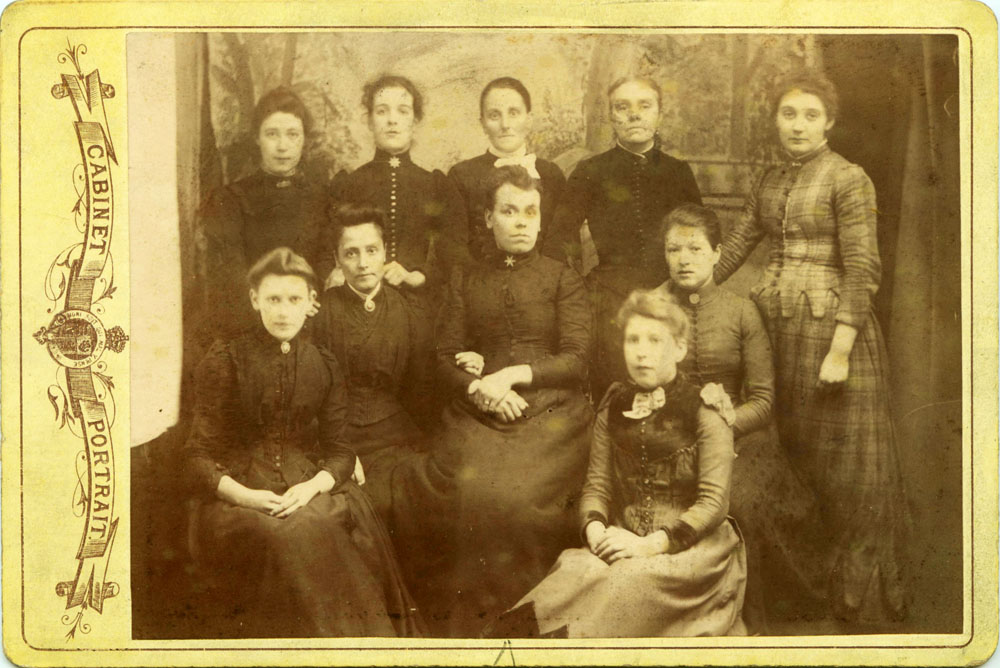
Image © and collection of Brett Payne
Cabinet portrait of unidentified group of women, c.1889-1893
Image © and collection of Brett Payne

There are very few inscriptions on the photographs, and none at all on the album pages. The only one that appears to offer any immediate clues to the identity of the subjects is on the back of a cabinet portrait of a large group of ten women taken in the very late 1880s or early 1890s by a professional, if somewhat hastily put together, studio. It has been mounted onto a standard cabinet card mount with no photographer's name, although the presence of a royal seal in the scroll work design strongly implies a United Kingdom origin.
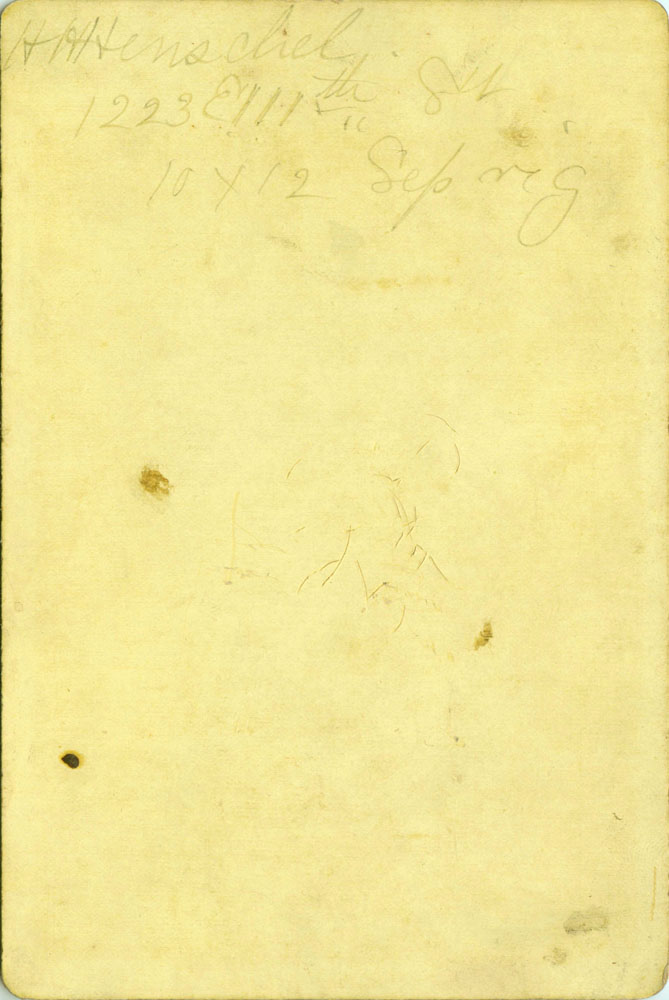
Image © and collection of Brett Payne
Inscription on reverse of cabinet card mount

The text, handwritten in pencil, appears to read as follows:
H.H. Henschel
1223 E 111th St
10 x 12 Sep vig
The first line is almost certainly a name, H.H. Henschel or conceivably "Herschel," and is probably the client's name, not necessarily that of the subject. The second line, I think, comprises an address, (number) 1223 East 111th Street, while the third I have deciphered as instructions for a copy enlargement of the portrait to be made, 10" x 12" Sepia vignette. At the edge of the front of the card mount is a small arrow marked in pen or pencil indicating that the central figure is the one which is to be enlarged.

The surname appears to be of Germanic origin, and the address is in a style more likely to have originated in the United States than in the United Kingdom. I came to the conclusion, therefore, that although the original portrait had been taken somewhere in the UK, the vignetted portrait enlargement was requested by someone who no longer had access to the original studio negatives. In other words, it may have been written, and therefore the enlargement made, some years after the original portrait had been taken. It could have been a simple framed vignette or a much more elaborate glazed and framed, colourised portrait, examples of which I have posted here and, with my Tauranga Historical Society hat on, here.
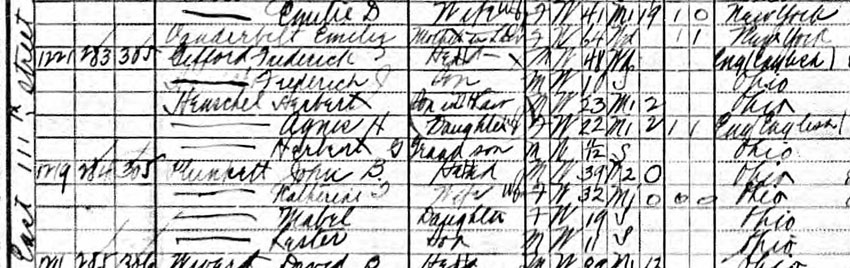
Image © The National Archives & courtesy of Ancestry.com
Census enumeration for 1221 E 111th St, Cleveland City, 23 Apr 1910
Image © The National Archives & courtesy of Ancestry.com

Given that Cleveland, Ohio features so prominently in the US portraits, I searched for the surname "Henschel" in census records for that city. Almost immediately I came up with the following spectacular discovery at 1221 East 111th Street, Cleveland in 1910:

Gifford Frederick / Head / 48 / Widr / b Eng / Imm 1892 / China Artist
Gifford Frederick J / Son / 10 / S / b OH
Henschel Herbert / SoninLaw / 23 / M 2y / b OH / Auto Co. Electrician
Henschel Agnes H / Dau / 22 / M 2y / b Eng
Henschel Herbert G / GdSon / 11m / S / b OH

Here was a family that fitted the bill, having arrived in the United States in 1892, settled in Cleveland, with a daughter who married Herbert Henschel in about 1908, and were living at in East 111th Street in 1910 - although at number 1221 instead of 1223. It seemed almost too good to be true but, as I investigated the family further through census records and the discovery of online family trees, pieces continued to fall into place.

Image courtesy of Ancestry.com
The Henschel family arrived on S.S. Cimbria in 1881
Image courtesy of Ancestry.com

Wilhelm (William) Henschel and his family emigrated from Berlin, Prussia in 1881. After a fifteen day voyage across the North Atlantic on board the Hamburg America Line steamship Cimbria, his wife Wilhelmina (Minnie) and three children arrived in New York on 6 October and joined William in Cleveland, Ohio.

Image © and collection of Brett Payne
Garfield Monument, Cleveland, Ohio, taken c. May 1890
Cabinet card by unknown photographer
Image © and collection of Brett Payne

Having arrived in the United States only a few weeks after the assassination of President Garfield, whose home town was Cleveland, it was natural that when a monument to him was unveiled at the Lake View Cemetery in Cleveland and dedicated in May 1890, the Henschel family should preserve a keepsake of such an historic occasion in their family album.
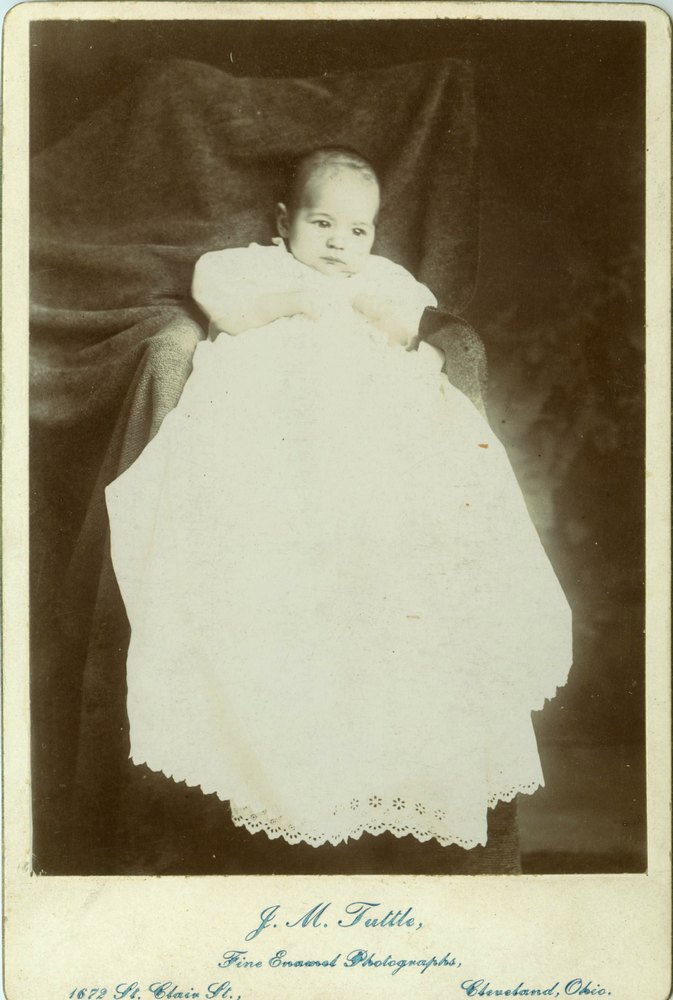
Image © and collection of Brett Payne
Unidentified child in christening gown, c.1889-1892
Cabinet card by J.M. Tuttle, 1672 St Clair St, Cleveland, Ohio
Image © and collection of Brett Payne

In the mean time, the Henschel family had grown. A fourth son William was born in September 1884 and a fifth Herbert Henry Henschel on 24 June 1888, nearly seven years after settling in Cleveland. Their only daughter Mamie arrived in July 1891. This baby in a christening gown could be either Herbert Henry or Mamie.
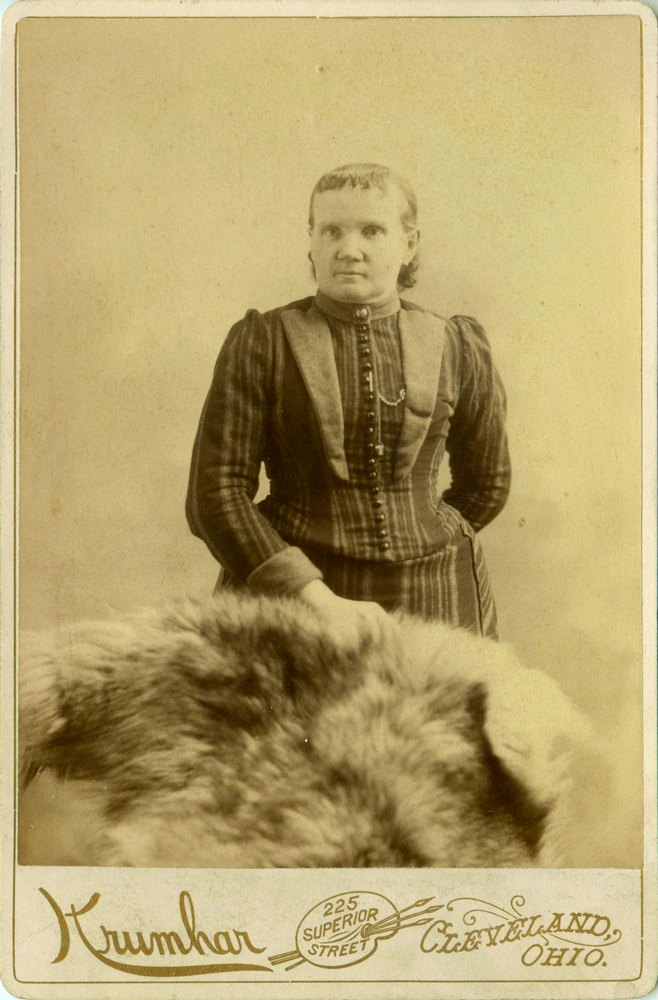
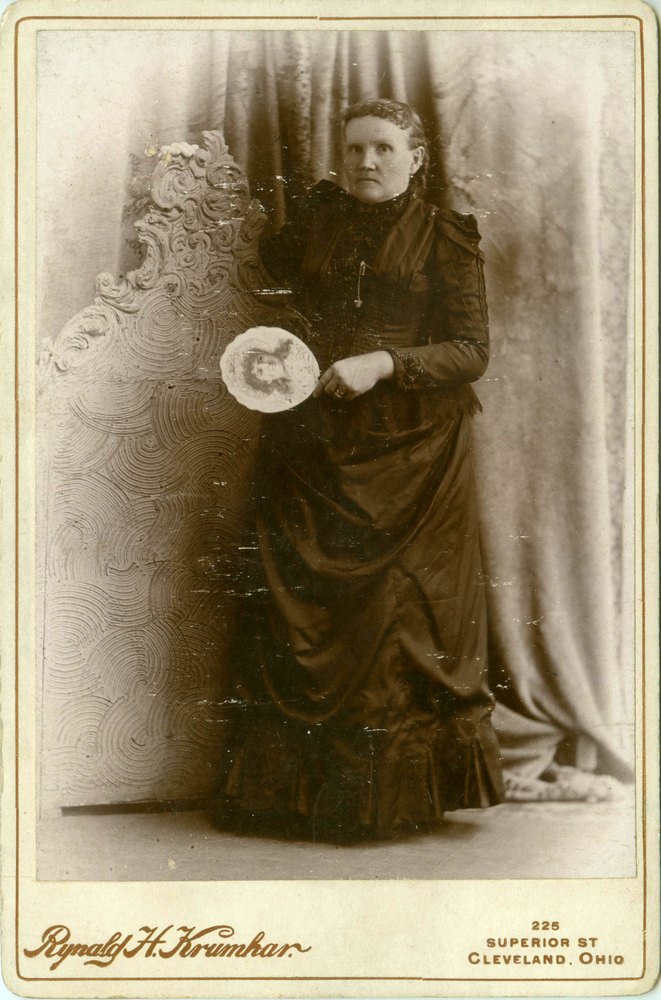
Image © and collection of Brett Payne Image © and collection of Brett Payne
Unidentified woman, taken c.1891-1892 (click images to enlarge)
Cabinet cards by Rynald H. Krumhar, 225 Superior St, Cleveland, Ohio
Image © and collection of Brett Payne

The two portraits of a middle-aged woman with a very close-fitting hair style and almost as severe an expression were taken by Rynald H. Krumhar who, according to Artists in Ohio, 1787-1900: A Biographical Dictionary, operated a studio in Cleveland on his own in 1891 and 1892 before teaming up with his brother Robert F. Krumhar between 1892 and 1895. Minnie Henschel (1848-) was in her early forties at the time these two portaits were taken, and I believe must be the prime candidate.
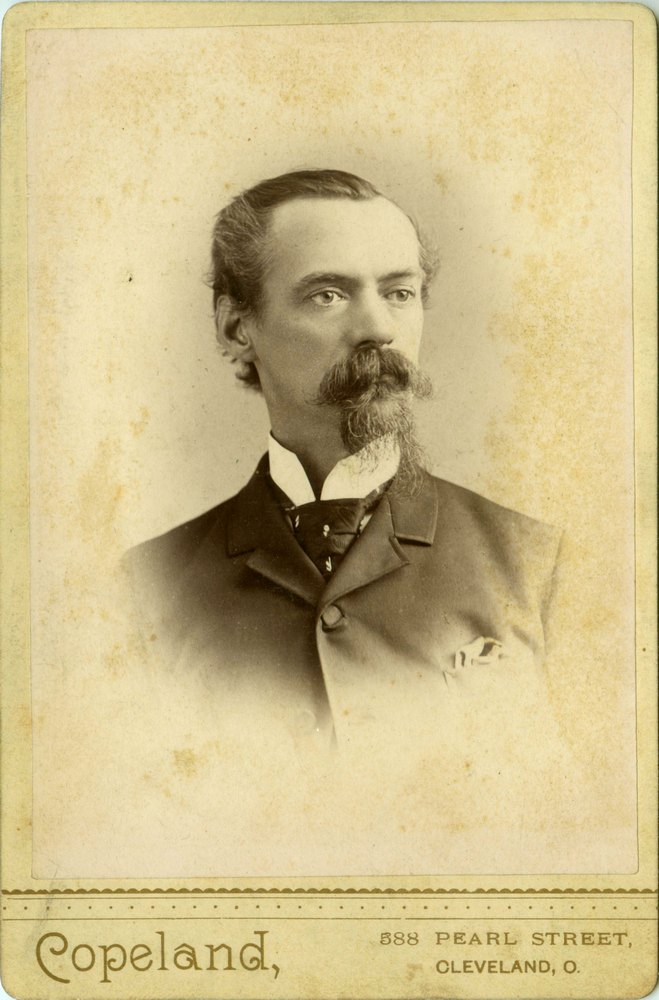
Image © and collection of Brett Payne
Unidentified man, taken c. 1887-1892
Cabinet card by Copeland, 588 Pearl Street, Cleveland, Ohio
Image © and collection of Brett Payne

A head and shoulders vignetted portrait of a similarly aged gentleman with a luxuriant moustache and goatee may have been taken slightly earlier. I don't have dates of operation of the Cleveland photographer Copeland, but from the style of mount, portrait and clothing I suspect it dates to the late 1880s or early 1890s. William Henschel Sr. (1850-) is the obvious choice here, as he too would have been about 40 years old.
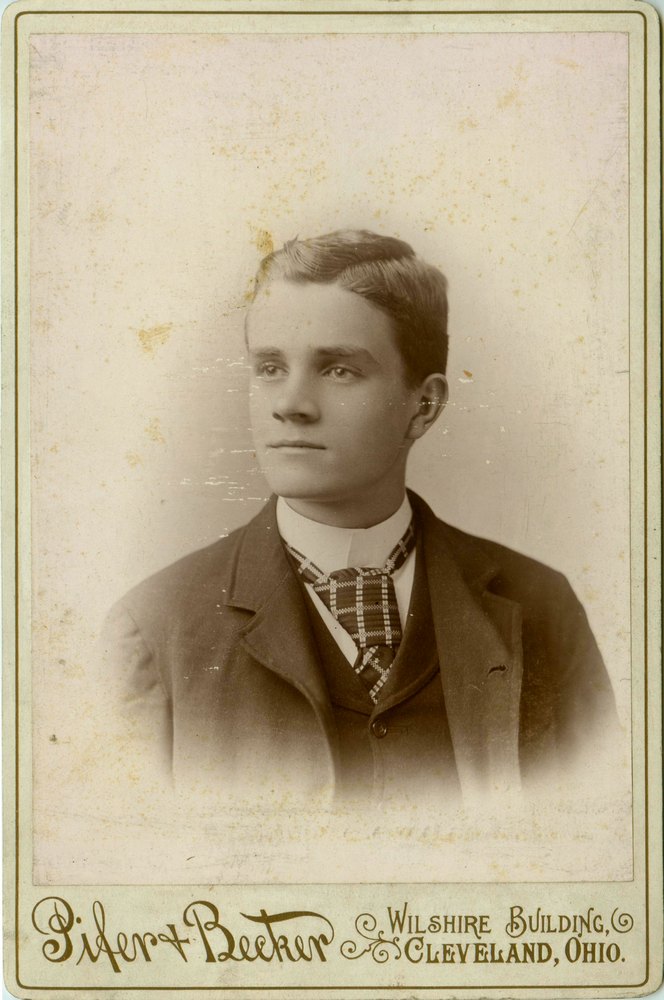
Image © and collection of Brett Payne
Unidentified young man, taken c. 1894-1897
Cabinet card by Pifer & Becker Photo-Palace, Wilshire Building, 94-100 Superior St, Cleveland, Ohio
Image © and collection of Brett Payne

This young man appears to be aged in his late teens, and probably visited Pifer & Becker's Photo-Palace studio in the mid-1890s. I suspect that it is one of Herbert's older brothers, Max, Hugo or Fred, all of whom were born in Germany.
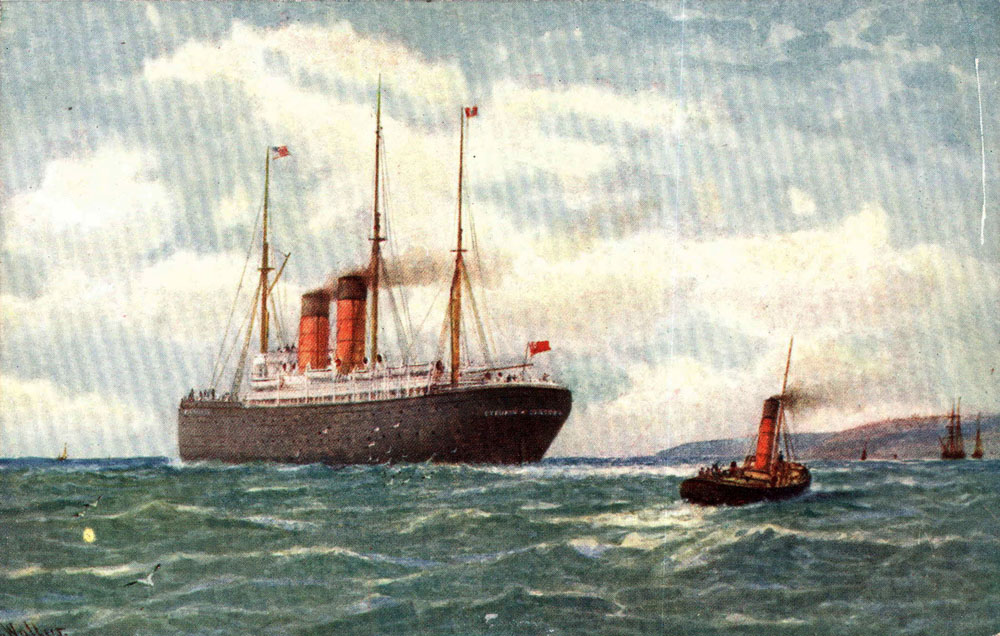
Image courtesy of Ancestry.com
Passenger manifest for S.S. Etruria, arr. New York 27 Feb 1893

On 27 February 1893 Frederick Thomas Gifford (1862-1932) and his wife Ellen arrived at Ellis Island, New York on board the SS Etruria from Liverpool, England with their four year old daughter Agnes Hammersley Gifford (1888-1967), giving Cleveland, Ohio as their destination on the ship's manifest.
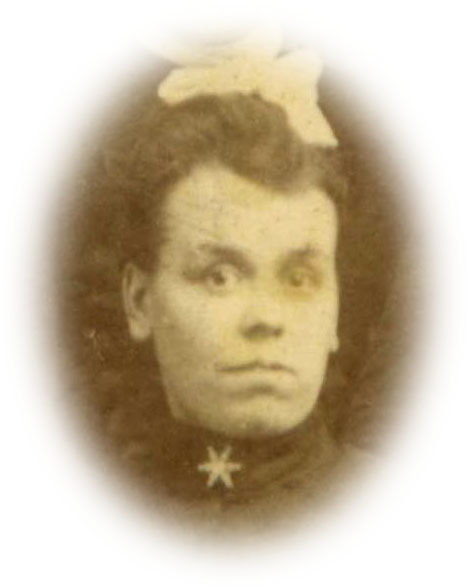
Image © and collection of Brett Payne
Vignette of unidentified woman marked on cabinet card

Frederick Thomas and Ellen Gifford had a son, also named Frederick, born in Cleveland in July 1899. Their daughter Agnes married Herbert Henschel in Hutchinson, Kansas in February 1907. Ellen Gifford died in April 1908 at 1221 East 111st Street, Cleveland, and was buried at Lakeview Cemetery. It was to this same address that the vignetted portrait enlargement - perhaps looking something like the image I created in Photoshop, above - was sent.

We also know that the widowed Fred Gifford, his son and the Henschel family were living there in 1910. By February 1913, when Herbert and Agnes' second child was born, the Henschels had moved to Indiana. It seems a distinct possibility, therefore, that the enlargement is of Agnes's mother Ellen Gifford (1866-1908), and that it was commissioned some time in the five years between her death in April 1908 and their arrival in Indiana in February 1913.

Image © and collection of Brett Payne
Unidentified child, taken c. 1892-1895
Carte de visite by Krumhar Bros., 225 Superior St, Cleveland, Ohio
Image © and collection of Brett Payne

When this warmly dressed child visited the Krumhar studio on Cleveland's Superior Street both of the Krumhar brothers were in attendance, dating it to between 1892 and 1895. Probably aged between 7 and 9 years old, and I'm guessing a girl because a boy is unlikely to be in a dress at that age, my estimate is that she would have been born circa 1883-1888. I believe this could be be Agnes H. Gifford.
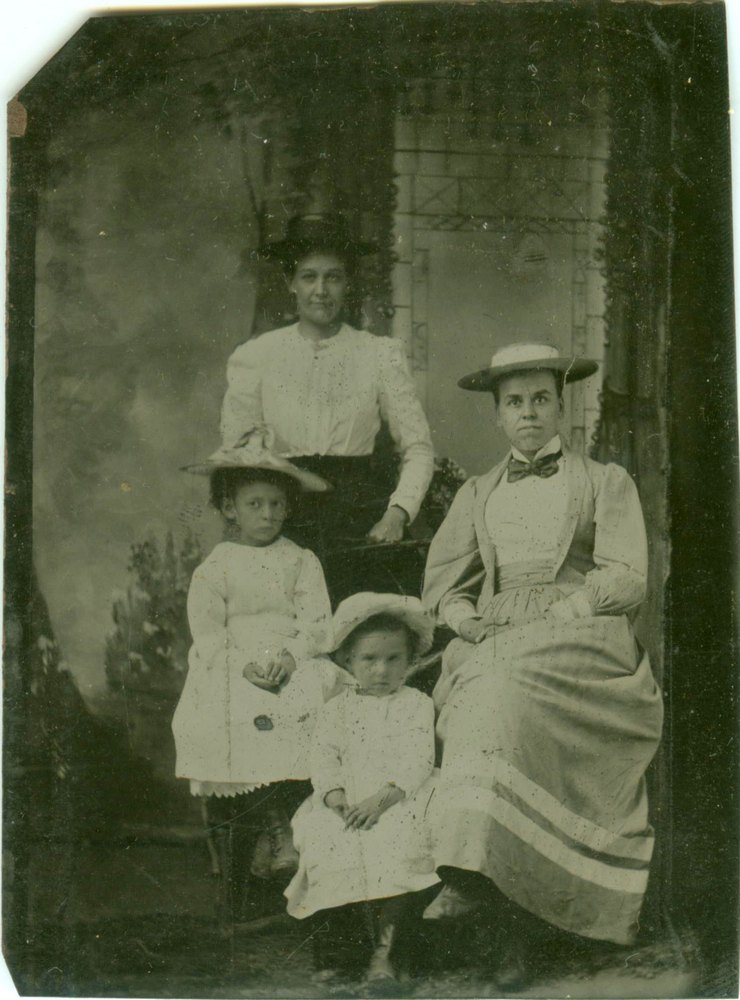
Image © and collection of Brett Payne
Unidentified group of 2 women & 2 children, taken c. 1892-1895
Sixth-plate tintype (63 x 84mm) by unidentified photographer
Image © and collection of Brett Payne

Inserted within the album are three loose, roughly trimmed sixth-plate tintypes, all taken in studio settings but without any indication of location. The clothing worn by the two women in this group portrait suggests they were taken in the early to mid-1890s, a time when the tintype was far more popular in North America than in England. The woman from the vignette appears seated on the right, wearing a broad-brimmed light-coloured hat, while the child from the Krumhar Bros. portrait is seated at left, also with a very flat hat. Are these two Ellen Gifford and her daughter Agnes? I think so, but then who might the other woman and younger child be?

Image courtesy of Ancestry.com
The Gifford family at 125 Becker Av, Cleveland City, 13 June 1900

The answer to the identity of the other child may lie in the 1900 Census record, which shows the Gifford family living at 125 Becker Avenue, Cleveland. In addition to (Frederick) Thomas, Ellen and Agnes, their ten month-old son Frederick J. is shown as having born in July 1899, probably too late to be the younger child in the tintype portrait. However, from the figures in the columns to the right of her age (Married for 13 years, Mother of 4 children, of which 2 living), we can infer that Ellen had two further children who died young. The younger child could be one of those who died, or alternatively belongs to the other woman who is standing at the back.
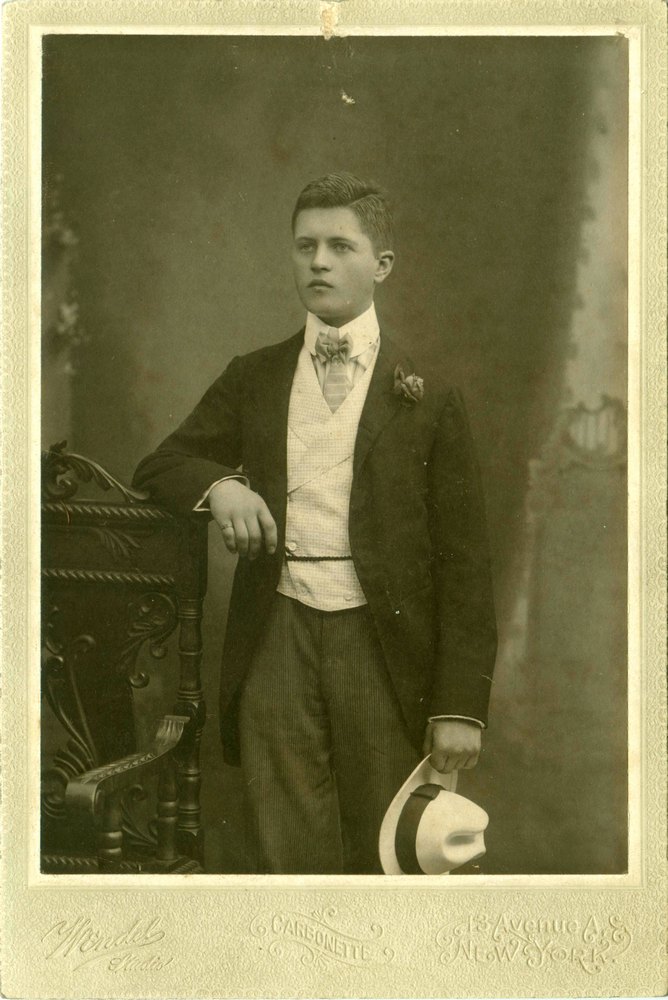
Image © and collection of Brett Payne
Unidentified young man, taken c. 1915-1925
Cabinet card (Carbonette) by Wendel Studio, 13 Avenue A, New York
Image © and collection of Brett Payne

This very smartly dressed young man with a bowtie, fedora and a rose in his buttonhole probably visited the Wendel Studio in New York for a portrait in the late 1920s or early 1920s. He looks to me to be in his late teens, perhaps between 17 and 20 years old, so I estimate that he was born c.1895-1908. The birth date of Frederick J. Gifford (1899-1959) lies well within this range; he married in 1930 and died at Jamestown, New York in November 1959. His father had also died at Jamestown in 1932.

Image © and collection of Brett Payne
Card mount (114 x 182mm) with no photograph, c.1910-1925
By the Globe Photo Co., 309 Main St., Jamestown, N.Y.
Image © and collection of Brett Payne

My last image for the moment is, in fact, not a photograph at all. This card mount from the Globe Photo Co. studio in Jamestown, New York has lost its contents, so we may never know whose face was framed within it. However I believe that it probably originally contained a postcard format portrait, and the style of mount suggests to me a date of perhaps the 1910s or early 1920s. I found several postcard format portraits from this studio on the web, and they come from a similar era.


I have no doubt that at this point several readers will be thinking that I have amassed a good deal of circumstantial evidence, and may even have indulged in a fair amount of speculation, but have presented little in the way of proof except for the single inscription. To my mind that inscription, and more specifically the juxtaposition of name and address, establishes the connection between that particular portrait and the Henschel-Gifford family without a doubt.

From that point, I agree that I'm on much more shaky ground, but I hope you'll bear with me as I continue to build up a family tree, and attempt to link portraits to individuals within that tree. Part of the difficulty is that one has to not only populate the family tree, but also show that individuals were in the right place at the right time to have their portraits taken. It's a lengthy and time consuming exercise to unravel the complex family relationships, which I'll have to spread over several articles in due course. Next week I'll turn to the English side of the family and look at portraits from Derbyshire and Staffordshire.

Friday, 19 July 2013

Sepia Saturday 186: Jack and Gill, a Christmas Pantomime?


Sepia Saturday by Alan Burnett

Although by far the majority of carte de visite and cabinet photographs were run-of-the-mill studio portraits of people in their Sunday best, browsing of old photo collections shows that even from the early 1860s many visited the studio wearing costumes. Some of these are clear representations of a particular character popular on the stage or in folklore, perhaps imitating the copyrighted photographs of actors published in significant numbers which have become sought after collectibles, while others are not quite so obvious.

I have previously written about such portraits from the mid-1880s by Derbyshire photographers Schmidt and Brennen, possibly depicting characters from a Gilbert and Sullivan musical (Dame Hannah and Ruddigore). Later examples from my collection include group photos with costumes from G+S's The Mikado and Tennyson's poem-play Dream of Fair Women.

Image © and collection of Brett Payne
"Jack & Gill," Capt. Marshall & Miss Pepworth, c.1881-1883
Cabinet card by H. Kisch, Maritzburg, Natal, South Africa
Image © and collection of Brett Payne

This week we have a South African couple, he at least dressed in costume, and an inscription on the reverse informs us that the subjects, identified as Captain Marshall and Miss Pepworth, are masquerading as "Jack & Gill." Whether this was for a stage performance - perhaps even a Christmas pantomine - or to attend a fancy dress party, will probably never be revealed. The portrait was almost certainly taken outdoors, although the latticework window, rocks, branches and plants appear to have been at least partly arranged by the photographer. The nature of the "second edge" close to the lower edge of the print suggests to me that it is a copy of a slightly earlier print mounted on card.

Image © and collection of Brett Payne
Reverse of cabinet card mount by Henry Kisch
with inscription handwritten in black/dark blue ink
Image © and collection of Brett Payne

Although the portrait is undated, Bensusan's comprehensive list of South African photographers shows that Henry Kisch operated photographic studios in Maritzburg (now Pietermaritzburg) between 1877 and 1885, after which he moved to Durban. The arrangement on the reverse of the card mount, with a diagonal signature, large ornate initial letters and ivy/scroll work, is typical of the "large letter" designs by Marion Imp of Paris that Roger Vaughan describes as being commonly used in the late 1870s and early 1880s.

Image © and courtesy of David Hill
Captain George Marshall (centre), Pietermaritzburg racecourse, 1890
Image © and courtesy of David Hill

A search on the net quickly led me to David Marshall's family history web pages, which include biographical details of his great-grandparents George Marshall (1850-1921) and Sarah Eleanor Pepworth (1859-1890). After an education at Rugby school, George went into the family business as a timber merchant. From 1873 he served with the Middlesex Yeomanry Cavalry, and in 1878 went with them out to South Africa where they fought in the Anglo-Zulu War in that and the following year.

Image © and courtesy of David Hill
Sarah Eleanor Pepworth, c. late 1870s
Image © and courtesy of David Hill

After the conclusion of the war he settled in Natal and on 4 July 1883 married Sarah Eleanor Pepworth, daughter of a prominent local resident and former mayor, Henry Pepworth, J.P. George started a timber business in Natal, while he and Sarah lived on a farm in the Dargle Valley, in the foothills of the Drakensberg mountains. Sarah died in August 1890, a few weeks after giving birth to their second child, and two years later George Marshall returned to England with the two young children, ending their association with South Africa.

References

Bensusan, A.D. (1963), 19th Century Photographers in South Africa, Africana Notes and News, Volume 15, No. 6, pp. 219-52, from South African Photographers of the 19th Century, on Ancestry24.

David Murray Marshall Hall's Ancestors and their Descendants

Thursday, 13 June 2013

Sepia Saturday 181: Gem Tintypes, Preservers and Wing's Multiplying Camera


Sepia Saturday by Alan Burnett and Kat Mortensen

The Sepia Saturday image prompt this week shows a cased daguerreotype of a young Texan woman, judging by the clothing and hairstyle probably taken in the 1850s or early 1860s. My contribution is not a daguerreotype, or the superficially similar and slightly later ambrotype, but it does have a superficial resemblance to both formats.

Image © and collection of Brett Payne (Allen Album)
Portrait of unidentified woman, undated, c.1862-1865
Gem ferrotype mounted with preserver on carte de visite mount
Image © and collection of Brett Payne (Allen Album)

This tiny gem tintype (aka ferrotype) is mounted within a gold-coloured foil or pinchbeck preserver (aka matte), which is then attached with two small lugs to a carte de visite mount (58 x 97mm), itself pre-printed with an ornate oval frame. It was one of 47 cartes de visites in an album which I purchased a few years ago, portraits from New York, Michigan, Wisconsin, Ontario and Darlington (England). The pinchbeck preserver appears to be an imitation of those used for cased daguerreotypes and ambrotypes prevalent in the 1840s and 1850s, and still present in the 1860s, along with the carte de visite.

Image © and collection of Brett Payne
Detail of gem tintype and preserver

These foil-edged, card-mounted gem tintypes are not uncommon, but the subject of this diminutive image is rather nice - a clear image of a young woman with spectacles, ringlets and slightly rouged cheeks. Her hair is combed flat with a central parting and hangs in ringlets, almost entirely covering her ears, the fashion suggesting it may have been taken in the early to mid-1860s. The preserver measures 19.5 x 26mm, implying that the tintype is the standard ¾" x 1" gem format, although the oval-shaped portion of it visible is only 15.5 x 21mm.

Reverse of carte de visite mount
Taken by George W. Godfrey & Co. of Rochester, New York
Image © and collection of Brett Payne

The reverse of the card mount shows the two lugs which have been pushed through slots cut in the card and folded over towards each other to secure the portrait. Printed on the back are the following details about the photographer and process used:

Made with Wing's Patent Multiplying Camera
☞ ONLY
At GEO. W. GODFREY & Co.'s
SUNBEAM GALLERY
Over 81 Main Street, Rochester, N.Y.

This deceptively simple fragment of print provides a clue to the origin of the gem tintype format, which was to survive for many decades and undergo several reincarnations. George W. Godfrey was a moderately successful photographer who operated the Sunbeam Studio in East Main Street, Rochester from the early 1860s until his death around 1889, but it is the name Wing which resonates. In the words of renowned photographic researcher and collector Mike Kessler, "after Simon Wing, photography was never quite the same."

Image © and courtesy of The Spira Collection
Portrait of man with Simon Wing's Patent Multiplying Camera, c.1865
Tintype by unidentified photographer
Image © and courtesy of The Spira Collection

The tintype was invented in France in 1853 and became enormously popular in a very short space of time in the United States, being cheap and simple to produce. In the late 1840s and early to mid-1850s, Albert S. Southworth of Boston and others had designed and patented a number of daguerreotype cameras which, using a combination of several lenses and a moving plateholder back, could produce multiple images on a single photographic plate. Simon Wing of Waterville, Maine and Marcus Ormsby of Boston purchased Southworth's patents and applied the technology to the then new wet collodion process used to produce ambrotypes and tintypes.

Image © and courtesy of Rob NiedermanImage © and courtesy of Rob Niederman
Uncut tintype sheets of unidentified husband and wife
Images © and courtesy of Rob Niederman

In June 1862 Wing patented his own "multiplying camera" to take up to 72 tiny images on a thin metal plate, which were then cut up into separate "gems," thus reducing the cost per portrait considerably.

Improvement on Photographic Card Mounts
Patent No. 40,302 by Simon Wing, 13 October 1863

Original box for Ferotype (sic) Preservers
Image © and courtesy of Matthew R. Isenburg

The gem portraits could be mounted behind preservers on cartes de visite, also designed by Wing, making them seem larger than they actually were, and in a style somewhat reminiscent of cased daguerreotypes and ambrotypes.

Image © and collection of Brett Payne
Henry H. Hinckley's Gem tintype album, c.1861-1874
Image © and collection of Brett Payne (Hinckley Album)

A popular alternative was to insert them into slots in a miniature album designed specifically for the format. The gem tintype album of Henry Hersey Hinckley Jr. (b. 1853) of Massachusetts, shown above (from the author's collection), includes portraits taken as early as c.1861-1862, although the compilation may have taken place at a later date.

Images © and courtesy of Rob Niederman
9-tube "Gem" wet-plate camera, by unknown U.S. maker
Images © and courtesy of Rob Niederman

Wing and other manufacturers made many versions of the "Gem" wet-plate cameras. Some, such as the one pictured above by an unknown U.S. maker, could be converted into a four-lens arrangement for taking carte-de-visite-sized portraits.

Images © and courtesy of Mike RoseberyImages © and courtesy of George Eastman House
Unidentified young man (left) and woman (right), c.1862-1865
Gem tintypes (20 x 25mm) on carte de visite mount (60 x 101mm)
By Geo. W. Godfrey & Co.'s Sunbeam Gallery, over 81 Main St, Rochester
Images © and courtesy of Mike Rosebery and George Eastman House

Several similarly mounted gem tintype portraits from the Sunbeam Gallery have been found on the web, with a variety of printed frames demonstrating that Godfrey used this particular format for some time. Similar to the manner in which Beard and Talbot had managed their rights to the daguerreotype and calotype patents in the United Kingdom, Wing sold cameras, photographic materials and "franchise" licences to a large network of studio operators, and assiduously pursued through the courts those whom he regarded as infringing his patents.

Image © and courtesy of the Library of Congress
Two portraits of unidentified men, c.1864
Gem tintypes (20 x 25mm) on carte de visite mount (60 x 101mm)
By E. Parker's Gallery, opposite Village Hall, Brockport, N.Y.
Image © and courtesy of the Library of Congress and eBay
 
These two gem portraits by E. Parker of Brockport have almost identical text on the reverse, indicating that they have been taken using "Wing's Patent Multiplying Camera" and providing further evidence of the franchises already put in place by then. A pencilled inscription on the back of the older man's portrait gives a useful date of February 1864. Kessler (1994) describes the arrangements thus:
When a photographer bought a Wing camera, he also bought a territory for a number of miles around. No other Wing cameras would be sold in the area for as long as the purchaser remained in business. If the photographer couldn't afford to buy the package outright, Simon would set him up with a pay-as-you-go program, with a percentage of the profits to be returned to the company until the debt was paid off.
Image © and courtesy of PhotoTree.comImage © and courtesy of PhotoTree.com

Portrait of unidentified young woman, c.1864
By Maynard & Nelson of Milford
Image © and courtesy of PhotoTree.com

This gem tintype in a very similar style was produced at roughly the same time at "Maynard & Nelson's Picture Gallery, over the P.O. Milford," almost certainly with one of Wing's competitors' cameras, and most likely a target for the never-ending series of prosecutions.

Image © and courtesy of Mike MedhurstImage © and courtesy of Mike Medhurst
Private Michael Malone, "D" Co. NY 14th Heavy Artillery Regt, c.1864
Taken by George W. Godfrey & Co. of Rochester, New York
Image © and courtesy of Mike Medhurst

By mid- to late 1864, Godfrey was already trying out alternative, simpler methods of mounting the gem tintypes, even though they were still being taken with his Wing camera. This example of a Union soldier's portrait in uniform at the Sunbeam Gallery in Rochester is mounted cartouche-style behind, rather than on top of, an embossed card. It is particularly useful because the subject has been identified from a pencilled annotation, and a revenue stamp is affixed of the back, thus making it possible to infer a fairly accurate date.

Malone enlisted at Rochester on 4 September 1863 and was killed at Blicks Station, Virginia on 19 August 1864. The blue revenue stamp, cancelled with a single stroke with a black pen, signified that a 2c Civil War federal tax, imposed on photographs costing 25c or less from 30 June 1864 until 1 August 1866, had been paid. While the portrait was most likely taken between the time of his enlistment and his company's deployment to Virginia in late April 1864 (Phisterer, 1912), it must only have been mounted after the tax had come into effect (Harrell-Sesniak, 2012).

President Abraham and Mary Todd Lincoln, c.1865
Copied by George W. Godfrey & Co. of Rochester, New York
Images © and courtesy of Cowan Auctions

George Godfrey continued to produce tintypes from the Sunbeam Gallery for a few years, although embossed and printed cartouche-style card mounts appear to have rapidly replaced those attached with foil preservers. The portraits of President Abraham Lincoln and his wife Mary Todd Lincoln shown above are typical examples and were probably produced in large quantities in 1865 after Lincoln's assassination.

Image © and courtesy of Rob Niederman
Wing Prototype Multiplying Box Camera, 1914
Image © and courtesy of Rob Niederman

Although the popularity of gem tintypes started to decline somewhat after the end of the Civil War, they were still produced in significant numbers throughout the 1870s and 1880s, and remained the format of choice for many travelling photographers. Simon Wing's cameras remained fundamentally the same until the late 1880s, when he and his son Harvey introduced a number of new designs, including the Ajax Multiplying Camera (c.1900) and the Wing Prototype Multiplying Box Camera (above) patented in 1914. Although only two of Harvey Wing's prototypes were ever produced, it is remarkable that the inherent concepts of these multiplying cameras were revived once again for the Polyfoto camera twenty years later, which I wrote about here on Photo-Sleuth three weeks ago.

I'm very grateful to The Spira Collection, Mike Kessler, Rob Niederman, Matthew R. Isenburg (via Marcel Safier), George Eastman House, Mike Rosebery, the Library of Congress, PhotoTree.com, Mike Medhurst and Cowan Auctions for the very useful scans of and information provided about items in their collections.

Update


By kind courtesy of the author, the late Mike Kessler, I am now able to offer you a PDF of the Summer/Fall 1994 issue of the Photographist containing the excellent article about Simon Wing as a direct download (click on the image above). Many thanks to Rob Niederman for facilitating this. It's an important resource to have available online.

References

Antique & 19th Century Cameras by Rob Niederman

Anon (1870) Who Infringe the Sliding Box Patent, The Philadelphia Photographer, Vol. VII, p. 45-46, courtesy of Archive.org.

Phisterer, Frederick (1912) 14th Artillery Regiment, Civil War, in New York in the War of the Rebellion, 3rd ed., Albany: J. B. Lyon Company, courtesy of the New York State Military Museum and Veterans Research Center, NYS Division of Military and Naval Affairs (2008).

Griffiths, Alan (nd) Revenue stamps during the American Civil War, on Luminous Lint.

H., Christine (2012) Civil War Revenue Stamps, on The Daily Postcxard, 19 October 2012.

Harrell-Sesniak, Mary (2012) Dating Old Family Photographs with Civil War Revenue Stamps, on Genealogy Tips from GenealogyBank, 14 November 2012.

Kessler, Mike (1994) After Simon Wing Photography Was Never Quite the Same, in The Photographist (Journal of the Western Photographic Collectors Association), No 102 (Summer 1994), p.6-47.

Safier, Marcel (2012) The Gem & Carte de Visite Tintype
Join my blog network
on Facebook