Showing posts with label Yorkshire. Show all posts

Thursday, 20 October 2011

Sepia Saturday 97: Geo W Holden, Brother of the more famous Jack

I've long enjoyed the catchy title of Barbara Trapido's book, and this is an excellent opportunity to appropriate it for my own use. The glimpses into the life and career of this elusive photographer that I've unearthed are intriguing, albeit sporadic and far too brief. However, they pale into medocrity beside the bizarre trail of tall tales left by his older brother.

I don't wish to distract either the reader or myself by the adventures of John Watkins Holden (1844-1917), Imperial prestidigitateur - I've taken a small liberty here in calling him "Jack" - so if you wish to read more of him, please visit Old Crone's fascinating account of The Mad Magician. Suffice to say, he was a man of many talents, not the least of which were a keen sense of self-aggrandisement and a tendency to accrue wives and children.

Image © Brecknock Museum & Art Gallery and courtesy of Culturenet Cymru
Pennoyre Mansion, near Battle, Brecon, c.1895
© Brecknock Museum & Art Gallery Courtesy of Culturenet Cymru

This account concerns the younger of the two brothers: George Watkins Holden was born on 3 September 1846 at Peckham in Surrey and baptised on 15 November at Christchurch, Camberwell. Although his brother was born two years earlier at Albany Terrace, Claines, Worcestershire, both were illegitimate sons of Emma Holden (1817-1887), and most likely fathered by the Welsh Liberal politician and Lord Lieutenant of Brecon, militia Colonel John Lloyd Vaughan Watkins (1802-1865). Watkins may well have provided for his mistress and her children - the 1851 Census shows them visiting a house in King Street, Laugharn, Carmarthenshire, and Emma is described as an annuitant.

Image © and courtesy of Google Maps
King Street, Laugharn, Carmarthenshire
Image © and courtesy of Google Maps

There doesn't seem to be much chance that George or John ever saw much of either their father or his grand residence, the mansion of Pennoyre near Battle in Brecon, built c.1846-1848. The colonel's wife Sophia Louisa Henrietta née Pocock, daughter of a baronet, remained ensconced there with her two sisters, childless but attended by a retinue of fourteen servants, until her death in May 1851. By this time Lloyd Watkins' attentions had strayed again, and he had fathered further illegitimate children by another woman.

By 1861 they had moved back to London, Emma described herself as a house proprietor and George, then aged 14, was working as a miniature painter. He disappears from view for a decade or so, although a girl he later claimed as his daughter was born at Ashburton, Devon in late 1866.

Image © and courtesy of John Rivis
Unidentified family, possibly in Yorkshire, c.1874-1878
Carte de visite by G.W. Holden of Windsor
Image © and courtesy of John Rivis

Then in December 1871, a report in The Era described a "portrait of [a] Welsh bullock ... from a photograph by Mr. George W. Holden of Portmadoc." This is the first evidence I have found of his photographic career, and a trade directory confirms that he was operating a studio in the High Street, Portmadoc, North Wales in 1874. The engaging carte de visite portrait of a large, but as yet unidentified family, probably taken somewhere in Yorkshire in the mid- to late 1870s, is by George W. Holden. By this time he was based at 12a William Street, Windsor, Berkshire, but clearly travelling widely in search of clients.

Image © and collection of Brett Payne
St Andrew's Middle Class School, Litchurch, Derby, c.1877
Carte de visite by G.W. Holden of 12a William St, Windsor
Image © and collection of Brett Payne

As early as 1877, when this school photograph including my great-grandfather was taken at St Andrew's Middle Class School in Litchurch, Derby, Holden had identified the niche of scholastic photography as one in which he could specialise.

Image © and collection of Brett Payne

The card mount is very similar, although not identical, to John Rivis' family group portrait. Judging by the remnants of Holden's output that I have found on the net, schools would be his main clients for at least the next two decades.


Class 1, unidentified group of school girls, c.1881-1883
Carte de visite by "Pen aur" G.W. Holden of London, Paris, Bristol & Swansea

In April 1881 George was in Oxford with his daughter Ada, aged 14, and a young wife Emily Ann, aged 21. It seems unlikely they were there for long because, from the evidence of several carte de visites from the early, mid-, and late 1880s, he appears to have been at least partly based at 42 City Road, Bristol. He operated under the "registered title" of Pen aur, an obvious reference to his father's former estates. The fact that his father died virtually penniless in 1887 was, of course, irrelevant from the point of view of self promotion.


It was during this period that Holden started to advertise his "instantaneous portraits of children with a new patent apparatus." Amongst the numerous extravagant and unverifiable claims made were that he was "under the patronage of several members of the Royal family, colleges, yacht clubs, 'Graphic' &c &c," and that he had studios in London, Paris, Bristol and Swansea. His firm of Holden & Co., described as scholastic group and landscape artists, were able to take "views,groups, machinery &c. ... from C de V to life size, in any part of the Kingdom or France at the shortest notice."

While I have little doubt that he was kept a busy man, I view with some suspicion his claims of such a widely distributed branch studio network, supported by a printing works in Bristol. He stated categorically that he used "no agents," and I suspect that, as was common amongst travelling photographers, he listed the locations that he frequented as "studios." Roger Vaughan, in his extensive list of Bristol Photographers, makes no mention of Holden. On one of the carte de visite mounts displayed on Roger's web site, Holden warns, "As the negatives of this photograph is not kept copies should be ordered without delay," an unusual statement among photographers who normally tried to encourage their customers to make return visits.

Image © and courtesy of Sophie Dickerson
Class 1, at Horninglow, Burton-on-Trent, Staffordshire, c.1888-1892
by Geo. W. Holden, Manager of The Elementary Schools Photographing Co. of Leeds & Hull
Image © and courtesy of Sophie Dickerson

An 1887 trade directory suggests that he was operating from "Pennoyre House" in Castle Street, Swansea. Sophie Dickerson sent me this school photo which includes family member Amelia Francis (born c. 1880), probably taken in Horninglow, Burton-on-Trent in the late 1880s or early 1890s. George Holden was by this time probably based in Hull. At least that's where two daughters were born in 1888 and 1889, and card mounts showed him as manager of the The Elementary Schools Photographing Co. at Leeds and Hull, but also visiting an exhausting list of 22 other towns throughout the England, Wales, Scotland and Ireland. There is no mention of Burton!

Image © and courtesy of Stephen Cook
Class 1, at Plymouth, Devon, c.1895
by Geo. W. Holden, Manager of The Elementary Schools Photographing Co. of Leeds & Hull
Image © and courtesy of Stephen Cook

This portrait sent to me of Maud Eva Pike (born 1888) and her class was sent to me by her grandson Stephen Cook, who believes it was probably taken around 1895 in the vicinity of Lipson Vale, Plymouth, Devon, where they lived at the time. Plymouth, for once, is included in the list of places visited by Mr Holden. In the census of early April 1891 his "family" were living in Hull, although he was recorded as a visitor in South Bishop Wearmouth, Durham.

Image © and collection of Brett Payne
Class 6, Mt Street School (?), unidentified location, c.1896-1898
by Geo. W. Holden, The Home & Colonial Photo Co. of Plymouth & Johannesburg
Image © and collection of Brett Payne

The last two examples are from my own collection, purchased on eBay and their provenance is unknown. The first has the locations "Plymouth & Johannesburg S.A." printed on the front and is inscribed in pencil on the reverse, "about 1899 Mt Street Scool [sic]." George Holden married Maud Louise Warnes at Plymouth in early 1894, and a son George Ernest was born at Belfast, Ireland the following year. It seems likely that they returned to the south of England soon after, as I estimate that this class photo is from the late 1890s.

Image © and collection of Brett Payne
Class 11, Gendros School, Swansea, Glamorgan, c.1900-1904
by Geo. W. Holden, The Home & Colonial Photo Co. of Cardiff & Johannesburg
Image © and collection of Brett Payne

In mid-1898 George Holden married Alice Norman, his previous wife's former "mother's help," 24 years his junior, settling in Cardiff, where they were living at the end of March 1901. This example is a slightly larger format mounted print, and has "Cardiff & Johannesburg S.A." printed on the front. The name of the school at which this portrait was taken is written on a large blackboard held up by the children in the front row: "YSGOL Y GENDROS (MORGANWG)" translates, I believe, to "Gendros School, Glamorgan."


Gendros Primary School, Swansea

Gendros Primary School, in Swansea, built in 1897, is still going and, from the look of the buildings seen over the wall in this Google StreetView, may have many of the original buildings - perhaps even the ones that formed the backdrop to my 110 year-old class photo.

I have pondered on the mention of Johannesburg, South Africa on Holden's later card mounts at some length, without coming to any firm conclusion. It is possible he visited South Africa at some stage, perhaps even intending to cater to the large number of troops heading out there during the Boer War. His brother John claimed, in his fanciful book A Wizard's Wanderings from China to Peru, to have travelled widely, and I think it likely that Johannesburg may also have been the the result of George's lively imagination.

George Watkins Holden continued to operate his photographic business out of the family home at 55 Tudor Street, Cardiff from 1907 until his death in 1921, aged 75, probably the longest settled period of his very busy life. He had five children, at least two of them illegitimate, by three different women, and lived for a time with a fourth. All of his partners were a good deal younger than him. They say that apples don't fall far from the tree.

Many thanks to John Rivis, Sophie Dickerson and Stephen Cook for the use of images from their personal collections.

If you, like me, have a penchant for old school photos, I can thoroughly recommend a visit to this edition of Alan Burnett's Sepia Saturday, where this week's charming image prompt depicts a group of young lads on a break from class, being asked to "Look up" by the photographer. A couple of them did! The rest ... well, they did what all school boys do when asked en masse to pose for a school photograph.

References

Alderman, Mari (2006) Victorian Professional Photographers in Wales, Sept 2006, GENUKI

Anon (2007) The Mad Magician (Old Crone Holden), The Family Tree Forum.

Vaughan, Roger (2003) Bristol Photographers 1852-1972.

Monday, 18 May 2009

The Hull Trawler Challenge

I've been visiting James Morley's web site What's That Picture? for some time now, partly because he has an interesting collection of old photographs of his own, but also for the series of User Galleries containing some interesting images submitted by visitors to the site. However, the images in his set of hand coloured lantern slides which he has made the subject of his Hull Trawler Challenge are nothing short of spectacular.

With James' permission, I would like to reproduce a few of these photographs here, as I think they are so unusually evocative of a way of life which is long gone, and probably quite foreign to most of us. Some readers whose ancestors were fishermen may find them particularly relevant and interesting. I hope, too, that this preview will give you a taste for more, and that you will want to view the entire, remarkable Hull Trawler collection hosted at Flickr. I think it's well worth directing more readers to this interesting research project, in the hope that more clues to the background story behind the photographs and the photographer will be uncovered in due course.

Image © and courtesy of James Morley & What's That Picture?
Hull Trawler H413 SS New Zealand
Hand coloured glass lantern slide
Image © and courtesy of James Morley & What's That Picture?

The series of seventy eight lantern slides consist predominantly of photographs taken aboard two fishing trawlers from a fleet that was based in Hull (aka Kingston-upon-Hull, Yorkshire), a port on the north bank of the River Humber estuary on the north-east coast of England. The SS New Zealand (shown above) was built in Hull in 1898 and owned and operated by the Hull Steam Fishing & Ice Co Ltd. until being requisitioned as a troopship in 1916. It is during this early period of the ship's life, i.e. in the decade or so prior to the ship's war service, that the photographs appear to have been taken.

Image © and courtesy of James Morley & What's That Picture?
Fishermen at work aboard SS New Zealand
Hand coloured glass lantern slide
Image © and courtesy of James Morley & What's That Picture?

Some of the images show men at work bringing aboard or sorting fish.

Image © and courtesy of James Morley & What's That Picture?
Fishermen eating, possibly aboard SS New Zealand
Hand coloured glass lantern slide
Image © and courtesy of James Morley & What's That Picture?

Many more depict them eating, ...

Image © and courtesy of James Morley & What's That Picture?
Fishermen relaxing aboard Hull trawler H1 SS Canada
Hand coloured glass lantern slide
Image © and courtesy of James Morley & What's That Picture?

... relaxing ...

Image © and courtesy of James Morley & What's That Picture?
Fishermen posing for the camera aboard SS New Zealand
Hand coloured glass lantern slide
Image © and courtesy of James Morley & What's That Picture?

... or in groups deliberately posed for the camera, albeit on a violently pitching deck, complete with pets. Both cats and dogs appear in several of the images.

Image © and courtesy of James Morley & What's That Picture?
Heavy seas encountered aboard SS New Zealand
Black and white glass lantern slide
Image © and courtesy of James Morley & What's That Picture?

While many of the photographs were obviously taken under relatively calm conditions, there are a significant number that clearly show heavy seas and a violently pitching deck, conditions that would have been commonly encountered by fishing fleets in the North Sea. The image above depicts a situation that I wouldn't want to have been anywhere near carrying a digital camera, let along the cumbersome photographic equipment that would have been required a hundred years ago. Nineteenth century newspapers e.g. the The Hull Packet and East Riding Times, are full of reports of sailors and fisherman lost at sea by being washed overboard, and it must have been a very dangerous means to earn a living.

Although my own ancestors from Norfolk, also on the east coast facing the North Sea, were largely farming folk, while searching parish registers I came across several entries for burials of unidentified bodies found washed up on the beach, presumably men who had been lost at sea and presumed drowned. It was obviously not an rare occurrence.

The images provide a wonderful insight into the lives of these hardy men, a lifestyle that has all but vanished, and I urge you to visit the Hull Trawler Challenge pages and browse the full set of full size images here. Many thanks to James Morley for permission to reproduce the images.

Friday, 5 December 2008

Another portrait by "Professor" Simpson of Ashbourne & Buxton

I've recently updated the article describing a cabinet photograph of a landau taken by "Professor" Frank Simpson of Ashbourne & Buxton, sent to me by John Bradley. Nigel Aspdin conducted some research at the Derby Local Studies Library and was successful in identifying the building in the background as the Railway Hotel in Buxton.

Image © & courtesy of Terry Nolan

In the mean time, I received another image of a photograph by Simpson. This one is a carte de visite portrait, possibly a few years earlier than the landau photo, and not nearly as decent quality. The owner of the photograph, Terry Nolan, writes:

The attached photo is from a collection of prints which belonged to my grandmother. Her name was Frances Helen Larissey, later Mrs Nolan of Handsworth, nr Sheffield. I can't identify any of the people in the picture, however the man in the middle of the three men in the back row, bears an uncanny resemblance to my late father. That being the case, it could be my great-grandfather John Larissey (b. 1845) or failing that my great-great-grandfather Thomas Larissey (b. 1810). It would be really useful to try to date the photograph. I still wouldn't be sure of the identity of the man, but it would be interesting to speculate.
Unfortunately, the carte de visite is a little faded, and not particularly clear. From what I can make out of the clothes that the women are wearing, the fashions more or less equate to the late 1870s, say between 1876 and 1880.

Image © & courtesy of Terry Nolan

The design on the reverse of the card mount is of a style - with text in a banner & stylized ivy - which was popular in the mid- to late 1870s. Roger Vaughan has a similar example on his web site which is accurately dated at November 1878. It is similar to the design on my profile of Frank Simpson profile, except that it has three "Prince of Wales feathers" motifs at the top instead of the coat of arms. I believe this example may have been slightly earlier than the "coat of arms" style, but the latter is not dated so that's not a great help.

The style of the backdrop, the clothes worn by the subjects, the shape of the card and the card mount design all point to a date of around 1877 to 1880, although it is possible that it could have been taken as late as 1881-1882. Older women tended to wear clothes which were perhaps not quite as up-to-date with the latest fashions, and the photographer Simpson, too, being something of an itinerant, may not have possessed the latest amenities in his travelling studio.

If that is the case, then it's possibly the oldest portrait by Simpson that I have yet come across, so I'm very grateful for the opportunity to use it - many thanks, Terry.

All six of the subjects look as they could easily be in their sixties, although the two in the middle, including the man you referred to, is possibly a little older than the others. I think it quite conceivable that he might be Thomas Larissey (1810-1882). Thomas and his wife Ann (née Fawcett) lived in the village of Loversall, near Doncaster in South Yorkshire, where he worked as a gardener from prior to 1841 until his death on 31 December 1882.

I think it quite likely that Thomas Larissey would have travelled to Buxton, together with his wife and perhaps friends or family, for a short holiday in the summer time, as it was a popular tourist resort. I suspect - although I don't yet have good documentation for this - that Simpson spent the summer holiday season in Buxton catering to the tourist trade visiting the Peak District and the hydropathic spas, and went back to Ashbourne for much of the rest of the year. It is also possible, although I believe less likely, that Simpson travelled to or through Doncaster or Loversall taking photographs as he went, as he operated from a caravan. The fact that he lists locations in Leicester, Burslem and London on the reverse of his card mounts suggests to me that he travelled a good deal, perhaps following the village and town fairs.

Saturday, 29 November 2008

Two framed ambrotypes from Yorkshire

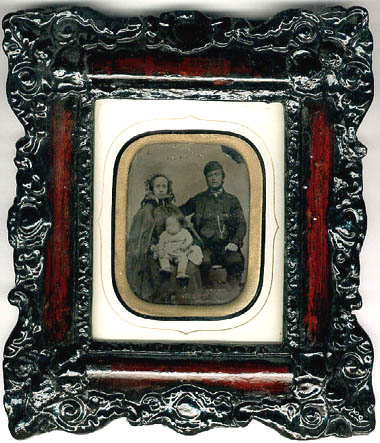
One of the ways in which a photographic studio could "add value" to its products was to offer an enlargement and framing service, and all but the smallest or most itinerant of operations tended to do this. The most basic type of framing in the early days, for daguerreotypes and ambrotypes, was an embossed leather- or papier mache-covered and silk- or velvet-lined rectangular wooden or thermoplastic case, which served the dual purpose of protecting the delicate images, examples of which are relatively common. If the portrait was wanted for display purposes, however, an alternative option was to have it mounted behind glass with a mat and frame, in much the same way as painted portraits were done.

Image © and courtesy of Brenda Croome

Brenda Croome recently sent me two images of framed ambrotypes of family members, with the following explanation:
I went north in October, and visited an old lady of 89 who is the great-grand-daughter of Christopher Richardson, my great-grandfather Thomas's brother. She very kindly gave me two photographs of two of Thomas and Christophers' sisters. The eldest girl is Mary Ann Esther Richardson born 1844, and her sister is Eliza Richardson 1847/1852. They were born in Neasham, Yorkshire, near to Darlington, their father was a shoemaker. I know very little about early photography - except that I seem to recall that daguerrotypes were very expensive, so for the rich!

I have taken the back off one of them and found:- Looking at the photos from the front, there is a glass covering, behind that the white and gilded mount. Behind that a coloured glass plate (with blue poorly fixed powdery substance, which came away on a cotton bud). Behind that a loose piece of almost black velvet, and laid on this loose piece of velvet at the bottom edge, about 1\3" thick, a roll of velvet - this holds the bottom of the glass negative just off the loose piece of velvet. Behind that a piece of card. The whole inner part pinned to the frame with ½" nails with extremely small heads.

The only other method of photography in about 1848 I have heard vaguely of is the process known as albumin negatives. Would there have been a photographic studio in Darlington at such an early date? Or would there have been travelling photographers? These are the earliest photographs I have and I would be thrilled to learn more about them.
Image © and courtesy of Brenda Croome

After I had cautioned Brenda about the danger of dismantling ambrotypes and daguerreotypes, she assured me "that I only took the cotton bud to the extreme edge of the glass plate, to see if the 'blue' was fixed. The whole process of taking the picture apart frightened me hugely!

Image © and courtesy of Brenda CroomeImage © and courtesy of Brenda Croome

They are, in fact, ambrotypes, which succeeded daguerreotypes and were considerably cheaper. The wet plate collodion positive process was invented in 1851 by Frederick Scott Archer, and became very popular for portraiture in a short space of time, so that by the mid-1850s, it had all but supplanted the daguerreotype. As it required little skill and a much lower cost to set up and produce ambrotypes, this continued to be the method of choice for almost a decade, until the even cheaper tintypes, paper prints and cardboard-backed carte de visites took over in the early 1860s.

The photograph was printed as a negative on the inside of the glass, and the black velvet backing then had the effect of turning this into a "positive" image. The coloured plate was used to impart colours to the image, as trying to colour the image itself would have destroyed the collodion. The whole set-up was then usually encased in a box similar to those previously used for daguerreotypes, although framed examples with white and gilt matts such as these are fairly common. A further development of the collodion positive process resulted in the ferro-type, commonly referred to as a tin-type. In this method the collodion was coated onto a thin sheet of black-enamelled, or "japanned," iron, and often covered with clear varnish, thus rendering them more durable than the ambrotypes that they replaced. Being more robust meant that they did not need cases, and could be sold "as is," in cardboard and/or paper frames, or presented in specially designed gem tin-type albums.

Image © and courtesy of Brenda CroomeImage © and courtesy of Brenda Croome

Being ambrotypes, Brenda's two portraits were indeed affordable to many everyday folk of the period, although would still, I suspect, have been quite a significant expense to the family of a shoemaker. The younger child appears to be about two years old, the older one perhaps four. I estimate that they were taken in the early to mid-1850s, say between 1853 and 1856, and the mounts and frames appear to be contemporary with the photographic images. The portraits both have the same toy in the left hand foreground, a wheeled horse with a missing head. This suggests to me that they were taken on the same occasion, and that one should therefore be looking for two children, aged about two years apart, who were born c.1849-1852 and c.1851-1854, respectively.

These dates don't really quite fit with the birth dates of Brenda's Mary Ann Esther and Eliza Richardson. I found them on the 1851 Census, living with their parents, Robert & Ann Richardson in the village of Neasham, County Durham, and numerous siblings, although by the time of the 1861 Census, Mary Ann was working as a servant and Eliza was nowhere to be found. I presume that she had died in 1852. I think it very unlikely, therefore, that the two children are Mary Ann and Eliza as identified by Brenda's relative, and would suggest looking for other members of the family who they might have been.

There were almost certainly photographic studios in Darlington by the mid- to late 1850s, although they may have been operated on a temporary basis by photographers visiting from larger towns. Alternatively, family members may have travelled to a larger town and had their portrait taken there.

More from Brenda:
There is ... a problem. With one, not very likely, exception, there are absolutely no other children who could fit that time frame. If the photograph was taken mid-1851, there is one other child born who could fit. This was William born 22 May 1849, the younger brother of the two girls, so Eliza would have been 5, and William 2 years and some months. Can the younger of the children be seen as a boy? It doesn't seem likely, why is 'he' wearing a frock. There would have been 'hand-me-downs' from the three elder sons.
Young boys and were commonly dressed in very similar, if not identical, clothes in this era, in particular dresses, and boys were often only "breeched," i.e. fitted with trousers, when they were 6 to 10 years old. One can sometimes tell from the position of the parting in the hair (central for girls, or side for boys) whether a child was a boy or girl, but this is by no means a fool-proof method.

Image © and courtesy of Brenda Croome

I'd prefer to leave further interpretation to Brenda, as so much of the investigative process depends on a detailed knowledge of the particular family. Out of interest, a close up image of the top left hand corner of one of the frames shows that it is made from wood with plaster embellishment. Roger Vaughan has an ambrotype of a couple and a small child with a very similar mat and frame, here.

For those readers who are interested in learning more about daguerreotypes, ambrotypes and the processes used to create them, I would like to strongly recommend The Birth of Photography: The Story of the formative years 1800-1900, by Brian Coe (publ. Spring Books, London, 1989, ISBN 0 600 56296 4). My copy was very kindly "rescued" and sent to me by Sylvia Rhodes. I have also put together a few links to online galleries of ambrotypes:

Wednesday, 15 October 2008

More photographs of and by F.J. Seaman

Further to my previous article about Frederick Joseph Seaman (1874-1953), I've received further information and photographs from his grand-daughter Anne Williams, and John Bradley, which are probably worth including as a separate post, rather than merely appending to the original one.

Image © and courtesy of Anne Williams

Anne sent me this rather nice studio self portrait by F.J. Seaman, taken at an unknown location and date. It appears to be a post card size, although I don't know if it has anything printed or inscribed on the reverse. Based merely on a comparison with other portraits of FJS, I estimate it was taken around the time of the First World War.

Image © and courtesy of Anne Williams

She also sent me a later family portrait, possibly taken in the mid- to late 1920s, showing FJS with Evie, Mable Maude (seated - the elder daughter, and always known as Maude) and Maud's husband, Ormonde Vivian O. Blackmore. Maud and Evie's mother Bertha died at Sculcoates (Hull) in 1912, and their father remarried the following year, also at Sculcoates, to Hilda Blanche Bailey Jackson. Their twin sons Austin and Stanley were born in 1914 at Blackpool. They moved to Doncaster in 1915 and stayed there until 1926, when they moved back to Chesterfield and lived over the shop.

This now gives a continuous and very useful time frame for the operation of the various F.J. Seaman studios as follows:

(1891-1896 : Chesterfield, Ilkeston, Alfreton in Derbyshire - as Seaman & Sons)
1897-1903 : Hucknall Torkard, Nottinghamshire
?1898-1903 : Heanor, Derbyshire (also possibly open in 1905-1906)
1903-1907 : Sculcoates, Hull, Yorkshire (also at York, Beverley, Darlington, Bridlington and Scarborough?)
1907-1915 : Blackpool, Lancashire
?1909-1912 : Davygate, York, Yorkshire
1915-1926 : Doncaster, Yorkshire
1926-1950 : Chesterfield, Derbyshire

Click on image for reverse of post card Image © and courtesy of John Bradley

John Bradley has this post card portrait of a very smartly dressed young couple taken in F.J. Seaman's Blackpool studio, probably shortly before the war, say between 1910 and 1914.

Many thanks to Anne Williams and John Bradley for their contributions.

Thursday, 25 September 2008

Henry Lord (1815-1887) of Huddersfield & Buxton

One of the difficulties in creating a historical database, for example a list of commercial portrait photographers who operated in a particular area over a particular time period, is the fragmentary nature of the evidence. My compilation of an index of photographers and photographers in Derbyshire, England can therefore never really be considered complete, and indeed it is difficult to determine at any time what proportion of the photographers have been discovered. Although I believe I have found and documented the bulk of those professionals who plied their trade in the county for any length of time, there were many who only operated for a couple of years, or even months. I still come across new candidates for the index on a regular basis, and most can be broadly categorised as follows:

  • travelling photographers, who often lived in and worked from caravans, and moved between counties from month to month, following country fairs or other events,

  • professionals who only worked in Derbyshire for a short period, before moving on and setting up elsewhere,

  • those who were well established elsewhere, and merely visited Derbyshire on a seasonal basis, or briefly operated a branch studio in the county,

  • people who tried their hand at professional photography but, for whatever reasons, moved on to another profession fairly quickly,

  • individuals whose primary profession or employment was in another field, either associated or completely unrelated, but who carried on portrait photography as a sideline, usually from home, often for some years,
One example from the third group is provided by a carte de visite in the collection of John Bradley, an image of which he sent me recently.

Image © and courtesy of John Bradley

It is a full length portrait of a young mean seated in a studio setting which is fairly standard fare for the mid- to late 1860s or early 1870s.

Image © and courtesy of John Bradley

The reverse of the card mount has a design consisting of a coat of arms and lines of text in several different fonts, typical of the mid-to late 1860s. The photographer was, "H. Lord, St Peter's Street, Huddersfield and Spring Gardens, Buxton." Henry Lord (1815-1887) was an established Huddersfield photographer who was originally a painter, but set up a studio in St Peter's Street in the late 1850s. He continued to operate in Huddersfield at least until the 1880s, and died there in 1887. His third son Ralph Herbert Lord was an assistant in the studio as a teenager, but after his marriage in 1878, he settled in Chesterton, Cambridgeshire, where he opened his own photographic business.

Image © and courtesy of Roger VaughanImage © and courtesy of Roger Vaughan

Roger Vaughan has a carte de visite of an unidentified couple by Henry Lord of St Peter's Street, Huddersfield on his web site, probably taken in the early to mid-1870s. The reverse does not list the Buxton branch, so it was presumably short-lived.

Thus far, I have been unable to find any other documentary evidence of Lord's visit (or visits) to Buxton. Buxton was a tourist town, even then, and a huge industry had grown up around catering for the many summer visitors to the mineral springs. Spring Gardens is shown by a later post card and trade directories of the period as a row of four-storey buildings with many lodging houses. I suspect that Henry Lord would rent a room there during his visits to Buxton, presumably designed to look for business at the peak of the holiday season, when many of his more affluent Huddersfield clientele would presumably be out of town.

Although it is possible that further sightings of Henry Lord in Buxton may be discovered in due course - indeed, that is part of the reason for my writing this article on Photo-Sleuth - addresses printed on the reverse of card mounts may subsequently prove to be the only evidence of their presence in a particular location.

Wednesday, 24 September 2008

Frederick Joseph Seaman (1874-1953)

The Chesterfield firm of Seaman & Sons was started by Alfred Seaman (1844-1910) around 1876, and by the early to mid-1880s his sons were joining him in the business. Many members of the Seaman family eventually entered the photographic profession - indeed, there is a descendant still operating in Chesterfield to this day - but it is Alfred's fourth son Frederick Joseph Seaman (1874-1953) who will be the focus of this article.

Image © Anne Williams & courtesy of John Bradley
George Seaman, Albert Seaman, Dennis Seaman
& F.J. "Joe" Seaman (right at back)
Image © Anne Williams & courtesy of John Bradley

This fine portrait from the collection of Joe Seaman's grand-daughter, Anne Williams, shows the four brothers, sons of Alfred by his first wife Elizabeth Dennis (1844-1874), taken in the early 1890s, presumably taken by their father Alfred, shortly after Joe had entered the business. All four of them are shown together in the 1891 Census (see image below), living at 49 Durrant Road, Chesterfield.

Image © The National Archives and courtesy of Ancestry.com

During the late 1880s and 1890s, the firm opened new branches in Ilkeston (by 1887), Alfreton (by 1895), Sheffield and Leeds (by 1899), and it seems likely that the sons played a major part in running these branches.

Image © and courtesy of Anne Williams

By 1897, however, F.J. Seaman was working from a new studio - not part of the Seaman & Sons chain - at 2 High Street, Hucknall Torkard, north of Nottingham. The cabinet card portrait of him shown above has the Hucknall premises printed on the mount.

Image © and courtesy of Anne Williams

In the same year (1897) he married Bertha Beatrice Thorpe at Basford, Nottinghamshire. The cabinet photo above, probably taken around 1897-1898, and possibly also by Alfred, since it is mounted on a Seaman & Sons card, shows Joe and Bertha with an older brother and sister-in-law.

Image © The National Archives and courtesy of Ancestry.com

At the end of March 1901 (see census image above), they were living at 2 South Street, Rushcliffe, Nottinghamshire with their three month-old baby Mable [sic]. He described himself as a "photographer & picture frame maker" working from home. According to Heathcote & Heathcote the Hucknall studio remained open until 1903.

Image © and courtesy of Malcolm Dabell
Unidentified young woman,
taken c. 1897-1898 by F.J. Seaman of Hucknall Torkard & Heanor
Image © and courtesy of Malcolm Dabell

During some of this period, i.e. 1897 to 1903, he also operated a studio across the county border in nearby Heanor (Derbyshire). The above photograph of an unidentified young woman was sent to me by Malcolm Dabell. It is a standard cabinet card with rounded corners, with an art nouveau design which is typical of the late 1890s and early 1900s. Merely from the style of clothing worn by the subject, I would have suggested that it was taken some time between 1895 and 1898. The enormous "leg of mutton"-style sleeves which are partly visible in the vignetted portraited were characteristic of the mid- to late 1890s. However, as both the Hucknall and Heanor studios are shown, the possible dates can be narrowed down to c. 1897-1898.

Image © and courtesy of Lies Ligthart
Unidentified child,
taken c. 1900-1903 by F.J. Seaman of Hucknall Torkard & Heanor
Image © and courtesy of Lies Ligthart

This cabinet card portrait of an unidentified young child belongs to Lies Ligthart, to whom I am most grateful for permission to reproduce it here. The style of clothing, elaborate wicker chair and potted aspidistra used as studio props, and art nouveau-style design on the card mount all point to a date of the early 1900s for this portrait, say between 1900 and 1903.

Adamson (1997) states that F.J. Seaman had a studio in the Red Lion Square, Heanor in 1905 and 1906. His obituary stated that, "after six years at Hucknall he moved to Hull, where he started a business and within a short period had branch establishments at York, Beverley and Scarborough." Other sources state that he was operating a studio at Davygate, York between 1909 and 1912. "In 1907 he went to Blackpool, where he carried on a photographer's business for 17 years, and for a short period before he came back to Chesterfield in 1926 he was in business at Doncaster ... The business he established at Scarborough was taken over by his brother, the late Mr. Alfred Seaman, and subsequently by Mr. A. Seaman's son.." The Exhibition Study Group web site lists postcards dated c. 1908 which suggest that he was then operating primarily from Hull and York, but had branches in Beverley, Darlington, Blackpool, Scarborough and Bridlington.

Image © and collection of Brett Payne

This vignetted postcard portrait of a young girl, identified on the reverse only as "Rita," is from my own collection. It was taken at the Doncaster branch studio, as evidenced by the studio name blind-stamped in the lower right-hand corner. It was possibly taken shortly after the Great War or in the early 1920s. Certainly he was in Doncaster by 1922.

Image © and courtesy of Anne Williams
F.J. Seaman with his wife Hilda, daughter Evie and the twins, Austin & Stanley
Taken on 25 August 1935 to mark the twins' 21st birthday
Blind stamped, "F.J. Seaman & Sons"
Image © and courtesy of Anne Williams

Upon returning to Chesterfield in 1926, he took over the premises in Irongate, "and carried on business there up to his retirement in 1950, when his son, Mr. Stanley Seaman, took over the business."

Image © and courtesy of Anne Williams

Frederick Joseph Seaman died at St. Margaret's Hotel, Torquay on 26 March 1953, at the age of 79.

Many thanks to F.J. Seaman's grand-daughter Anne Williams for several images of the Seaman family and a wealth of information. I am grateful also to John Bradley for images and a continuing interest in my projects, and to Malcolm Dabell and Lies Ligthart for images of photographs in their collections.

References

Adamson, Keith I.P. (1997) Professional Photographers in Derbyshire 1843-1914, Supplement No. 118 to The PhotoHistorian, September 1997, ISSN 0957-0209.
Heathcote B. & Heathcote, P. (n.d.) Pioneers of Photography in Nottinghamshire, Nottinghamshire County Council, ISBN 0 902751 38 7.
Death of Mr F J Seaman, Unidentified newspaper cutting, dated 2 April 1953, courtesy of Anne Williams.
Index to GRO Birth, Marriage & Death Indexes from FreeBMD
International Genealogical Index (IGI) from the LDS Church's FamilySearch database
Indexed 1841-1901 UK Census Images from Ancestry
Emails from Anne Williams & John Bradley

Wednesday, 11 June 2008

A group of railway navvies near Sheffield, Yorkshire

Itinerant photographers were in a good position to take portraits of groups of men working outdoors, particularly those labouring further afield from the main centres.

Image © and collection of Brett Payne

This roughly trimmed cabinet card photograph from my collection shows a group of five young men who appear to be railway navvies. They are certainly dressed suitably for the job, with rough working clothes and heavy boots. They are excavating a channel which may be a railway cutting, although it could well be for some other purpose, such as a canal. They have picks and shovels, and two of the men are leaning against the skips used to transport excavated material away from the rock face, on the rather crooked rails visible in the foreground.

Image © and collection of Brett Payne

Andre Hallam has very kindly provided me with a digitally repaired image of this photograph, for which I am most grateful.

Derived from the terms "navigation engineer" and "navigator," the word navvy (plural navvies) was originally used to describe the workers who excavated the earth for canals in the development of the British canal network during the late eighteenth and early nineteenth centuries. Fortunately, as the great canal-building period was waning, the rapidly growing railway construction industry in the 1830s and later created a huge need for suitable workmen, and navvies filled this need perfectly. Much of the work was done by hand, although explosives were employed when harder rock was met with, particularly in tunnels. (Source: Wikipedia)

Courtesy of the National Museum of Science & Industry and the National Railway Museum

This photograph shows navvies building a railway cutting in a London street in about 1861 (Courtesy of the National Museum of Science & Industry's ingenious web site and the National Railway Museum). The article accompanying the photograph described the navvies thus:
By the standards of the day they were well paid, but their work was hard and often very dangerous. The railway navvies soon came to form a distinct group, set apart by the special nature of their work. They were assembled in huge armies of workers, men and women from all parts of the British Isles and even continental Europe. Many were fleeing famine in Ireland, and some were the ancestors of the 15,000 travellers who live in Britain today. Tramping from job to job, navvies and their families lived and worked in appalling conditions, often for years on end, in rough timber and turf huts alongside the bridges, tunnels and cuttings that they built. In the 1840s there was no compensation for death or injury, and railway engineers like Brunel resisted all efforts to provide their workers with adequate housing and sanitation, or safe working conditions ... The harsh conditions and communal living meant that navvies evolved a lifestyle, culture and even a language of their own. They built a reputation for fighting, hard living and hard drinking. ‘Respectable’ Victorians viewed them as degenerate and a threat to social order, but much of the criticism was unjustified. Despite cruel exploitation and extreme deprivation the navvies achieved amazing feats of engineering, equipped with little more than gunpowder, picks and shovels.
Image courtesy of W.W. Norton & Company and The Warder Collection, NY

The image above clearly shows the working clothes of railway navvies, one of whom appears to be in his mid-teens, somewhere in America, possibly New York (Courtesy of W.W. Norton & Company and The Warder Collection, NY), probably taken in the 1890s or early 1900s. Their tools include shovels, spades and a wooden wheelbarrow.

Image courtesy of the National Archives of Canada

This photograph commemmorating the driving of the last spike in the Canadian Pacific Railroad at White Horse, Yukon in June 1900 (Courtesy of the National Archives of Canada) includes some railway navvies dressed similarly to those in my photograph. They have rough working clothes, wide-brimmed hats or flat caps, and some appear to be carrying picks and shovels.

Image © and collection of Brett Payne

The mount of the cabinet card is stamped on the reverse with a floral design in purple ink containing the photographer's name, Albert Dixon, and his location, Midhope Hall, Sheffield. I don't know anything about this photographer, and would appreciate any information about him, or the possible location of the photograph at the head of this article. Also, if you have an old photograph showing working groups in similar or related professions, I would be happy to feature them in a future article on Photo-Sleuth. (Email)
Join my blog network
on Facebook