Showing posts with label E.M. Treble. Show all posts

Sunday, 15 February 2009

Edward Montague Treble (1869-1925) of Derby

The two postcard portraits featured in this post, which were a recent purchase, are typical of the style which became particular popular before, during and after the Great War (1914-1918).

Image © and collection of Brett Payne

Apart from the use of the postcard format, which brought the price of studio portraits within reach of practically everyone, the pose is a complete contrast to those characteristic of a decade or two earlier. The stiff formally arranged family group, often in a symmetrical triangular, diamond, W or inverted-W pattern has been replaced by an asymmetrical distribution. However, the most striking difference in this style of portrait is that the subjects are smiling. Well, the children are; while their mother is perhaps trying, she doesn't seem to be able to put out of her mind the Victorian studio habits that she grew up with. The chintz-covered chaise longue is fairly typical of the Edwardian period between the turn of the century and the Great War.

Image © and collection of Brett Payne

The 1910s also saw a return to the spartan studio settings not seen for several decades. Here the subject is perched on a plaster bench left over from the excesses of the 1890s, but the remaining background has been stripped to the bare essentials - a plain floor and wall, probably purposely light in colour in order to bring out the detail in the girl's clothing, which might otherwise have appeared somewhat washed out. With a child of this age, the ball that she is holding is less likely to have been used to keep her from fidgetting, but more as a simple accessory.

Image © and collection of Brett Payne

The use of generic, mass-produced postcards enabled the studios to reduce the cost of production even further. Some of them would be stamped on the reverse with the the photographer's or studio's name, but a method used very commonly from the early 1900s until the 1930s was the blind stamp. This involved the embossing of text, an image or a logo, or a combination of these, onto the postcard without using ink or gilding. Although printed, embossed card mounts were produced by the same studios, they were able to offer these standard, stock-in-trade postcards very cheaply indeed.

Edward Montague Treble was born in Hastings, Sussex in 1859, the youngest son of artist & photographer Frederick Treble and Elizabeth Wyndham. His father at various times operated from premises in Nottingham, Yeovil, Salisbury, Hastings, London, Brighton and Norwich, and his older brother Charles Frederick Treble also became a photographer, with studios in London, Norwich and Great Yarmouth. E.M. Treble possibly trained with his father before working as a photographer's manager in Yardley, Worcestershire, and appears to have moved to Derby in around 1912, when he took over the studio of C.F. Dereské in East Street. He was in business at least until the mid- to late 1920s.

Tuesday, 23 September 2008

Arthur Latham, Derby County player & manager

Image © and courtesy of Cynthia Maddock

This postcard portrait, also sent to me by Cynthia Maddock, posed a few identification problems for her. However, after an equiry through an article in the Derby Evening Telegraph's 'Bygones' section, reproduced on This is Derbyshire here, Derby author Anton Rippon came up with the information that it was Arthur Latham, a former Derby County player in the early days of the club.
He was one of the club's early players when they joined the Football League in 1888 and became trainer when he finished playing in 1891. He was the England trainer on several occasions. He died in Derby, in November 1929.
The site Bygone Derbyshire, which appears to be an online version of the DET Bygones feature, has an article entitled, "Derby County: Plan Backfires" which has a photograph of the 1898 Derby County football team, the Rams, including a younger Arthur Latham. He is also mentioned in another Bygones article, "Derby County: Men who wielded the magic sponge":
One of the first ["men of the magic sponge"] at Derby County was Arthur Latham, who played right-back for the Rams in their early Football League days. By the mid-1890s, he had become the trainer and continued in the role until 1919. That was typical, for while players and managers come and go at an alarming rate, a trainer often stays with one club for many years.
Arthur Latham was born in 1863 at Coventry in Warwickshire, the second child of a silk weaver Thomas Latham and his wife Ann Fleeman. Shortly after he was born, the family moved to Derby, where they settled in St Werburgh's parish. By the time Arthur was eighteen, he was working with his father as a house painter and decorator, a profession in which he continued for most of his life. In 1887, he married Harriet Ann Adcock at Derby, and they were to have at least five children (four daughters and a son).

Image © and courtesy of Cynthia Maddock

The reverse of the postcard has a postmark showing that it was franked at 8 p.m. on 7 September 1912. The message, written on the same day and addressed to "Mr. J.J. Burnett, c/o The Elms, 40 North Parade, Aberystwyth," reads:
The County made a draw 1 to 1 but had the best of the game. Blackburn scored from a penalty kick. - Mrs. B. all right. J.H.S. 7/9/12.
The 1911-1912 season was the one in which Steve Bloomer, who will feature in a future Photo-Sleuth article, helped Derby County to win the Second Division title. Being at the top of the table meant that they were promoted, together with Chelsea, to the First Division for the 1912-1913 season. Blackburn Rovers had finished the 1911-1912 season at the top of the First Division, so Derby holding them to a draw would presumably have been considered pretty good form. (Not that I know much about football, but I can read as well as the next man)

The front of the postcard portrait has the studio name, "Treble, Derby," in white at the lower left, indicating that it was printed by hand on the negative. Edward Montague Treble had a studio on East Street, Derby from around 1912 until at least the late 1920s.

References

Adamson, Keith I.P. (1997) Professional Photographers in Derbyshire 1843-1914, Supplement No. 118 to The PhotoHistorian, September 1997, ISSN 0957-0209.
Trade Directories on microfiche from the Derbyshire Family History Society (Collection of Brett Payne):
"Postcard Picture was Rams Player", on This Is Derbyshire, from The Derby Evening Telegraph, 25 August 2008
"Derby County Plan Backfires" and "Derby County: Men who wielded the 'Magic Sponge'", on Bygone Derbyshire, from The Derby Evening Telegraph
Index to GRO Birth, Marriage & Death Indexes from FreeBMD
International Genealogical Index (IGI) from the LDS Church's FamilySearch database
Indexed 1841-1901 UK Census Images from Ancestry

Friday, 13 June 2008

Harold Victor Payne (1898-1921) of Derby & friends

The introduction of the postcard as a relatively inexpensive format for photographic portraits soon after the turn of the century appears to have been accompanied, at least by some photographers, with a relaxation of the stiff, formal poses previously expected in studio portraits. This was particularly the case in group portraits, with gatherings of friends who wanted to preserve their leisure antics with some kind of a permanent record. I have featured a couple of such postcards in a previous article, "The Boys' Day Out."

Image © and collection Barbara Ellison

This rather battered postcard shows my grandfather's younger brother, Harold Victor Payne (1898-1921), seated in the centre of the front row in a uniform, perhaps supposed to be that of a policeman or soldier. Five other men are also in costume, two as clowns, and the three standing at the back wearing a tam-o-shanter, top hat and glengarry cap, from left to right. It can be identified as a studio portrait by the fact that a painted backdrop has been used, although there is no photographer identified - the reverse is a standard, generic printed postcard.

Harold Victor was born and grew up in New Normanton, where his parents Charles Vincent and Amy Payne had around 1903 moved into a house built by his grandfather Henry Payne at 139 St James' Road, known as "The Hollies." This photograph appears to have been taken when he was about 18 or 19, and therefore c. 1916-1917. I assume that he would have enlisted in the British Army soon after he had turned eighteen, as were all able-bodied young men. Unfortunately, his service records appear not to have survived.

Image © and collection Brett Payne

I have another postcard photo of him taken at Derby by E.M. Treble, in which he is dressed in a civilian suit, and which is inscribed on the reverse "HV Payne July 1918." Presumably, since he was already twenty years old by then, he was home on leave from the army.


Perhaps it was taken shortly before he departed for France, where he served with the Tank Corps? The medal card shown above gives his name, regimental number, rank, unit, and the medals to which he was entitled (Source: British Army WWI Medal Rolls Index Cards, 1914-1920, from Ancestry; Original data from the Army Medal Office, in the care of The Western Front Association).

Image © and collection Barbara Ellison

The image shown above is of a postcard from Harold addressed to his mother, dated 22 November 1919, and obviously sent when he was in Cologne awaiting demobilization. Also written on the reverse is "Pte H Payne 315778 B.A.O.R." The B.A.O.R. is an acronym for British Army of the Rhine, which occupied Germany after the Great War. Harold is again seated in the middle of the front row, having a cigarette lit for him. Members of the Great War Forum have identified the clothing as "hospital blues," which indicates that the group were all convalescing at the time.

Image © and collection Barbara Ellison

Indeed, another photograph (shown above), presumably from the same sequence, shows Harold, this time seated on the left, indoors with two friends, one of whom has his head bandaged.

Image © and collection Barbara Ellison

Image © and collection Barbara Ellison

Andre Hallam has again done an excellent job of colourising the postcards which have featured in this article, producing two most evocative group portraits. We have gone to some effort to ensure that the colours used are as close as possible to the original colours of the uniforms and hospital clothing of the time. I am very grateful to various members of The Great War Forum (Mike Morrison, Grant, Jon & Peter) for their assistance. If you are interested in how we got there, visit this forum thread, although I should point out that you will have to register on the site to be able to see the images.

Tuesday, 14 August 2007

His lordship taking his rum ration

This image, much later than any of those presented in this blog thus far, is one taken from my own collection. I have included it, as it is an example of how many different aspects, some perhaps not directly related to the photograph itself, may be used to discover more about the incident represented in a photo. It is sometimes astonishing how much can be ascertained.

I knew who it was - my grandfather Charles Leslie Lionel Payne (1892-1975) - and approximately when and where it was taken, as it had the following inscription on the reverse:
Will... (?sp) Kent, August 1915
However, I never really knew my grandfather, having grown up thousands of miles away from Derbyshire, where he and my grandmother lived. During my investigations into his life, and more specifically while researching his military service during the First World War, I decided that there must be more to to be found.

First, I looked at the style of the photograph - it was a standard print of the times, probably taken with a cheap camera by an amateur. There were therefore no markings such as a studio name to assist further in that direction.

Secondly, I investigated the provenance. My father was able to refer me to a letter in the collection of family papers. It was written to Leslie Payne in 1936 by an old friend of his, Ed Pye. As young men they had worked together for the Canadian Pacific Railroad (CPR) in Saskatchewan, Canada, in 1912 and 1913, and both subsequently served in the Canadian Expeditionary Force (CEF) - although in different units - during the Great War. Obviously written after they had been out of touch for many years, the letter reminisces on some of their shared experiences, both before and during the war, and mentions several photos which Ed Pye had enclosed with the letter, including the one shown above:

"His lordship taking his rum ration - The latter I have removed from my war picture album."
Presumably Ed Pye was present at the time the photo was taken, indeed he may have taken the picture himself.

Next, I looked at the photograph itself. The photo shows Leslie, dressed in typical CEF military uniform, sitting on the grass in a field, legs outstretched, and holding a mess tin (or billy can) in his right hand, presumably containing his "rum ration." Unfortunately the scan that I have is not clear enough to show what the items are on the ground next to him, but his boots are hob-nailed, and he appears to be wearing spurs. In the background, there are a couple of horses grazing, and at least three other soldiers, lounging around in the shade of a belt of trees, which appear to mark the edge of the field. The image below, from the web site of the PPCLI Living History Unit, shows the standard "D" model mess tin in use by the British and Canadian Forces at the time:


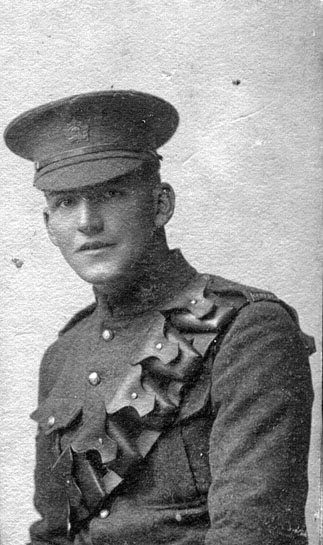
The inscription on the reverse of the print suggests that it was taken in August 1915. Certainly Leslie looks much the same as in another photo of him in the family collection (see below). This was taken at the studio of E.M. Treble in Derby, and I believe the sitting was probably during a visit home on leave from the army in June or July of 1915.

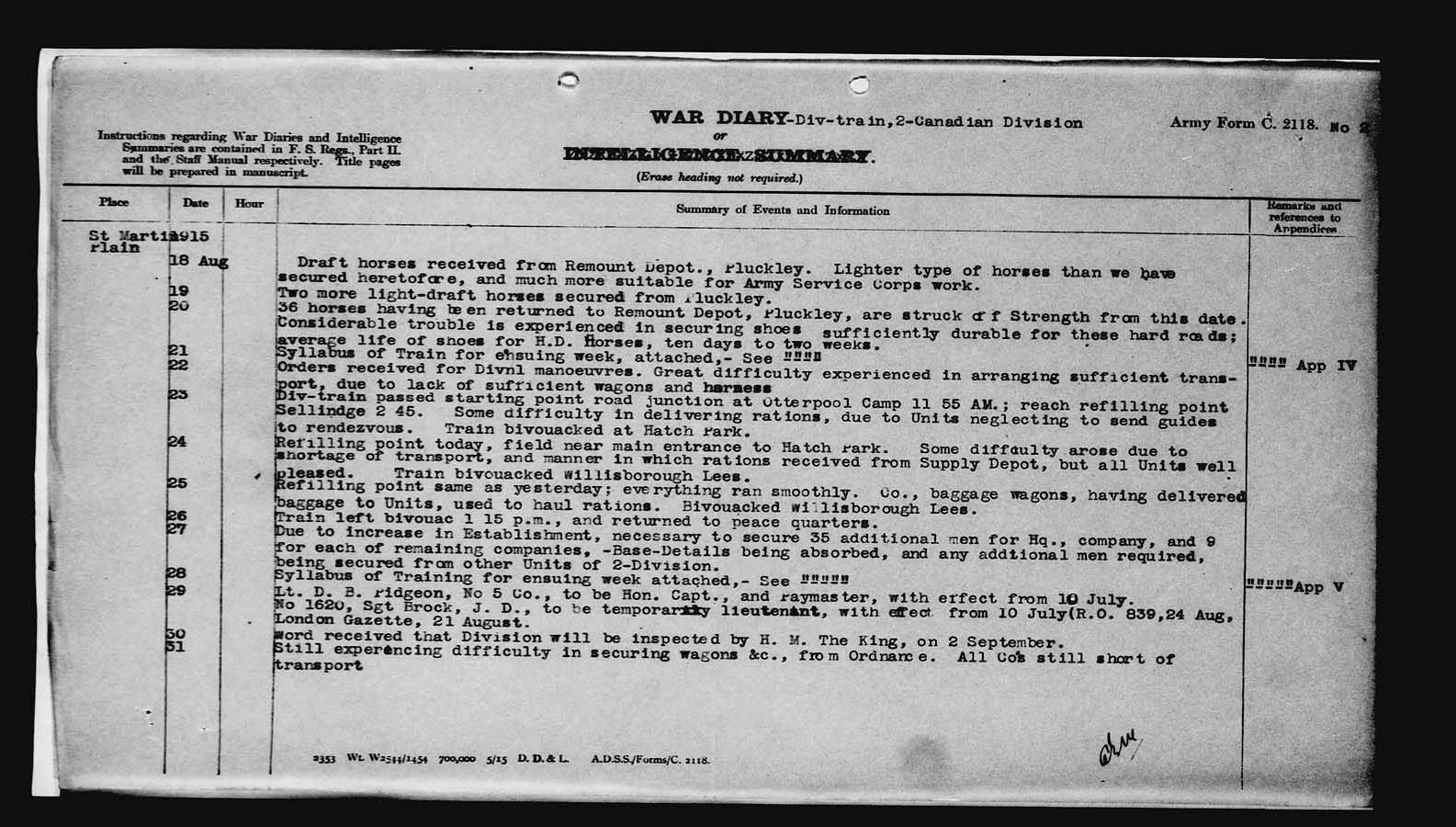
To investigate further the movements of my grandfather in the spring and summer of 1915, I resorted to his CEF war service records and the war diaries of the unit in which he was serving at the time, the 2nd Divisional Train, Canadian Army Service Corps (CASC). His service records I had previously ordered from the Library & Archives of Canada (LAC), and scanned images of the CEF War Diaries are now available online from the same source.

Leslie Payne and his unit spent four and a half months in the south of England training with the Canadian forces prior to their embarkation for France in mid-September 1915. They were based mainly at Dibgate Camp, near Shorncliffe, west of Folkestone in Kent. According to the War Diary for August 1915, the entire Canadian Second Division including my grandfather's unit, spent four days from 23rd to 26th August doing "manoeuvres."

The entries show that the 2nd Div. Train bivouacked at Willisborough Lees for two nights on the 24th and 25th August. They camped at nearby Hatch Park on the 23rd. It is clear that the inscription "Will... (?sp) Kent, August 1915" is in fact "Willisborough Lees" - or Willesborough Lees as it is spelled on contemporary Ordnance Survey maps.

The hamlet of this name is located just to the north-west of the town of Willesborough, near Ashford in Kent (see portion of 1945 one inch to a mile Ordnance Survey map, above). From what I can tell, this is the only occasion that they were near this location, or indeed near anywhere with a name starting "Will.."

While I am unlikely to ever find the exact location of my grandfather's bivouack site in a paddock near Willesborough Lees on the 24th and 25th August, I am confident that the photo was taken there. I will be visiting the Shorncliffe area briefly in October, and may get the opportunity to at least drive through the Willesborough Lees area. It will provide a fitting conclusion to my research into this photo.
Join my blog network
on Facebook