Showing posts with label inscriptions. Show all posts

Friday, 3 July 2015

Sepia Saturday 286: The Importance of Deciphering a Hasty Scrawl

Sepia Saturday by Alan Burnett and Marilyn Brindley

I spend lot of time trying to decipher almost illegible scrawls inscribed on the back of old photographs, often the only clue to the subject matter of the image on the front. Quite frequently, it comes down to whether a flick of the pen was the start of a new letter or part of the previous one. There's not much point in dwelling on the matter of whether a little more care could have been taken at the time. You just get on with it and work with what you have.

Image © and collection of Brett Payne

Six years ago a tattered and threadbare velvet-covered album of family photographs came into my possession, having originally been purchased at a yard sale in eastern Pennsylvania. Jack Armstrong had intended to research it himself, but after several years the almost total lack of any clues left its origins as mysterious as when he bought it.

A number of the portraits in the album had been taken by studios in Derbyshire (England) - hence my interest - but all provenance had been lost, and clues to the identity of the subjects were almost completely non-existent. I subsequently used the album as a photo-archival exercise, with several articles published here on the standard photographing, scanning and documentation procedures that I use for such projects (here, here and here). I also used a photograph from the album as the introductory image for a Sepia Saturday article (SS 170) that I wrote about gamekeepers.

Image © 2015 Brett Payne
Geographical distribution of photographs (click image to enlarge)

In addition to scanning and documenting the collection, I also did some geographical analysis of the studios at which the portraits were taken. As shown in the pie chart above most of the 55 portraits were taken in the United Kingdom, and of those the majority came from Derbyshire (10) and Staffordshire (9). In the United States the bulk of the portraits were taken in Cleveland, Ohio (8).

My initial analysis suggested, therefore, that the family which owned the album may have emigrated from one of several locations in Staffordshire or Derbyshire to Cleveland, Ohio at some time within the date range of the portraits in the album.

Image © 2015 Brett Payne
Dates of portrait sittings (click image to enlarge)
N.B. 5-yr moving average of mid-points of date estimates

I then constructed a graph showing the frequency of portrait sittings over time, using five year moving averages of the mid-points of the estimated date ranges. I realise that the logic and methodology of using five-year moving averages to represent date range estimates is a bit dodgy, to say the least, and I have since revised my date estimates for several photos, but I hoped that this would smooth out the graphs and at least give an an overall visual impression of the main periods that the images were taken, which it does fairly well.

The graph (or chart, if you prefer) demonstrates that the US photos start to appear in the early 1880s, while from the early 1890s onwards, the preponderance of UK photos diminishes markedly. To me this suggests an immigration date range from the early 1880s to the early 1890s. It is conceivable that one part of the family immigrated to the US in the early 1880s, while a second part arrived in the early 1890s. This could have been a husband and wife's family arriving at different times, or indeed something far more complicated.
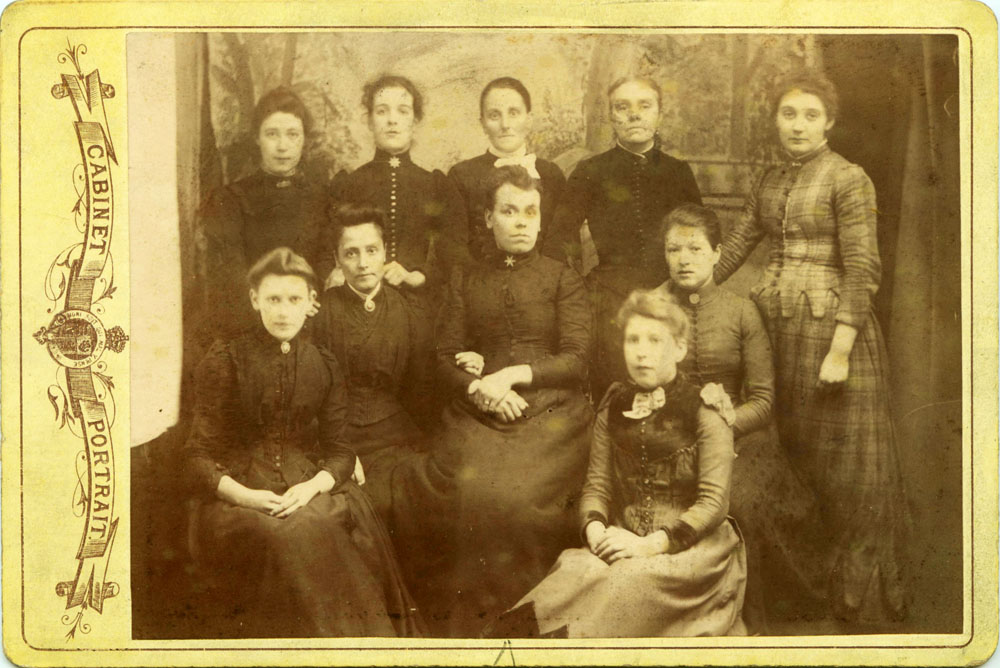
Image © and collection of Brett Payne
Cabinet portrait of unidentified group of women, c.1889-1893
Image © and collection of Brett Payne

There are very few inscriptions on the photographs, and none at all on the album pages. The only one that appears to offer any immediate clues to the identity of the subjects is on the back of a cabinet portrait of a large group of ten women taken in the very late 1880s or early 1890s by a professional, if somewhat hastily put together, studio. It has been mounted onto a standard cabinet card mount with no photographer's name, although the presence of a royal seal in the scroll work design strongly implies a United Kingdom origin.
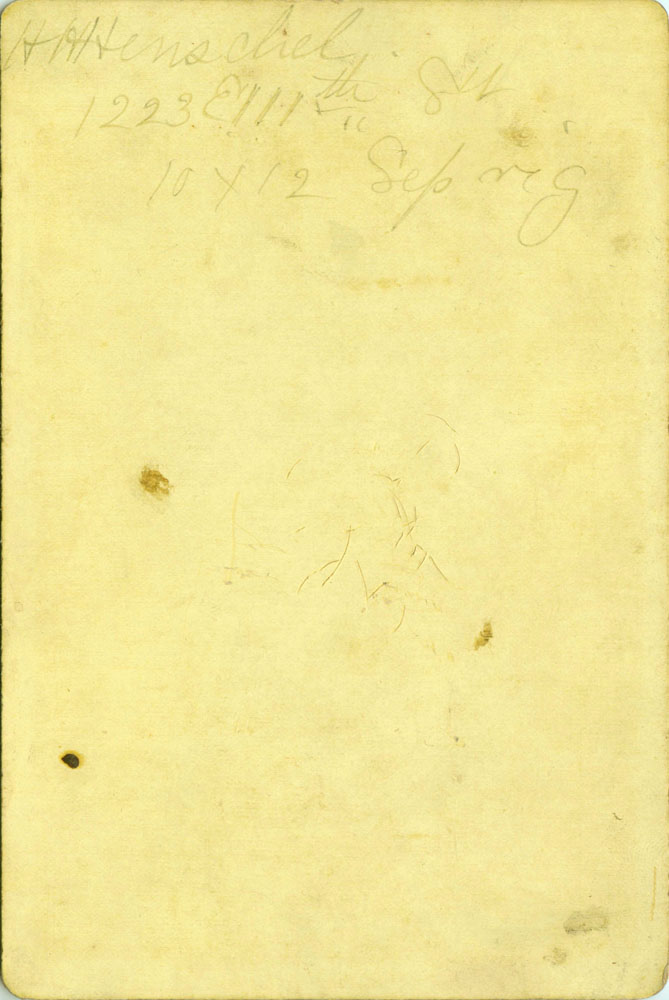
Image © and collection of Brett Payne
Inscription on reverse of cabinet card mount

The text, handwritten in pencil, appears to read as follows:
H.H. Henschel
1223 E 111th St
10 x 12 Sep vig
The first line is almost certainly a name, H.H. Henschel or conceivably "Herschel," and is probably the client's name, not necessarily that of the subject. The second line, I think, comprises an address, (number) 1223 East 111th Street, while the third I have deciphered as instructions for a copy enlargement of the portrait to be made, 10" x 12" Sepia vignette. At the edge of the front of the card mount is a small arrow marked in pen or pencil indicating that the central figure is the one which is to be enlarged.

The surname appears to be of Germanic origin, and the address is in a style more likely to have originated in the United States than in the United Kingdom. I came to the conclusion, therefore, that although the original portrait had been taken somewhere in the UK, the vignetted portrait enlargement was requested by someone who no longer had access to the original studio negatives. In other words, it may have been written, and therefore the enlargement made, some years after the original portrait had been taken. It could have been a simple framed vignette or a much more elaborate glazed and framed, colourised portrait, examples of which I have posted here and, with my Tauranga Historical Society hat on, here.
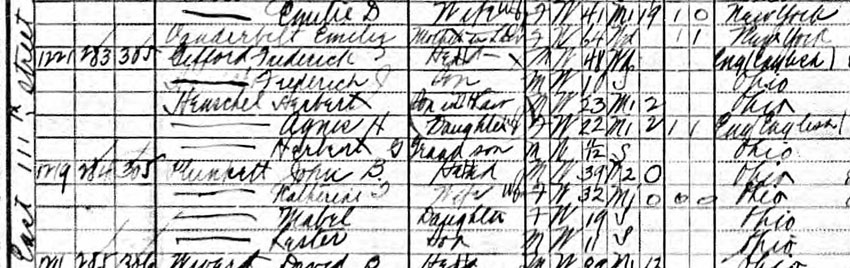
Image © The National Archives & courtesy of Ancestry.com
Census enumeration for 1221 E 111th St, Cleveland City, 23 Apr 1910
Image © The National Archives & courtesy of Ancestry.com

Given that Cleveland, Ohio features so prominently in the US portraits, I searched for the surname "Henschel" in census records for that city. Almost immediately I came up with the following spectacular discovery at 1221 East 111th Street, Cleveland in 1910:

Gifford Frederick / Head / 48 / Widr / b Eng / Imm 1892 / China Artist
Gifford Frederick J / Son / 10 / S / b OH
Henschel Herbert / SoninLaw / 23 / M 2y / b OH / Auto Co. Electrician
Henschel Agnes H / Dau / 22 / M 2y / b Eng
Henschel Herbert G / GdSon / 11m / S / b OH

Here was a family that fitted the bill, having arrived in the United States in 1892, settled in Cleveland, with a daughter who married Herbert Henschel in about 1908, and were living at in East 111th Street in 1910 - although at number 1221 instead of 1223. It seemed almost too good to be true but, as I investigated the family further through census records and the discovery of online family trees, pieces continued to fall into place.

Image courtesy of Ancestry.com
The Henschel family arrived on S.S. Cimbria in 1881
Image courtesy of Ancestry.com

Wilhelm (William) Henschel and his family emigrated from Berlin, Prussia in 1881. After a fifteen day voyage across the North Atlantic on board the Hamburg America Line steamship Cimbria, his wife Wilhelmina (Minnie) and three children arrived in New York on 6 October and joined William in Cleveland, Ohio.

Image © and collection of Brett Payne
Garfield Monument, Cleveland, Ohio, taken c. May 1890
Cabinet card by unknown photographer
Image © and collection of Brett Payne

Having arrived in the United States only a few weeks after the assassination of President Garfield, whose home town was Cleveland, it was natural that when a monument to him was unveiled at the Lake View Cemetery in Cleveland and dedicated in May 1890, the Henschel family should preserve a keepsake of such an historic occasion in their family album.
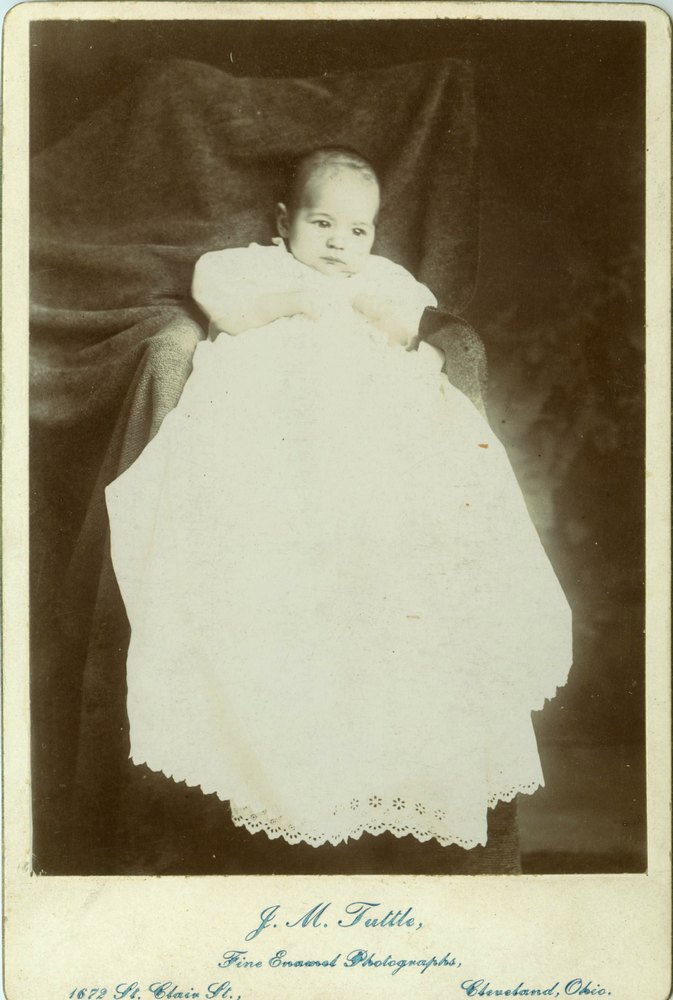
Image © and collection of Brett Payne
Unidentified child in christening gown, c.1889-1892
Cabinet card by J.M. Tuttle, 1672 St Clair St, Cleveland, Ohio
Image © and collection of Brett Payne

In the mean time, the Henschel family had grown. A fourth son William was born in September 1884 and a fifth Herbert Henry Henschel on 24 June 1888, nearly seven years after settling in Cleveland. Their only daughter Mamie arrived in July 1891. This baby in a christening gown could be either Herbert Henry or Mamie.
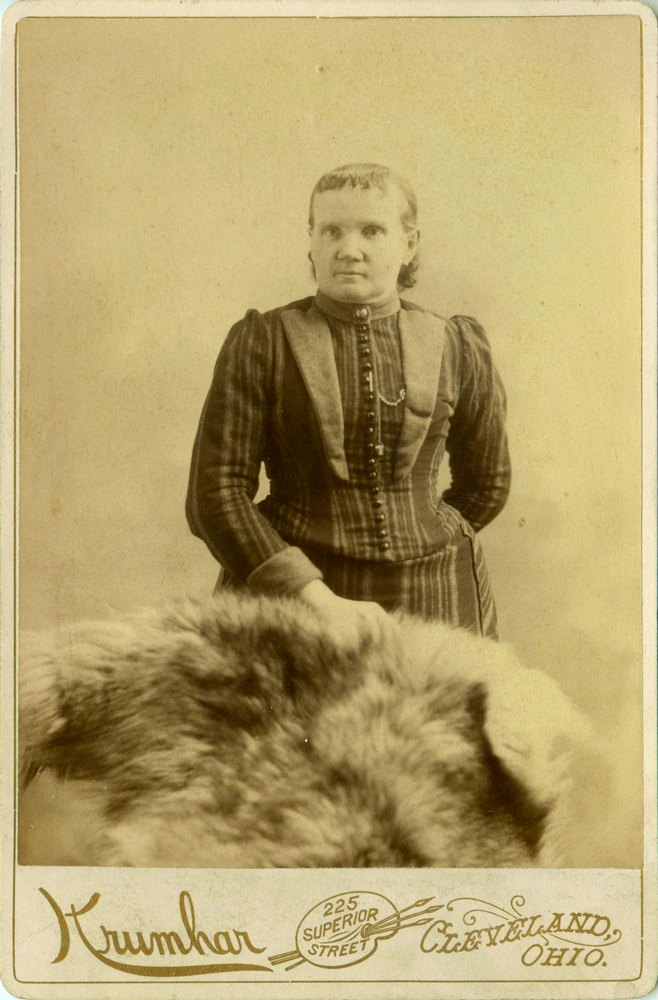
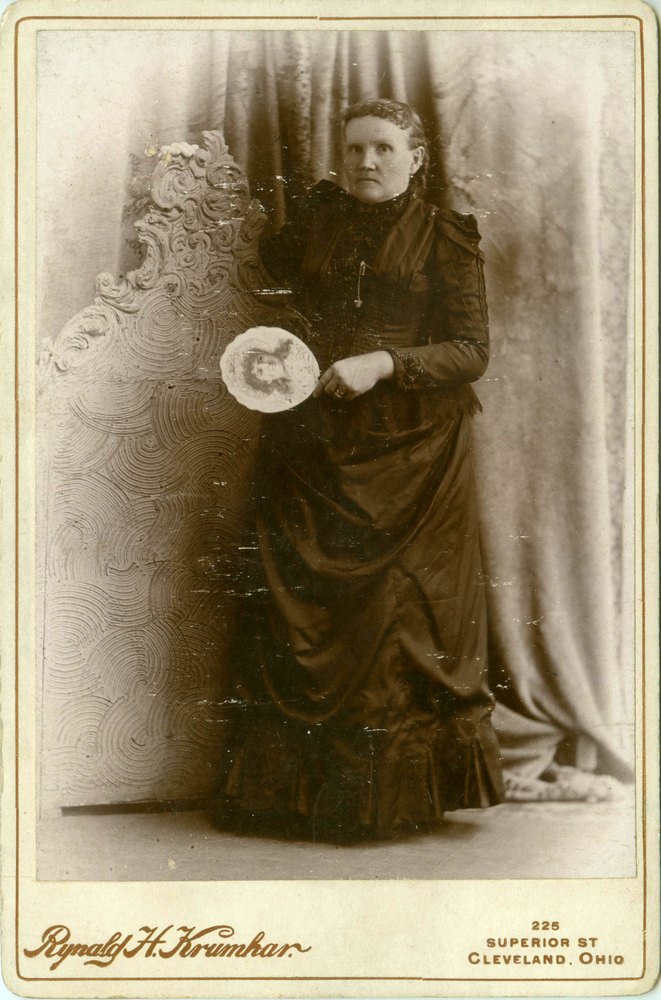
Image © and collection of Brett Payne Image © and collection of Brett Payne
Unidentified woman, taken c.1891-1892 (click images to enlarge)
Cabinet cards by Rynald H. Krumhar, 225 Superior St, Cleveland, Ohio
Image © and collection of Brett Payne

The two portraits of a middle-aged woman with a very close-fitting hair style and almost as severe an expression were taken by Rynald H. Krumhar who, according to Artists in Ohio, 1787-1900: A Biographical Dictionary, operated a studio in Cleveland on his own in 1891 and 1892 before teaming up with his brother Robert F. Krumhar between 1892 and 1895. Minnie Henschel (1848-) was in her early forties at the time these two portaits were taken, and I believe must be the prime candidate.
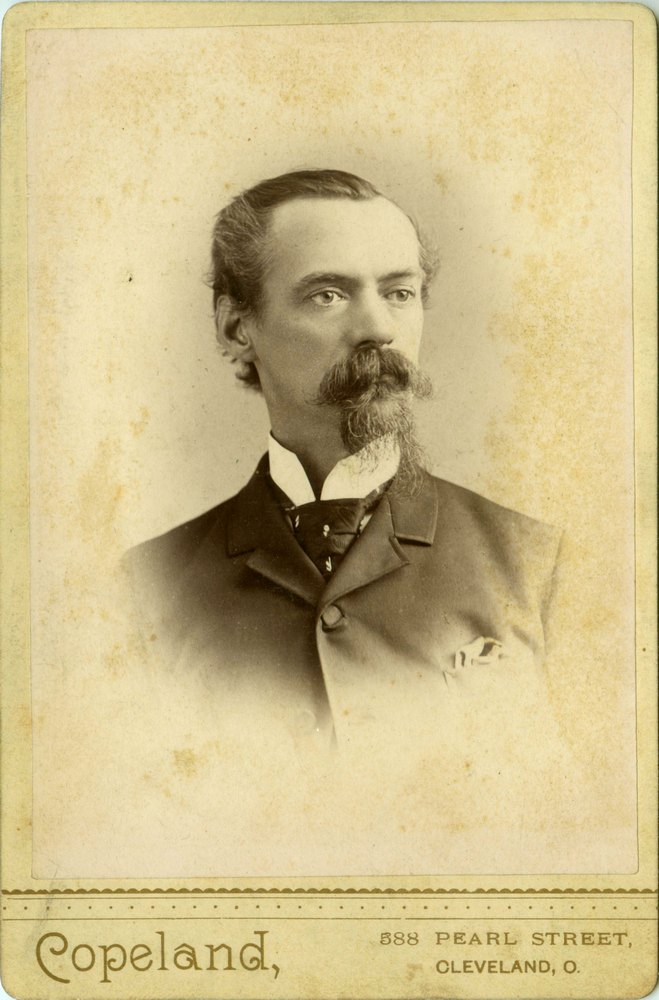
Image © and collection of Brett Payne
Unidentified man, taken c. 1887-1892
Cabinet card by Copeland, 588 Pearl Street, Cleveland, Ohio
Image © and collection of Brett Payne

A head and shoulders vignetted portrait of a similarly aged gentleman with a luxuriant moustache and goatee may have been taken slightly earlier. I don't have dates of operation of the Cleveland photographer Copeland, but from the style of mount, portrait and clothing I suspect it dates to the late 1880s or early 1890s. William Henschel Sr. (1850-) is the obvious choice here, as he too would have been about 40 years old.
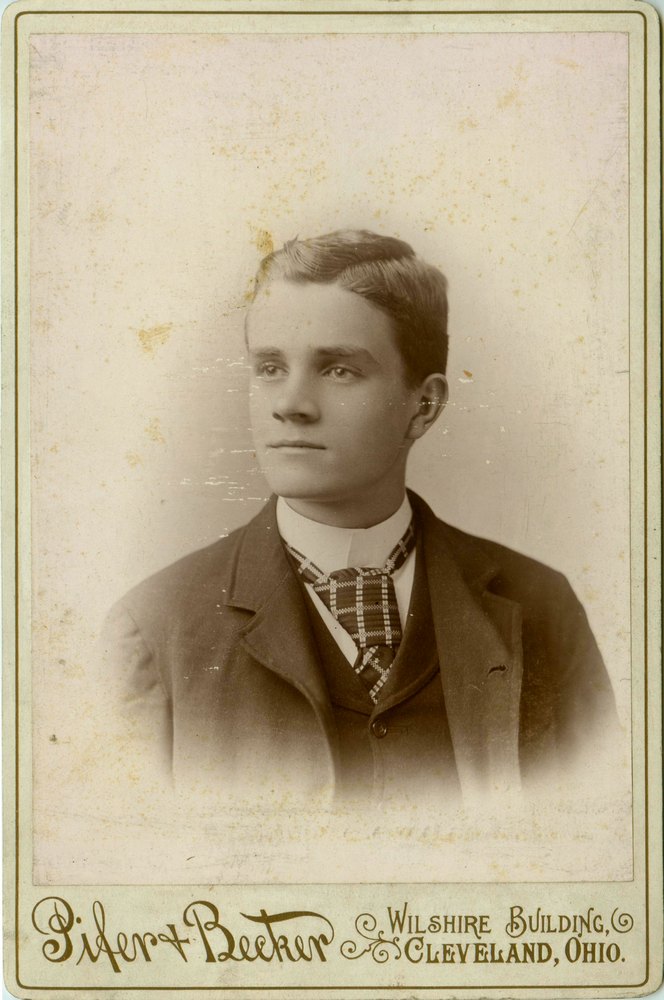
Image © and collection of Brett Payne
Unidentified young man, taken c. 1894-1897
Cabinet card by Pifer & Becker Photo-Palace, Wilshire Building, 94-100 Superior St, Cleveland, Ohio
Image © and collection of Brett Payne

This young man appears to be aged in his late teens, and probably visited Pifer & Becker's Photo-Palace studio in the mid-1890s. I suspect that it is one of Herbert's older brothers, Max, Hugo or Fred, all of whom were born in Germany.
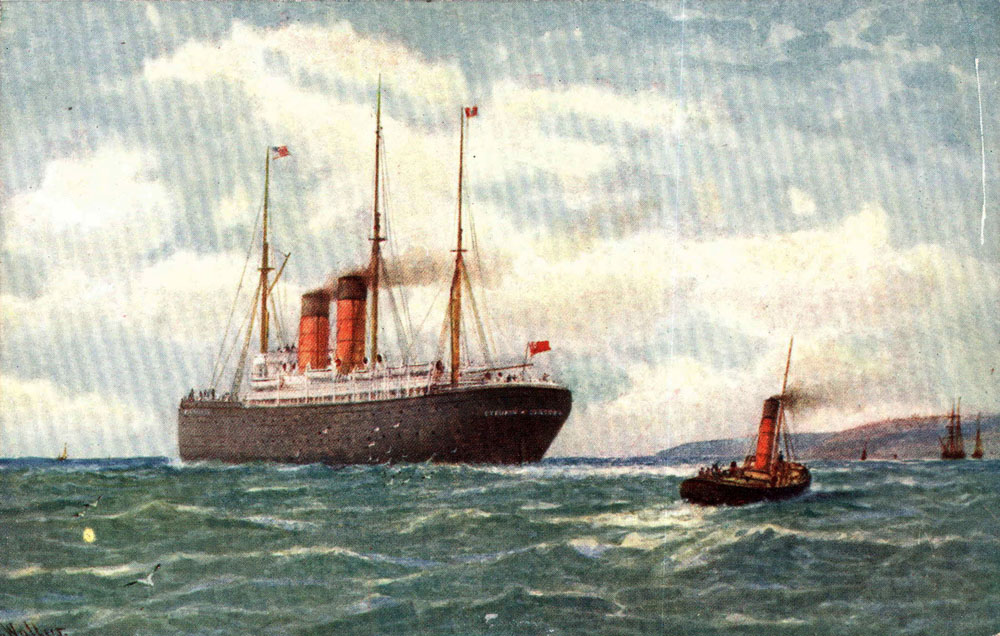
Image courtesy of Ancestry.com
Passenger manifest for S.S. Etruria, arr. New York 27 Feb 1893

On 27 February 1893 Frederick Thomas Gifford (1862-1932) and his wife Ellen arrived at Ellis Island, New York on board the SS Etruria from Liverpool, England with their four year old daughter Agnes Hammersley Gifford (1888-1967), giving Cleveland, Ohio as their destination on the ship's manifest.
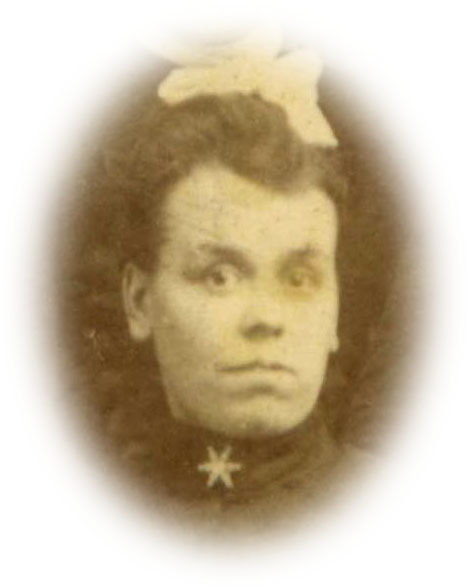
Image © and collection of Brett Payne
Vignette of unidentified woman marked on cabinet card

Frederick Thomas and Ellen Gifford had a son, also named Frederick, born in Cleveland in July 1899. Their daughter Agnes married Herbert Henschel in Hutchinson, Kansas in February 1907. Ellen Gifford died in April 1908 at 1221 East 111st Street, Cleveland, and was buried at Lakeview Cemetery. It was to this same address that the vignetted portrait enlargement - perhaps looking something like the image I created in Photoshop, above - was sent.

We also know that the widowed Fred Gifford, his son and the Henschel family were living there in 1910. By February 1913, when Herbert and Agnes' second child was born, the Henschels had moved to Indiana. It seems a distinct possibility, therefore, that the enlargement is of Agnes's mother Ellen Gifford (1866-1908), and that it was commissioned some time in the five years between her death in April 1908 and their arrival in Indiana in February 1913.

Image © and collection of Brett Payne
Unidentified child, taken c. 1892-1895
Carte de visite by Krumhar Bros., 225 Superior St, Cleveland, Ohio
Image © and collection of Brett Payne

When this warmly dressed child visited the Krumhar studio on Cleveland's Superior Street both of the Krumhar brothers were in attendance, dating it to between 1892 and 1895. Probably aged between 7 and 9 years old, and I'm guessing a girl because a boy is unlikely to be in a dress at that age, my estimate is that she would have been born circa 1883-1888. I believe this could be be Agnes H. Gifford.
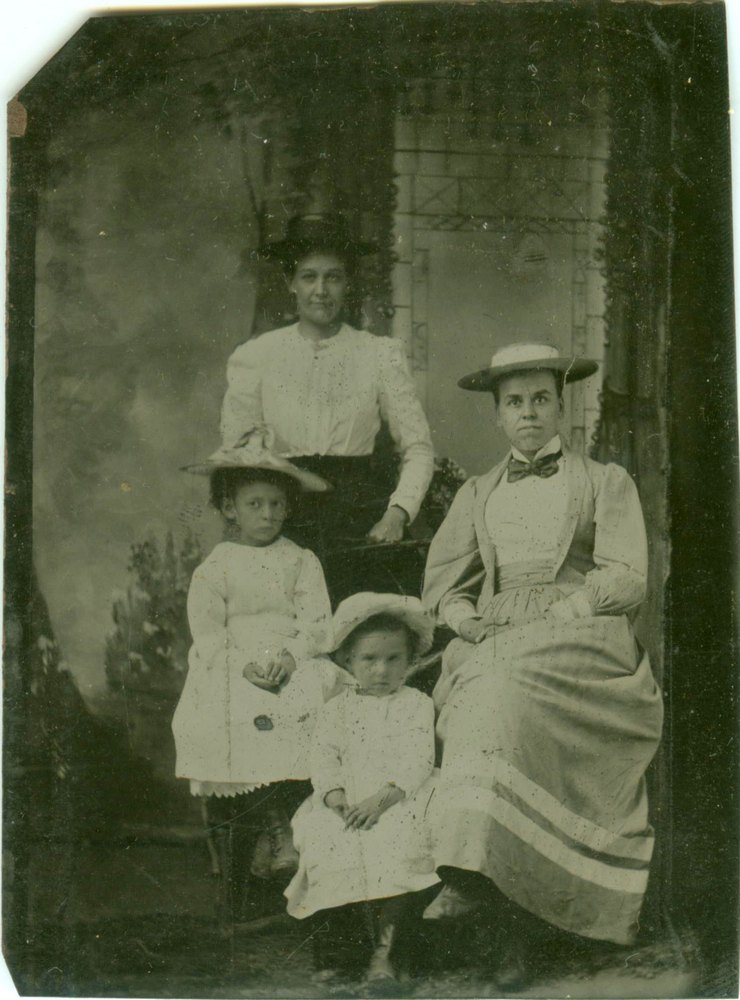
Image © and collection of Brett Payne
Unidentified group of 2 women & 2 children, taken c. 1892-1895
Sixth-plate tintype (63 x 84mm) by unidentified photographer
Image © and collection of Brett Payne

Inserted within the album are three loose, roughly trimmed sixth-plate tintypes, all taken in studio settings but without any indication of location. The clothing worn by the two women in this group portrait suggests they were taken in the early to mid-1890s, a time when the tintype was far more popular in North America than in England. The woman from the vignette appears seated on the right, wearing a broad-brimmed light-coloured hat, while the child from the Krumhar Bros. portrait is seated at left, also with a very flat hat. Are these two Ellen Gifford and her daughter Agnes? I think so, but then who might the other woman and younger child be?

Image courtesy of Ancestry.com
The Gifford family at 125 Becker Av, Cleveland City, 13 June 1900

The answer to the identity of the other child may lie in the 1900 Census record, which shows the Gifford family living at 125 Becker Avenue, Cleveland. In addition to (Frederick) Thomas, Ellen and Agnes, their ten month-old son Frederick J. is shown as having born in July 1899, probably too late to be the younger child in the tintype portrait. However, from the figures in the columns to the right of her age (Married for 13 years, Mother of 4 children, of which 2 living), we can infer that Ellen had two further children who died young. The younger child could be one of those who died, or alternatively belongs to the other woman who is standing at the back.
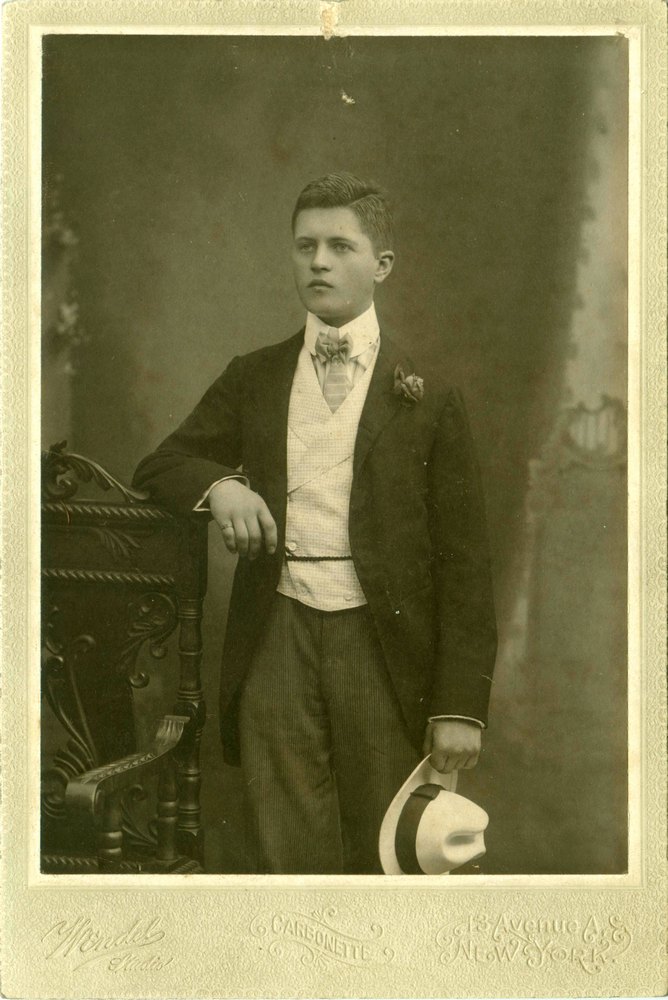
Image © and collection of Brett Payne
Unidentified young man, taken c. 1915-1925
Cabinet card (Carbonette) by Wendel Studio, 13 Avenue A, New York
Image © and collection of Brett Payne

This very smartly dressed young man with a bowtie, fedora and a rose in his buttonhole probably visited the Wendel Studio in New York for a portrait in the late 1920s or early 1920s. He looks to me to be in his late teens, perhaps between 17 and 20 years old, so I estimate that he was born c.1895-1908. The birth date of Frederick J. Gifford (1899-1959) lies well within this range; he married in 1930 and died at Jamestown, New York in November 1959. His father had also died at Jamestown in 1932.

Image © and collection of Brett Payne
Card mount (114 x 182mm) with no photograph, c.1910-1925
By the Globe Photo Co., 309 Main St., Jamestown, N.Y.
Image © and collection of Brett Payne

My last image for the moment is, in fact, not a photograph at all. This card mount from the Globe Photo Co. studio in Jamestown, New York has lost its contents, so we may never know whose face was framed within it. However I believe that it probably originally contained a postcard format portrait, and the style of mount suggests to me a date of perhaps the 1910s or early 1920s. I found several postcard format portraits from this studio on the web, and they come from a similar era.


I have no doubt that at this point several readers will be thinking that I have amassed a good deal of circumstantial evidence, and may even have indulged in a fair amount of speculation, but have presented little in the way of proof except for the single inscription. To my mind that inscription, and more specifically the juxtaposition of name and address, establishes the connection between that particular portrait and the Henschel-Gifford family without a doubt.

From that point, I agree that I'm on much more shaky ground, but I hope you'll bear with me as I continue to build up a family tree, and attempt to link portraits to individuals within that tree. Part of the difficulty is that one has to not only populate the family tree, but also show that individuals were in the right place at the right time to have their portraits taken. It's a lengthy and time consuming exercise to unravel the complex family relationships, which I'll have to spread over several articles in due course. Next week I'll turn to the English side of the family and look at portraits from Derbyshire and Staffordshire.

Thursday, 17 April 2014

Sepia Saturday 224: The Servants at Quantock Lodge


Sepia Saturday by Alan Burnett and Marilyn Brindley

The Sepia Saturday image prompt this week shows a woman watering her artichokes while a man, presumably her husband, stands with a pipe firmly clenched in his mouth and holding a shovel. He's perhaps pretending that he's just finished the weeding, but is clearly not dressed for the task. My contribution to the meme this week is a group of servants, including gardeners and groundsmen, who may be in their best clothes, but they don't look quite as out of place in the garden.

In something approaching the manner popularised by fellow Sepians Tattered + Lost and Mister Mike, I will attempt a deconstruction and/or reconstruction of the occasion.

Image © and collection of Brett Payne
Quantock Lodge Servants, 79/August, Cabinet card portrait
Image © and collection of Brett Payne

This early cabinet portrait mounted on plain card was a fortuitous purchase on eBay a few years ago, lucky in that such items often attract furious bidding which very quickly puts them totally out of my reach costwise, but if I remember correctly I was the only one to show any interest in this. It is unusual not only for the subject matter, a large group of servants from a big house, but also that the location and date are written on the card mount.

Quantock Lodge is a mansion built as a holiday residence in the Gothic revival style during the mid-19th century for Henry Labouchere, 1st Baron Taunton (1797-1869), and described by Nocolas Pevsner as "a large rather dull Tudor house ... Gothic Stables, a specially crazy Gothic Dovecote and a big Gothic Lodge." Although Baron Taunton's second wife inherited the estate on his death in 1869, his eldest daughter Mary Dorothy Labouchere (1842-1920) lived there after her marriage in 1872 to Edward James Stanley, D.L., J.P. (1826-1907), later a British Conservative politician from 1882 until 1907. By August 1879, when this photograph was taken, the Stanleys had a son and a daughter, both born at St George Hanover Square, London, and a second son was born on 30th August, also in London.

Image © and collection of Brett Payne
Cabinet card portrait by Monsieur Bernard's Prince Imperial Photographie Francaise, 8 Alphington St, Exeter
Image © and collection of Brett Payne

Rather than using printed card mount, the photographer has used a small paper label with his details pasted on the back of the card.

MONSIEUR BERNARD'S
PRINCE IMPERIAL
MEMORIAL
Photographie Francaise.
-:o:-
8, Alphington St. EXETER.

Copies may always be had.
No.

I've been unable to find records of a photographer named Bernard working in either Exeter or Somerset. However, there was a Daniel Bernard of Austrian origin living at 12 Smythen Street, Exeter in April 1881 who described himself as picture frame dealer. That he had links with Somerset is demonstrated by the birth of his two children at Bristol in 1875 and 1878. Bernard's use of the name "Prince Imperial Memorial" was particularly opportunisitic, considering that Napoléon, the Prince Imperial, had been killed in Zululand only a couple of months earlier, and the "Prince Imperial Memorial Fund" set up in mid-June.

Image © and collection of Brett Payne
Detail of Quantock Lodge servants

This group of servants - 10 male, 9 female and a young lad - is large, indicative of a fairly wealthy household, which the Stanleys certainly were. Mary's mother and paternal grandmother were members of the Baring banking family. The census record of Quantock Lodge, Over Stowey, Somerset for 3 April 1881 (p1 & p2), only 20 months after the photograph was taken, shows 21 servants - 8 male, 12 female - as well as a governess and a young boy, with three additonal male employees living in married quarters nearby. In order to compare the census list with the people we see in the photograph, I have extracted their details:

NameAgeOccupation1871--1891
Eleanor E. MAJOR22Governess
Annie REID40Butler's wife (Visitor)
Caroline FARLEY49Housekeeper
Emile WELLS30Cook
Elise REDFLEUR31Ladies Maid [sic]
Mary MAY25NurseHousekeeper, 1891
Thomas REID45Butler
Walter REID37Valet
William DAVIS28Under Butler
Thomas WALKER30Footman
James GRANDFIELD25FootmanUnder Butler, 1891
Henry WATTS322nd Coachman
James STACEY23Groom
George LUCAS22House Servant
Mary A. PRICE26Kitchen maid
Alice E. TOFFS19Kitchen maid
Elizabeth VINCENT22House Maid
Gerald A. ELLIS8Scholar (Nephew)
Clara PACKER31Head Housemaid
Hannah HUTCHINGS28Still Room Maid
Elizabeth WALTER282nd Housemaid
Jane HOOPER193rd Housemaid
Caroline THORNE184th Housemaid
William ISTED39Head Coachman
Archibald BOUSIE60Head GardenerHead Gardener, 1871
John MARSHALL56Head Gamekeeper

The boy was actually Mrs Stanley's nephew, Gerald Arthur Ellis, but I've included him in the extract because he is, rather oddly, listed among the servants. Gerald's father Major-General Sir Arthur Ellis was Equerry to the Prince of Wales, and Gerald himself became a Page to Queen Victoria.

Image © and courtesy of BBC
Status and heirarchy of servants in a Victorian house
Image © and courtesy of BBC News Magazine

I can't give an authoritative source for this, but I have the impression that census listings for such households generally show the servants in order of seniority. It is interesting to note that the head gardener had been there since 1871, while two of the servants were still working at Quantock Lodge a decade later in 1891. In those ten years Mary May had worked her way up from Nurse to Housekeeper, while James Grandfield had undergone a similar promotion from Footman to Under Butler.


The Butler and the Housekeeper, Quantock Lodge

The two central figures in this tableaux, also probably the oldest, are almost certainly the most senior male and female servants in the household, the butler and the housekeeper. The butler looks to be in his forties. Thomas Reid was shown as 45 in the 1881 census, but 46 or 47 when he died at Quantock Lodge in February 1884 - depending on source - and is therefore a good candidate. His wife Annie is described as a visitor in the census, and was therefore not a regular member of the household. After her husband's death, she continued to live nearby in Taunton, described in the 1891 Census is "living on her own means."

The housekeeper at Quantock House in April 1881 was Caroline Farley. She gave her age as 49, but I've been able to track her through the remaining census records from 1841 to 1901, and it appears that at the time the photograph was taken in the garden of Quantock Lodge in August 1879, Caroline was probably in her mid-fifties. The housekeeper in the photograph looks a little older than this, perhaps in her sixties, but there are no older women in the census list, so this may be Caroline Farley's predecessor - it's difficult to be sure.


The Valet, Quantock Lodge

Thomas' younger brother Walter Reid was also at Quantock Lodge in 1881, aged 37 and employed as a valet. Judging by his clothing, his age and the similarity of their facial features (in particular ears, nose and mouth), I think he may be standing in the back row, second from right, with his right hand resting with some degree of familiarity on the shoulder of a woman seated on the butler's right, and possibly his left hand on the shoulder of another young woman. Walter was the executor of his brother's will dated April 1884, in which he left a personal estate of £480. I've been unable to find any record of Walter after this date.


The Under Butler and the House Servant, Quantock Lodge

Judging by their clothing, their ages and their proximity in the lineup to the butler, I believe that the two young men standing in the back row, directly in line with the butler and the housekeeper, are probably the Under Butler (right) and male House Servant (left), listed in the 1881 census as William Davis (aged 28) and George Lucas (aged 22). George Lucas was an inmate of the Dorchester Union Workhouse at Fordington in 1871, his mother having died when he was very young.


The Two Footmen and the 2nd Coachman, Quantock Lodge

The double-breasted coats with large brass buttons worn by all three young men standing at the right hand end of the back row makes them likely to have been footmen and coachmen. In 1881 Thomas Walker (30) and James Grandfield (25) were the two footmen, while Henry Watts (32) was the Second Coachman. It is difficult to tell whether that is the order they appear in the photograph.


The Cook and the Head Housemaid, Quantock Lodge

Unfortunately these two are in a part of the photograph which has been overexposed, with a resulting loss of definition. From their clothing, seniority dictated by their position seated to the housekeeper, and their ages, I believe them to be the Cook (left) and the Head Housemaid (right). In 1881, these positions were filled by Emily Wells (30) and Clara Packer (31). I tracked down Emily/Emma Wells to the magnificent Petworth House in Sussex in 1871, where she was employed by the 2nd Lord Leconfield as a Still Room Maid, the most junior servant in the household.


The Governess and the Lady's Maid, Quantock Lodge

There are only two women dressed in dark clothing, both of them fairly young, and they must, I think, be the Governess and Lady's Maid. The young woman seated on the grass at the far left of the group has a substantial hat, and appears to be of an appropriate age to be the 22 year-old Governess, Eleanor E. Major. Ten years later she was working as a Governess to the family of her previous employer's sister, Mina Frances Ellis, and was still employed as a governess in 1901. The woman holding a dog on her lap may be the 31 year-old Elise Reafleur (or Redfleur), the Swiss-born lady's maid to Mary Stanley.


The Nursemaid, Quantock Lodge

Five months prior to the sunny summer morning when Monsieur Bernard visited Quantock Lodge, the Honourable Mrs. Stanley placed an advertisement in the Morning Post, a conservative daily London newspaper "noted for its attentions to the activities of the powerful and wealthy," looking for a "superior Nurserymaid to help in the care of two children (see below). Pregnant with her third child, she was obviously anticipating the extra work load. It would be nice to think that Mary May, the 25 year-old "Nurse" listed in the 1881 Census, who was still with the Stanleys ten years later at Quantock Lodge as housekeeper, came to them in response to this advertisement. My feeling is that she is seated at far left, between the butler and the governess.


Advertisement in the Morning Post, 18 March 1879

In 1898 Mary Ann May married the under-butler James Grandfield and the couple moved to Kensington where James found work, now as a butler. The 1901 Census shows the Stanley household without a butler. James was still working as a butler in London in 1911 and died in 1919, while Mary died in 1939.


The Kitchen and House Maids, Quantock Lodge

The three remaining women in the group, standing immediately behind the butler, housekeeper and cook, look to be in their early to mid-twenties, and could be either kitchen or house staff. Unaccounted for in the census are two kitchen maids, four house maids and a still room maid. Presumably some were either too busy to outdoors engaging in such frivolities as a photographic portrait (read camera-shy), or absent on the day.


The Head Gardener, Quantock Lodge

The man standing at the extreme left of the group may be the Head Gardener, Archibald Bousie, who lived with his family in the gardener's cottage on the estate. He was born on 9 March 1821 at Markinch, Fife, Scotland and, judging by the number of credits in The Flora of Forfarshire by William Gardiner, published in 1848, he was a very knowledgeable and active botanist as a young man. Mr Bousie was employed from c. 1848 by Henry Labouchere, Lord Taunton, as the head gardener in the famous gardens laid out by Capability Brown and Humphry Repton at Stoke Park in Buckinghamshire. He won numerous medals and prizes for his fuschias, rhododendrons, calceolarias, fancy pelargoniums, figs and desert apples in flower and fruit shows at the Crystal Palace, Royal Botanic Society and Royal Horticultural Society between 1855 and 1863.

After Stoke Park was sold in 1863, Bousie moved to Quantock Lodge where he worked in a similar capacity, first for Lord Taunton and later for his daughter and son-in-law, the Stanleys. He died at Over Stowey on 20 December 1910, aged 89 years, after having passed on the reins at Quantock Lodge to his son David Alexander Bousie.


The Head Gamekeeper and the Groom, Quantock Lodge

As we get further down the list, I feel on more shaky ground regarding identifications. The man with a large stick and an even more impressive beard seated on the grass is dressed as an outdoor servant, but I don't believe he can be the Head Coachman, so I think it more likely that he is a gardener or a gamekeeper. The 1881 Census shows one John Marshall, aged 56, Head Gamekeeper, living near Quantock Lodge and it seems likely this is him. The man seated at far right, holding onto a dark-coloured poodle, is probably the groom, shown in the census as James Stacey, aged 23.


The Young Lad, Quantock Lodge

Finally, we have the well dressed young lad sitting cross-legged in front of the housekeeper and the cook. There is only one boy shown in the census, Gerald Ellis, nephew of Mrs Stanley, but in August he would have been only six years old, and this chap looks to me to be around 9 or 10, at least. The Stanley's eldest son Henry Thomas Stanley was a year younger than Gerald, so it's not likely to be him either. I suspect that he was a local lad employed as a Hall Boy.

Image © and collection of Brett Payne
Quantock Lodge servants

Possible identification of individuals in Quantock Lodge Servants photo:

1. Archibald Bousie, aged 60, Head Gardener
2. Walter Reid, aged 37, Valet
3. Unidentified Kitchen or House Maid
4. George Lucas, aged 22, House Servant
5. Unidentified Kitchen or House Maid
6. William Davis, aged 28, Under Butler
7. Unidentified Kitchen or House Maid
8. James Grandfield, aged 25, Footman
9. Thomas Walker, aged 30, Footman
10. Henry Watts, aged 32, Second Coachman
11. Mary May, aged 25, Nurse(maid)
12. Thomas Reid, 45, Butler
13. Caroline Farley, aged mid-50s, Housekeeper
14. Emily Wells, aged 30, Cook
15. Clara Packer, aged 31, Head Housemaid
16. Elise Reafleur/Redfleur, aged 31, Lady's Maid
17. James Stacey, aged 23, Groom
18. Eleanor E. Major, aged 22, Governess
19. John Marshall, aged 56, Head Gamekeeper
20. Unidentified Hall Boy

Of course I understand that most readers will have decided, probably well before getting to this point, that my IDs are at best tentative, and in the worst case, rather unlikely. My aim at putting this list out in the cybersphere is to generate some interest and possibly further information about the servants who worked, perhaps not straight away, but hopefully in due course.

For more gardening of the sepian variety, I can recommend visiting the other Sepia Saturday contributers.

Thursday, 25 July 2013

Sepia Saturday 187: Ephemera and the preservation of family photo albums


Sepia Saturday by Alan Burnett

The image prompt for Sepia Saturday this week gives me an opportunity to look at some of the non-photographic material often found in family photo albums, as well as to show off some of the photo-related ephemera in my collection. Although Victorian carte de visite and cabinet portrait albums contain largely that, i.e. photographic portraits - the purpose-designed sleeves weren't really suitable for flimsy pieces of paper and arbitrarily sized cards - one does often find a variety of family history-related ephemera in them.

Image © and collection of Brett Payne
Edith Mary Morton's photo album
Image © and collection of Brett Payne

This album was an eBay purchase a few years ago. It is in a rather dilapidated state, but in addition to 45 cartes de visite, five cabinet cards and a postcard format photo, the album also contains an ornate baptism card and a printed memorial card.

Image © and collection of Brett Payne

An inscription on the front page of the album demonstrates that it was a birthday gift to Edith Morton from her sister Amy.

May 19th 1895
To Edith Morton
With best wishes For a
Happy Birthday
From her sister Amy.

Image © and collection of Brett Payne
Baptism certificate for Sidney Stephen Sears
Image © and collection of Brett Payne

Near the front of the album, and loose between the pages, I found a brightly coloured baptismal certificate for Sidney Stephen Sears, dated April 12th 1903 at St James Enfield Highway, filled in and signed by the vicar, J. Leonard Boulden. The baptismal certificate is of a type that appears to have been used quite commonly in parish churches in the early twentieth century. I have found almost identical examples from as late as 1933. [1,2] Boulden was vicar of St James until at least 1922. [3]

Image © London Metropolitan Archives and courtesy of Ancestry.com
Entry in baptism register for Sidney Stephen Sears
Enfield Highway St James, Register of Baptism, Ref. DRO/054, Item 007
Image © London Metropolitan Archives and courtesy of Ancestry.com [4]

The entry in the baptism register for St James, archived at the London Metropolital Archives, is in the same handwriting. Not only does it confirm the baptism date, but it also provides the very useful information - not given on the certificate - that Sidney Stephen was born on 16th February 1903, the son of Stephen and Edith Mary Sears of 22 Durrants Road.

Image © and collection of Brett Payne
Edith Mary Sears, c. 1897-1901
Albumen print (96 x 139mm), probably detached from cabinet card
Attrib. Henry Bown, 31/33 Jamaica Rd & 43 New Kent Rd, S.E. London
Image © and collection of Brett Payne

Using this information, I was able to identify the owner of the album as Edith Mary Morton (1874-1944). Edith was born in 1874 at Riverhead in Kent, to a railway clerk Frederick William Morton (1843-1891) and his wife Emily Wanstall née Andrews (1843-1896). She grew up with her six sisters and three brothers in Sevenoaks and Deptford in Kent and as a young woman worked as a book folder. [5]

Image © and collection of Brett Payne
Stephen George Sears, c.1896-1900
Cabinet card (107 x 166mm) by W.H. Fawn, 13 Evelyn Street, Deptford
Image © and collection of Brett Payne

On Christmas Day 1897 Eadie married Stephen George Sears (1875-1934). They lived at 22 Durants Road, Ponders End, Enfield Highway in Middlesex and had three children, Ethel Edith (born 15 November 1898), Helen Amy (born 27 August 1900) and the youngest Sidney Stephen.

Image © and courtesy of John Bradley
Roadworkers in Church Street, Ashover, c.1900-1910
Mounted albumen print by J.J. Shipman of Ashover
Image © and courtesy of John Bradley

Stephen Sears' occupation is listed in various records (marriage, baptisms of children, etc.) as engine driver or engineer, but in 1891 he was employed as a "plowing portable engine boy," i.e. an agricultural traction engine, and by the time of the 1901 census he described himself as a "steam road roller driver." This gives me the chance to re-use this excellent image of a steam road roller at work, albeit in a small Derbyshire village, which I wrote about for Sepia Saturday a couple of years ago. The 1911 Census shows him as an "engineer fireman" working for the District Council.

Image © and collection of Brett PayneImage © and collection of Brett PayneImage © and collection of Brett PayneImage © and collection of Brett Payne
Four unidentified women from Edith Sears' photo album
Cabinet cards from the studio of Henry Bown, S.E. London
Image © and collection of Brett Payne

Sadly, the album doesn't seem to contain photographs of any children that I can identify unequivocally as Ethel, Helen or Sidney. In fact, the bulk of the portraits are of young women dressed to the nines, taken between the late 1880s and the late 1890s, probably Edith's sisters and possibly including some of her friends. There are a few photos of children, but I suspect they are Edith's nephews and nieces.

Image © and collection of Brett Payne
Frederick William Morton, c. December 1908
Postcard portrait (87 x 138mm) by unidentified photographer
Image © and collection of Brett Payne

This postcard addressed to Edith was sent from Toronto, Canada by her younger brother Frederick William Morton in 1908.

124 John St, Toronto, Canada, Dec 8th 12/08.
Dear Eadie.
Just a line hoping you are quite well as it leaves me the same hoping steve and the children are the same and wishing you all a Merry Christmas and a Happy and Prosperous New Year we have got winter here now and the sleighs out with the Bells Jingling and nice frosty air hoping you will know this photo allright I remain your affectionate Brother.
Fred Morton

Image © and collection of Brett Payne
Memorial card for Emily Wanstall Morton (1843-1896)
Image © and collection of Brett Payne

Also found loose in the album was this memorial card for Edith's mother, who died in August 1896, only fifteen months after Edith had received the photo album as a gift for her 23rd birthday.

IN LOVING REMEMBRANCE
OF
Emily Wanstall Morton,
Who died 12th August, 1896,
AGED 53 YEARS.
--x--
INTERRED IN BROCKLEY CEMETERY,
No. OF GRAVE 718A, PLOT P.

Image © and collection of Brett Payne
Probably Emily Wanstall Morton, c.1892-1896
Carte de visite portrait by Parisian School of Photography, London
Image © and collection of Brett Payne

There are two photographs in the album which could be of Edith's mother. This carte de visite portrait shows a middle-age woman dressed in rather heavy clothing, perhaps even mourning dress, and was taken in the early to mid-1890s. Emily was widowed in 1891.


Possibly Emily Wanstall Morton, c.1866-1871
Carte de visite portrait by Hellis & Sons, London
Image © and collection of Brett Payne

Another carte de visite portrait, of which there are two similar copies, may also be of Emily. It was printed at one of the Hellis & Sons branch studios, judging by the addresses list on the reverse of the card mount, probably between 1899 and 1901. However, I can tell from the hair, clothing and pose styles, as well as the studio furniture, oval vignetting (a technique commonly employed to hide the edges of the original) and faded nature, that it was almost certainly copied from a much earlier photographic portrait, perhaps taken in the late 1860s or very early 1870s.


View Larger Map
22 Durants Road, Ponders End, Enfield

Sidney died in 1920, aged only 16. For the rest of their lives, his parents continued to love in the same house at Ponders End that they had moved into after their marriage in 1897 [6]. Stephen Sears died in 1934, aged 59, while Edith lived to the age of 70; she died in 1944. Ethel and Helen never married, and passed away in 1976 and 1991 respectively. Presumably the lack of any surviving descendants is what resulted in the album eventually finding its way onto eBay.


Morton-Sears Album

I find it interesting that there don't appear to be any photographs in the album of the Sears family after their marriage, except perhaps the portraits of Stephen and Edith Sears. Why would this be? After a lengthy contemplation of the album's contents I've come to the conclusion that it has survived largely intact since the most recent photograph (Fred's postcard sent from Canada in 1908) was inserted in it. There are some portraits taken after her wedding in 1897, but these are probably of her siblings and their children. Edith may have kept this album as a record of her life prior to becoming a wife and mother.

Image © The National Archives and courtesy of Ancestry.com
Sears family at 22 Durants Road, Ponders End, Sunday, 2 April 1911
Image © The National Archives and courtesy of Ancestry.com

Even though the album contains very few items with inscriptions - effectively three photographs and a further three pieces of documentary ephemera - I was able to identify the original owner of the album with a high degree of confidence. Using census and birth, marriage and death records, it was then possible to build up an extensive tree of both Edith and her husband's families. Quite apart from generating a list of potential candidates for the remaining photographs in the album, it also enabled me to locate and contact a descendant of one of Edith's sisters.

Image © and courtesy of Ron Plumley
Group at front door of 22 Durants Road, Ponders End, c.1915-1920
Loose amateur print by unidentified photographer
Image © and courtesy of Ron Plumley

Ron Plumley is the grandson of Edith's sister Emily, and among his Nan's photographs he found this snapshot, which turns out to have have been taken outside the Sears family's front door at 22 Durants Road - compare this with the modern Streetview image above. Although it isn't a very high resolution scan, it's detailed enough to see that the clothing of the woman (at left), the man (at right) and three possible teenagers standing in the doorway equates with the fashions worn immediately before and during the Great War.

I estimate that it was taken between 1915 and 1920 and it's difficult to be sure, but I think this must be the Sears family. Apart, that is, from the man standing at the right, who seems to be too old to be Stephen Sears, then in his early 40s. Perhaps that is Ron's grandfather William Henry Plumley (1869-1919), who would then have been in his late 40s or early 50s, and the Plumleys could have been on a day visit to the Sears family on the northern outskirts of London from their home in Deptford, also in London, but just south of the Thames?

Image © and courtesy of Ron Plumley
The Morton sisters: Grace Harriett Jenkins? (1870-1945), Agnes Helen Wright (1882-1947), Amy Maria Morton (1875-1963), Florence Maud Zillwood (1866-1946) and Emily Wanstall Plumley (1872-1958)
Postcard portrait by unidentified photographer, c.1930s
Image © and courtesy of Ron Plumley

Finally, this image also shared by Ron shows his grandmother (at far right) with her sisters. It's quite a contrast with the photographs of the Morton sisters taken four decades earlier, naturally, but they look like they are having a lot more fun.

One day this album will return to a family member, but it is only by a stroke of luck that this has been possible. It could easily have been broken up and offered for sale on eBay as individual photos, as many such albums in a somewhat worn state clearly are. If that had happened, almost all of the photographs would have lost all connection with the provenance, history and genealogy that it has been possible to deduce from them as an intact collection.

Image © and collection of Brett Payne

I cannot stress enough how important it is not to break up albums, even if the paucity of documentation suggests there is little chance of identifying the subjects of the portraits, as clues may only become apparent at a future date. Sadly, inevitable financial imperatives will result in the continued dissolution of many such family collections from deceased estates and yard sales via eBay, but we can all do our part to make sure those in our own families do not share the same fate.

I hope you'll join the other Sepia Saturday enthusiasts this week presenting their own family heirlooms, bibles, books, letters and a variety of other ephemera.

References

[1] Baptism certificate for Hilda Charlson, 12 April 1911, on Hindsford St Anne Parish Page, Lancashire Online Parish Clerk Project.

[2] Baptism certificate for Ian Brackenbury Channell, Easter Day 1933, St Michael's Framlingham, Website of the Wizard of New Zealand.

[3] Licence from Bishop of London to Joseph Leonard Boulden, Vicar of St James, (To officiate in the district chapel of St Peter and St Paul, Enfield Lock, in the parish of St James), The National Archives, Ref. DRO54/45/2, 18 Aug 1922.

[4] London, England, Births and Baptisms, 1813-1906 database, from Ancestry.com.

[5] 1881, 1891, 1901, 1911 Census records, UK Census Collection from Ancestry.com.

[6] London, England, Electoral Registers, 1832-1965, from Ancestry.com
Join my blog network
on Facebook